

FLAST is a network and community focused on Family Law in Australia and providing support and training for members with current family law matters.
Access the FLAST-AI Legal Research Assistant
FLAST helps improve access to justice for it's members with:
Free Daily Court Digests of Cases Coming out of the Family Courts.
Private Members area where members can communicate with legal professionals, ask questions, engage in discussions all with an anonymous profile.
Mentoring Services to help guide you through the quagmire that is Family Law working collaboratively with your lawyers.
Document Drafting Services with review by Legal Practitioners.
Case Management Services with review by Legal Practitioners.
Ad-Hoc legal services for advice when you need it, keeping costs down.
AN OVERVIEW OF THE FLAST NETWORK
Join FLAST as a subscribed member for added services.
CLICK HERE TO JOIN or UPGRADE Membership
CLICK HERE TO JOIN or UPGRADE Membership
Click Below to Book a Free Consultation



In Helias & Tadeu [2026] FedCFamC1A 161, the paternal grandfather and step-grandmother appealed after the primary judge refused to make orders for a four-year-old child to spend time with them. The appeal was dismissed. The Full Court made the central point clearly: the absence of an unacceptable risk of harm does not create a presumption that time must be ordered. Parenting orders are not made because contact is “safe enough”; they are made only if the order is in the child’s best interests.
The case is important because the grandparents had never met the child, the father had taken no part in the final hearing, and the mother’s capacity to parent was accepted as likely to be detrimentally affected if orders for time were made.
🧩 Facts and Issues
Facts:
The appellants were the child’s paternal grandfather and step-grandmother. The child was born in 2022 and was about four years old at the time of the appeal. The child’s parents separated before the child was born. The father took no part in the final hearing and did not seek any orders. Neither the father nor the appellants had ever met the child.
The background was highly fractured. In July 2021, while the mother was pregnant, a dispute occurred at the grandparents’ home, after which they demanded that the parents leave. The primary judge found that forcing the pregnant mother from the home created a significant degree of unresolved antipathy toward the grandparents.
After the child was born, the paternal grandfather sent a long and derogatory email to the maternal grandfather. The email accused the mother of being manipulative, criminal, a drug user and dealer, a neglectful parent and a child abuser. It also threatened that the grandparents would fight for custody, produce evidence, subpoena people, and “drag up every piece of dirt” they could find.
The mother gave evidence that she was afraid of the grandparents, could not emotionally supervise time, and felt overwhelmed, fearful, unable to talk and brought to tears when thinking about the child being ordered to spend time with them.
The Family Report writer observed that the child had a warm and close relationship with the mother and her current partner, who was described as a psychological parent. The child was thriving in the mother’s care.
The primary judge refused to make orders for time. The grandparents appealed. The appeal was dismissed and they were ordered to pay the mother’s costs fixed at $25,000.
Issues:
- Did the primary judge err by refusing orders for time where there was no finding that the grandparents posed an unacceptable risk of harm?
- Does the absence of safety risk create a presumption in favour of time?
- Was it open to the primary judge to consider the likely future impact of time orders on the mother and child?
- Could the primary judge find that the mother’s parenting capacity would likely be detrimentally diminished by orders for time?
- Did the primary judge wrongly prioritise the mother’s anxiety over the child’s best interests?
- Was the primary judge required to follow the Family Report writer’s recommendation for supervised monthly time?
- Were the reasons inadequate because the child was excluded from time with the paternal grandparents?
⚖️ Applicable Law – Legislation, Regulations, Rules
Family Law Act 1975 (Cth)
- s 60CA — the child’s best interests are the paramount consideration.
- s 60CC — factors relevant to determining the child’s best interests.
- s 65CA — parenting orders must be made by reference to the child’s best interests.
- s 65D — the Court may make such parenting order as it thinks proper.
The appeal also turned on the principles in House v The King. Because parenting orders involve a discretionary judgment, it is not enough to say the appeal court might have made a different order. The appellant must show error: wrong principle, irrelevant consideration, mistaken fact, failure to consider something material, or an outcome that is unreasonable or plainly unjust.
📌 Precedents Relied On
- House v The King — appellate restraint in discretionary decisions.
- Russell & Close and Re Andrew — impact of contact orders on a primary carer’s capacity may, in some cases, outweigh the benefit of contact.
- Minister for Immigration & Ethnic Affairs v Guo Wei Rong — past events may provide a basis for assessing the probability of future events.
- Kennedy & Kennedy — a court is not bound by a family report writer’s recommendations.
- Norbis v Norbis — mere preference for a different result is not enough on appeal.
- Whisprun v Dixon — reasons need not mention every fact or argument relied on by the losing party.
- Arrighetti & Qodirova and Boyle & Zahur — a fallback position is not necessarily a concession against the party’s primary case.
🧠 Analysis
Issue
Was the primary judge wrong to refuse orders for the child to spend time with the paternal grandparents where there was no finding that the grandparents posed an unacceptable risk of harm to the child?
Rule
The governing rule is not:
“If there is no unacceptable risk, time must be ordered.”
The governing rule is:
The Court must make the parenting order that is in the child’s best interests.
The appeal judge rejected the grandparents’ argument that the absence of unacceptable risk created some kind of default pathway to time. Section 60CA requires the Court to treat the child’s best interests as paramount, and s 60CC requires a broader evaluation of the child’s needs, the capacity of relevant adults, and the benefit of relationships where safe.
The Court made the point sharply: a serious safety risk will generally prevent contact, but it does not follow that the absence of safety risk creates a presumption in favour of contact. That would wrongly collapse the best-interests inquiry into a single question of safety.
Application
1. The grandparents’ argument was too simplistic
The grandparents’ first ground was essentially this: because there was no finding that they posed an unacceptable risk of harm to the child, the Court should have made time orders.
Justice Riethmuller rejected that approach. The issue was not simply whether the grandparents were dangerous to the child. The real issue was whether time with them would promote the child’s best interests, given the child’s age, developmental needs, emotional security, lack of existing relationship with the grandparents, and the likely impact on the mother’s parenting capacity.
That distinction is critical. Safety is necessary, but it is not sufficient.
A person may be safe enough not to pose an unacceptable risk, but contact may still not be in the child’s best interests.
2. The child had no existing relationship with the grandparents
This was not a case of preserving an established grandparent relationship. It was an introduction, not a reintroduction.
The child had never met the paternal grandparents. The father had also never met the child and did not participate in the final hearing or seek orders.
That mattered because the proposed orders required the child to be introduced to strangers from the paternal side at the same time she was still to be helped to understand her biological paternity. The primary judge was concerned that adding the grandparents into that process could derail or destabilise the child’s adjustment.
3. The mother’s anxiety was not treated as the end point — it was treated as part of the child-impact analysis
The grandparents argued that the primary judge wrongly prioritised the mother’s anxiety over the child’s best interests. That argument failed.
The appeal judge accepted that a primary carer’s anxiety is not automatically decisive. In many parenting cases, a parent is distressed by the other side, but orders for time are still made because the child’s relationship with the other parent or family member is important.
But this case was different on its facts. The mother’s distress was not treated as a private preference or mere discomfort. It was accepted as likely to affect her parenting capacity and thereby affect the child.
The crucial finding was that if time were ordered, the mother’s capacity to parent would be detrimentally diminished, contrary to the child’s best interests.
4. The Court accepted that the mother’s distress would spill into the child’s world
The primary judge found that the mother would be unable to facilitate handover without exposing the child to her distress. Even if there were alternate or supervised changeovers, the mother’s feelings would likely spill over before and after the time.
That is the practical parenting point. A Court is not only concerned with what happens during the visit. It can consider:
- the lead-up to changeover;
- the child’s separation anxiety;
- the primary carer’s emotional regulation;
- the child’s sense of security;
- the aftermath of return;
- whether the order destabilises the child’s secure base.
Here, the child was young, had separation anxiety, and was thriving in the mother’s care. The primary judge was entitled to find that forced time could undermine the child’s security and trust with the mother.
5. The past conflict was relevant because it explained likely future impact
The grandparents argued that the primary judge wrongly treated disputed past conflict as determinative of risk to the child. The appeal judge rejected that.
The primary judge did not use past conflict to find that the grandparents posed an unacceptable risk. Instead, the past conflict explained why the mother’s anxiety was genuine and why time orders would likely affect her parenting capacity.
The history included the pregnant mother being forced from the grandparents’ home, the threatening and derogatory email, and the admitted threat to take the child from the mother.
The appeal judge described the primary judge’s approach as orthodox: it focused on the child’s best interests within a constellation of fractured and toxic extended-family relationships.
6. Parenting cases are future-focused
One of the most important parts of the judgment is the treatment of likely future events.
The grandparents argued that the primary judge was speculating about future harm or future impact. Justice Riethmuller rejected that. Parenting cases are necessarily future-focused because parenting orders regulate the future care of a child.
The Court said findings about future impacts must be based on current circumstances, the parties’ intentions, and past events. Past events are not certain predictors, but they may provide a reliable basis for assessing the likelihood of recurrence or future consequences.
This is a major lesson. A primary judge is not only permitted to assess likely future impact — they are required to do so when deciding best interests.
7. The Family Report did not bind the judge
The Family Report writer had recommended supervised monthly time. The grandparents argued that the primary judge failed to properly consider or explain departure from that recommendation.
That failed. The Court repeated the orthodox principle: a family report is important, but it does not decide the case. The judicial officer hears all the evidence, sees the witnesses, assesses the parties, and must make the final best-interests decision.
The primary judge had considered the Family Report writer’s concern that the child might later experience confusion or resentment if she had no relationship with the paternal family. But the judge weighed that against the likely impact on the mother’s parenting capacity and concluded that, in the short to medium term, the child derived no benefit from time with the grandparents.
That was open on the evidence.
8. The mother’s fallback position was not a concession
The mother had put forward an alternative proposal for limited contact if the Court did not accept her primary position. The grandparents argued this undermined her no-time case.
The appeal judge rejected that too. A fallback position is not a concession. It is sensible litigation behaviour. Parties should consider fallback positions so a case does not become all-or-nothing, which is rarely in a child’s best interests.
This is important for family law advocacy. A party can say:
“My primary position is no time. But if the Court orders time, it should be limited and protected.”
That does not mean the party has conceded that time is in the child’s best interests.
9. Letters, cards and gifts failed because they were not properly run as a standalone case
On appeal, the grandparents tried to argue that the primary judge should have made orders for letters, cards and gifts.
The difficulty was that their case at trial was run as a case for physical time. A standalone proposal for letters, cards and gifts was not properly pursued as a fallback position.
The appeal judge held that, in the circumstances of this case, if the grandparents wanted that order as a separate alternative, it needed to be articulated before cross-examination. Otherwise, the mother and expert were deprived of the opportunity to respond properly.
This is a practical litigation lesson: if you want a fallback order, plead it, run it, and test it in evidence.
10. The reasons were adequate
The grandparents also argued that the primary judge failed to give adequate reasons for completely excluding them from the child’s life.
The appeal judge rejected this and made a broader comment: inadequate-reasons claims are raised far too often in appeals as a way of trying to avoid the restraint that applies to discretionary decisions.
A judge does not need to quote every section or mention every argument. The purpose of reasons is to explain the outcome, not to demonstrate legal scholarship. A primary judge is presumed to know the law.
Here, the reasons disclosed why time was refused: the child was young, had no relationship with the grandparents, was thriving in the mother’s care, was experiencing separation anxiety, needed to be helped to understand her paternity, and the mother’s parenting capacity would likely be harmed if contact were ordered.
Conclusion
The appeal was dismissed.
The key holding is that absence of unacceptable risk does not create a presumption in favour of time. Best interests remain broader than safety. The Court must consider the child’s developmental, psychological and emotional needs, the capacity of the proposed carers and primary carer, and whether the proposed relationship will actually benefit the child.
It was open to the primary judge to find that orders for time would likely diminish the mother’s parenting capacity and adversely affect the child’s security. Parenting cases are future-focused, and judges are required to assess likely future impacts based on current circumstances and past events.
The grandparents failed to show House v The King error. The primary judge’s decision was not unreasonable, plainly unjust, or unsupported by evidence. The grandparents were ordered to pay the mother’s appeal costs fixed at $25,000.
🧠 Take-Home Lesson
This case is a powerful reminder that parenting orders are not made by asking only:
“Is this person unsafe?”
The better question is:
“Will this order actually benefit this child in this child’s real life?”
A person may not pose an unacceptable risk and still not receive time. That is because parenting orders must promote the child’s best interests, not adult expectations of entitlement, biology or family connection.
The sharp FLAST lesson is:
No unacceptable risk is not the same as positive benefit.
For grandparents and extended family applicants, the case shows that they must do more than prove they are not dangerous. They must show that time will positively support the child’s best interests and will not destabilise the child’s secure care environment.
For primary carers, the case shows that the Court can take seriously the impact of proposed orders on the primary carer’s parenting capacity — but the evidence must be concrete. The stronger case is not simply “I am anxious.” It is:
- why the anxiety exists;
- what past conduct caused it;
- how it presents;
- how it affects parenting capacity;
- how the child experiences it;
- why the proposed order would likely destabilise the child;
- what alternative pathway is safer for the child.
The central lesson is this:
Family law is future-focused. The Court may refuse time where forced contact is likely to harm the child indirectly by destabilising the child’s primary carer and secure base — even without a finding that the proposed person poses an unacceptable risk.


Victoria has now passed the Justice Legislation Amendment (Family Violence, Coercive Control, Good Character, Risk Assessment and Other Matters) Bill 2026 through both Houses. The reforms create a standalone coercive control offence, remove reliance on “good character” to reduce sentence, make family-violence discrimination unlawful, strengthen FVIO/PSIO protections, expand fines relief for victim-survivors, void certain old imprisonment warrants for unpaid fines, and decriminalise begging. (t.co)
The central shift is this: family violence law is moving away from incident-only thinking and toward pattern, risk, control, autonomy and victim-survivor safety.
🧩 Facts and Issues
Facts:
The reforms were introduced to strengthen legal protections for victim-survivors of family and sexual violence. The passed reforms include a standalone criminal offence of coercive control, unlawful discrimination protections for people subjected to family violence, expanded fines relief where fines have been weaponised, changes to intervention orders, PSIO recognition of grooming, and the removal of “good character” as a way to lessen sentence. (Premier of Victoria)
The coercive control offence applies to coercive control of an intimate partner and carries a maximum penalty of 10 years’ imprisonment. The prosecution will not need to prove that physical or mental harm actually occurred; the test is directed to whether the accused should have understood the conduct would probably cause harm. (Steve McGhie)
The reforms also strengthen intervention orders. A court will be able to extend or vary an FVIO at the end of related criminal proceedings, and where an offender is sentenced to prison for a family violence offence, the default FVIO extension period will be the total sentence plus 12 months. The court must seek the views of the protected person before changing or extending an order. (Steve McGhie)
Issues:
- What has actually changed in Victorian law?
- Why does coercive control require a pattern-based approach?
- What does the new offence need to prove?
- What is no longer treated as a mitigating factor?
- What can still be a mitigating factor?
- How do the reforms affect family violence intervention orders, fines, discrimination and personal safety orders?
- What does this mean for family law, parenting risk and evidence preparation?
⚖️ Applicable Law – Legislation, Regulations, Rules
Criminal law — coercive control
Victoria has created a standalone criminal offence for coercive control of an intimate partner, with a maximum penalty of 10 years’ imprisonment. The reform recognises coercive control as serious offending even where physical injury is absent. (Steve McGhie)
Sentencing — good character
The reforms remove “good character” as a mitigating factor in sentencing, so offenders cannot rely on reputation, community standing or glowing character references to lessen sentence. (Premier of Victoria)
Equal Opportunity Act 2010 (Vic)
The reforms make “subjection to family violence” a protected attribute, making it unlawful to discriminate against someone because they are experiencing or have experienced family violence. This is aimed at conduct such as workplace punishment, denial of promotion, performance management or refusal of housing because a person has taken steps to stay safe. (The National Tribune)
Family Violence Intervention Orders
Courts will be able to extend or vary FVIOs at the end of related criminal proceedings, and courts must seek the protected person’s views before doing so. Where imprisonment is imposed for a family violence offence, the default extension period will be the total sentence plus 12 months. (Steve McGhie)
Personal Safety Intervention Orders
The reforms clarify that PSIOs may be made against adults engaging in grooming behaviour, recognising grooming as conduct that can precede sexual violence and serious harm. (Country News)
Fines reform
The reforms expand the Work and Development Permit system so eligible people experiencing vulnerability or hardship can work off unpaid court fines, not only infringement fines. The Family Violence Scheme will also apply where a victim-survivor receives an excessive-speeding camera fine but was not the driver and cannot safely nominate or reject a false nomination because of family violence. (Fines Victoria)
Begging and old imprisonment warrants
Council amendments inserted changes to repeal the offence of begging or gathering alms and to void certain old imprisonment warrants for infringement fine default made under repealed pre-2018 legislation. (Advoc8)
📌 Background Relied On
This is legislative reform, not a court judgment. The relevant “authorities” are therefore legislative and policy sources rather than decided cases:
- the Justice Legislation Amendment (Family Violence, Coercive Control, Good Character, Risk Assessment and Other Matters) Bill 2026, now passed both Houses;
- the Victorian Government’s public reform materials;
- the existing Victorian family violence and sentencing framework;
- prior reforms under the Justice Legislation Amendment (Family Violence, Stalking and Other Matters) Act 2026, which clarified stalking and family violence-related protections; and
- community legal sector responses warning about risks of misidentification and systems abuse if coercive control criminalisation is not implemented carefully. (t.co)
🧠 Analysis
Issue
Do the reforms merely add another criminal offence, or do they change the way family violence must be understood, proved and responded to?
Rule
The reforms recognise coercive control as a serious form of family violence. The legal focus is not simply on one punch, one threat, one text message or one financial act. The focus is on a course of controlling conduct that a person should understand would probably cause harm. (Steve McGhie)
The law also now draws a clear sentencing boundary: being thought of as a good person is not a reason to reduce sentence after committing an offence. Reputation is not accountability. Community standing is not mitigation. (Premier of Victoria)
Application
1. The major change: coercive control is now criminal
The most important reform is the creation of a standalone offence of coercive control of an intimate partner. This fills a gap between visible, incident-based violence and the lived reality of many victim-survivors, where the abuse is cumulative, strategic and controlling. (Steve McGhie)
The significance is that the law is no longer limited to asking:
“Was there a physical assault?”
The better question becomes:
“Was there a pattern of conduct designed to dominate, intimidate, isolate, surveil, humiliate, financially control or psychologically entrap the victim-survivor?”
This is critical because coercive control often escalates before physical violence, after separation, or through children, finances, threats, systems abuse, surveillance, litigation and social isolation.
2. Actual harm does not need to be proved
The reform is important because the prosecution will not need to prove that physical or mental harm actually occurred. The test is whether the accused should have understood that the conduct would probably cause harm. (Steve McGhie)
That matters because coercive control often works by fear, dependency and anticipation. The harm is not always visible. A person may not have bruises. They may still go to work. They may still parent. They may still communicate with the perpetrator. But their choices may have been narrowed by fear and control.
The evidentiary focus should therefore be:
- What did the accused do repeatedly?
- What control did it create?
- What autonomy was lost?
- What choices became unsafe?
- What would a reasonable person understand about the likely harm?
3. The reform is intimate-partner focused
The offence is directed to coercive control of an intimate partner. (Steve McGhie)
That is both powerful and limited. It captures the most common and lethal context for coercive control, but it does not necessarily capture every coercive-control pattern in broader family, carer, elder abuse, sibling, adult-child, or non-intimate contexts. Those patterns may still be relevant under family violence law, intervention orders, stalking, threats, assault, financial abuse, elder abuse or other legal frameworks, but the new standalone offence is framed around intimate partner control.
4. Good character is no longer mitigation
This is the second major reform. Offenders will no longer be able to rely on “good character” references to reduce sentence. The Government framed the reform as preventing offenders from relying on reputation, community standing, or being described as a “good friend”, “good workmate” or “good person” to downplay offending. (Premier of Victoria)
That matters in family violence and sexual violence sentencing because victim-survivors have often been forced to sit through glowing references about the person who harmed them. The reform says that reputation does not erase harm.
5. What is a mitigating factor?
A mitigating factor is a matter that may justify a less severe sentence because it reduces culpability, shows rehabilitation, saves court resources, or affects the just sentence in the particular case.
Common examples may include:
- an early guilty plea;
- genuine remorse;
- cooperation with authorities;
- demonstrated rehabilitation;
- youth or immaturity, where legally relevant;
- impaired mental functioning, where it actually affects culpability or sentencing principles;
- hardship, where legally recognised;
- delay, where it has caused real forensic or personal prejudice;
- steps taken to address behaviour, such as treatment, counselling or behaviour-change work.
Those are different from saying, “People in the community think I am a good person.”
6. What is not a mitigating factor under these reforms?
The reform targets good character as mitigation. That means the offender should not receive a lighter sentence because people say:
- “He is a good bloke.”
- “She is respected in the community.”
- “He volunteers.”
- “She is a loving parent.”
- “He has done good things for others.”
- “This is out of character.”
- “Many people still support him.”
Those matters may explain public reputation, but they do not undo the offence. They do not reduce the victim’s harm. They do not turn coercive control, sexual violence, assault or family violence into less serious conduct.
The reform is particularly important because coercive controllers may often appear charming, generous, helpful or respectable outside the home. That public reputation can be part of how control is hidden.
7. The sharper distinction: good character vs rehabilitation
This is where the reform must be understood carefully.
Good character says:
“I should receive leniency because people think well of me.”
Rehabilitation says:
“I have accepted responsibility, undertaken treatment, changed my behaviour, and reduced the risk of reoffending.”
The first is reputation.
The second is evidence of change.
A sentencing court may still need to consider rehabilitation, remorse, treatment and risk. But the reform removes the ability to use reputation itself as a discount.
8. FVIO reforms make protection more continuous
The FVIO changes are practical and important. A victim-survivor should not have to restart litigation or return to court unnecessarily when a criminal proceeding has already exposed ongoing family violence risk. (Steve McGhie)
The default extension of an FVIO for the length of the sentence plus 12 months recognises that risk does not end at sentencing. Risk may escalate during imprisonment, release planning, parole, post-sentence contact, or renewed attempts to regain control. (Country News)
The requirement to seek the protected person’s views also matters. It places the victim-survivor’s safety and lived knowledge at the centre of the order-making process.
9. Fines reform recognises systems abuse
The fines reforms recognise that perpetrators can weaponise fines, cars, nominations and financial systems. Fines Victoria already recognises that the Family Violence Scheme assists where a person’s experience of family violence contributed to the offence or made it unsafe to nominate the person responsible. (Fines Victoria)
The new reforms expand this logic. The Family Violence Scheme will apply where a victim-survivor receives an excessive-speeding camera fine, was not driving, but cannot safely nominate the driver or reject a false nomination because of family violence. (Steve McGhie)
That is coercive control in practical form: the perpetrator does not need to hit the person if they can trap them in fines, debt, licence consequences and fear.
10. Discrimination protection recognises harm after leaving
Making “subjection to family violence” a protected attribute under the Equal Opportunity Act is a major social protection reform. It means a person should not be punished at work, in housing or in public life because they are experiencing or have experienced family violence. (The National Tribune)
This is important because leaving violence often creates visible disruption: police attendance, court dates, safety planning, housing moves, child arrangements, trauma symptoms, work absences and communication issues. Without protection, victim-survivors can be punished for the consequences of abuse.
11. Grooming is now recognised in the PSIO framework
The reforms clarify that Personal Safety Intervention Orders may be made against adults engaging in grooming behaviour. (Country News)
That matters because grooming is often preparatory, gradual and relational. It may not look like an offence at the beginning, but it can be the pathway to sexual exploitation, intimidation, dependency and harm. Recognising grooming within the PSIO framework gives courts a protective tool before the harm escalates.
12. The caution: criminalisation carries implementation risks
The community legal sector has supported many parts of the reform package but warned that a standalone coercive control offence carries risks, including systems abuse and misidentification of victim-survivors as predominant aggressors. (The National Tribune)
That concern is real. Coercive control is pattern-based. If police, lawyers or courts look only at the final incident, the victim-survivor may appear reactive, angry, non-compliant or aggressive. The perpetrator may appear calm and organised.
Implementation must therefore focus on:
- identifying the primary aggressor;
- understanding the history;
- reading communications in context;
- distinguishing resistance from abuse;
- avoiding isolated-incident analysis;
- training police and courts;
- protecting First Nations, migrant, disability and other over-policed communities from misidentification.
FLAST-AI V9 is particularly well suited to this kind of issue because coercive control is rarely proved by one message, one argument or one isolated incident. The material you provided correctly emphasises that the real task is to identify the pattern of domination, control, escalation and impact over time, while avoiding the risk of mistaking a victim-survivor’s reactive behaviour for primary aggression.
How FLAST-AI can help identify the pattern — and the likely primary aggressor
FLAST-AI does not simply search for words such as “threat”, “abuse” or “control”. Using its KIRAG case-intelligence system, it can examine communications, affidavits, court documents, diary notes, financial records and other evidence across an entire matter and connect related events.
It can help identify:
- Repeated controlling behaviour — isolation, surveillance, financial control, threats, withholding information, interference with children or repeated boundary violations.
- Escalation over time — whether behaviour became more frequent or severe around separation, court proceedings, new relationships or intervention orders.
- Who initiates and who reacts — helping distinguish a continuing course of coercive conduct from a person responding to pressure, threats or previous abuse.
- Patterns across different evidence — for example, a calm affidavit may be compared with years of text messages, emails and prior conduct.
- Systems abuse — repeated use of complaints, litigation, finances, parenting arrangements or other processes as a means of control.
- Impact on autonomy — evidence showing that one person's choices, movements, finances, relationships or parenting became increasingly constrained.
- Contradictions and changes in account — identifying where statements made in affidavits or reports differ from earlier communications.
- Frequency and statistics — for example, how often requests were ignored, threats occurred, contact was restricted, or allegations appeared following particular events.
Why this matters when identifying the perpetrator
In coercive-control matters, the person who appears angry in the final message is not necessarily the person exercising control.
A victim-survivor may eventually become frustrated, defensive or reactive after months or years of pressure. Conversely, the person exercising coercive control may present as calm, reasonable and organised.
FLAST-AI can help step back from the last incident and examine the whole history.
For example, it could be asked:
“Analyse five years of communications and identify which party repeatedly attempted to control contact, finances, parenting decisions or access to information.”
or:
“Identify whether the Respondent’s angry communications appear as isolated behaviour or reactions following repeated controlling conduct by the Applicant.”
or:
“Create a chronology showing the behaviour preceding each alleged incident and identify recurring patterns of control, resistance and escalation.”
The Knowledge Graph can then connect people, events, communications, orders and evidence, while Combined Analysis can compare each party's account against the underlying documents.
Conclusion
The reforms do more than add a new offence. They change the legal frame.
Victoria is now recognising that family violence is often not a single event. It is a pattern of control. Coercive control can be criminal even without proof of actual physical or mental injury, provided the accused should have understood the conduct would probably cause harm. (Steve McGhie)
Good character is no longer a sentencing shield. A person’s public reputation, volunteer work or community standing is not a reason to reduce accountability for offending. (Premier of Victoria)
The reforms also protect victim-survivors beyond the criminal charge: through stronger FVIO management, discrimination protection, fines relief, grooming-related PSIOs, and decriminalisation of begging. (Country News)
🧠 Take-Home Lesson
The practical lesson is this:
Coercive control must be proved as a pattern, not pleaded as a slogan.
For family law, intervention order and criminal-law contexts, the evidence should be organised around:
- the repeated behaviours;
- the method of control;
- the impact on autonomy;
- the impact on children;
- the escalation points;
- the safety risk;
- the practical protection needed.
The sentencing lesson is equally clear:
Reputation is not mitigation. Responsibility, remorse and rehabilitation may matter. Being described as a good person does not.
This reform is therefore not just about punishment. It is about changing what the system is trained to see: not just bruises, not just isolated incidents, but the pattern of domination that strips a person of freedom.

In AF Lawyers & Pirani [2026] FedCFamC1A 155, the Full Court dismissed an appeal by a law practice that had intervened in family law property proceedings to recover unpaid legal fees from its former client. The law firm tried to rely on its costs agreement, charging clauses over real property, and an asserted fruits of litigation lien. The appeal failed because the firm did not provide compliant costs disclosure and a costs agreement “as soon as practicable” after receiving instructions. The consequence was severe: the costs agreement was void under the Legal Profession Uniform Law 2014 (NSW), the charging clause could not be relied upon, there was no fruits of litigation lien, and the law firm was ordered to pay the second respondent’s appeal costs of $35,666.08.
🧩 Facts and Issues
Facts:
The appeal arose out of financial proceedings between Ms Pirani and her estranged husband under s 79 of the Family Law Act 1975 (Cth). Two law firms had acted for Ms Pirani at different stages and later intervened in the property proceedings to recover alleged unpaid legal fees. The appellant, AF Lawyers, acted for Ms Pirani from 24 April 2023 to 7 September 2023. The second respondent acted from 24 August 2023 to 17 September 2024.
AF Lawyers sought declarations that it had a fruits of litigation lien, that its lien had priority over the second respondent’s claim, that its debt was secured by an equitable charge over the Suburb J property, and that other parties should be restrained from transferring assets to Ms Pirani before its costs were paid. Its claim depended on clauses in its costs agreements: clause 20 for the lien and clause 33 for the charge.
The second respondent also claimed unpaid fees of $466,168.95 plus interest, and asserted its own charge over the Suburb J property. Ms Pirani opposed both firms’ claims.
At first instance, the primary judge dismissed AF Lawyers’ claim because it had not provided its costs disclosure and agreement to Ms Pirani as soon as practicable. The firm was first retained on 24 April 2023, but did not provide compliant costs disclosure and a costs agreement until 10 May 2023, 16 days later. The primary judge found that contravened s 174(1)(a) of the LPUL, making the costs agreement void under s 178.
Issues:
- Did AF Lawyers provide costs disclosure and a costs agreement as soon as practicable?
- If not, was the costs agreement void under s 178 of the LPUL?
- Could the charging clause survive even if the costs agreement was void?
- Did AF Lawyers have a fruits of litigation lien over Ms Pirani’s retained property?
- Did Ms Pirani obtain or recover any “fruit” of the litigation to which a lien could attach?
- Did the Court need to determine priority between AF Lawyers’ claimed charge and the second respondent’s charge?
- What was the practical consequence for the law firm?
⚖️ Applicable Law – Legislation, Regulations, Rules
Family Law Act 1975 (Cth)
- s 79 — property settlement proceedings between spouses.
Legal Profession Uniform Law 2014 (NSW)
- s 174 — obligation of a law practice to disclose the basis on which legal costs will be calculated and an estimate of total legal costs.
- s 174(1)(a) — disclosure must be made as soon as practicable after instructions are initially given.
- s 174(3) — the law practice must take all reasonable steps to satisfy itself that the client understands and consents to the proposed course of action and proposed costs.
- s 178 — consequences of failing to comply with costs disclosure obligations, including that the costs agreement is void.
- ss 192 and 194 — issues concerning bills and notices.
Legal Profession Uniform General Rules 2015 (NSW)
- r 72A — possible amelioration of the consequences under s 178 if the law practice establishes the required conditions.
📌 Precedents Relied On
- Metwally v University of Wollongong — a party cannot raise a new argument on appeal that it failed to raise at trial.
- Robinson Helicopter Co Inc v McDermott — appellate challenge to factual findings requires showing the finding was glaringly improbable, contrary to compelling inferences, or demonstrably wrong.
- Bingham v Bevan — considered the effect of non-compliance with LPUL costs disclosure obligations.
- Ex parte Patience; Makinson v The Minister — classic explanation of a solicitor’s equitable lien over money recovered through litigation.
- Grogan v Orr — considered solicitor liens in the context of family law property proceedings.
- Jackson v Richards — important authority rejecting a broad lien merely because a solicitor helped a client preserve property.
- Australian Receivables Ltd v Tekitu Pty Ltd — considered when funds may be characterised as recovered or preserved through litigation.
- Sun Alliance Insurance Ltd v Massoud, Bennett & Bennett, and Fowles & Fowles (No 2) — adequacy of reasons.
🧠 Analysis
Issue
Was AF Lawyers entitled to enforce its costs agreement, charging clause or fruits of litigation lien against Ms Pirani’s property, despite having failed to provide compliant costs disclosure and a costs agreement until 16 days after being retained?
Rule
A law practice must give costs disclosure and a costs agreement as soon as practicable after receiving instructions. This is not a mere technicality. The purpose of the disclosure regime is to ensure the client can make informed choices about legal options, likely costs, and the consequences of agreeing to pay or secure those costs.
If the law practice contravenes the disclosure obligations, s 178(1)(a) provides that the costs agreement is void. A law practice may avoid the full consequence only if it satisfies the conjunctive requirements of r 72A, including reasonable steps to comply, rectification within time, and that the contravention was not substantial and would not reasonably have affected the client’s decision.
A solicitor’s fruits of litigation lien generally attaches to money or property recovered through the solicitor’s efforts. It does not automatically attach merely because a client successfully resists a claim and retains property they already owned.
Application
1. Sixteen days was not “as soon as practicable”
AF Lawyers first saw Ms Pirani on 24 April 2023. She was provided with a client information sheet and two estimates of costs during the conference, but those documents did not comply with the statutory disclosure requirements. The compliant costs disclosure and costs agreement were not provided until 10 May 2023, 16 days later.
The firm argued that the work was urgent, intensive and complex. It said Ms Pirani’s position required protective action, investigation, urgent interlocutory preparation and information about counsel’s fees before a proper estimate could be given.
The Full Court accepted that “as soon as practicable” depends on all surrounding circumstances and is not to be construed narrowly. But the Court agreed with the primary judge that the circumstances did not explain why compliant disclosure could not have been provided earlier.
During the 16-day period, the firm conducted six conferences, telephone attendances, searches, a property attendance, and drafted an application, affidavit and financial statement. The Court held this did not support the proposition that the firm was so consumed by urgent work that it was precluded from complying with its statutory disclosure obligations.
2. The early estimates did not save the firm
At the first conference, Ms Pirani was apparently given two large fee estimates: one of approximately $1 million or more, and another of more than $1.5 million excluding disbursements and counsel’s fees. But neither estimate complied with the LPUL disclosure obligations.
That was important. Providing a rough or informal estimate is not the same as giving statutory costs disclosure. The client information sheet also did not help because it expressly disclaimed that it was a costs estimate and did not contain the required information about Ms Pirani’s rights. The Full Court rejected any suggestion that the firm’s efforts before 10 May 2023 could be regarded as conscientious compliance.
The problem was therefore not just delay. It was delay in providing the legally required disclosure that allows the client to understand the proposed course, costs, rights and consequences.
3. The firm could have given disclosure and updated it later
A key practical point was that the firm did not explain why it could not provide disclosure early and then update it later if necessary. The Court noted that s 174(1)(b) permits updated disclosure and costs estimates. In fact, AF Lawyers later updated its costs agreement on 5 August 2023.
This weakened the firm’s excuse. If the case was urgent and uncertain, the firm could still have provided compliant initial disclosure and then revised it as the matter developed.
The Full Court held that the primary judge’s finding was open on the evidence and was not glaringly improbable, contrary to compelling inferences, or demonstrably wrong.
4. The primary judge’s reasons were adequate
AF Lawyers argued that the primary judge failed to give adequate reasons. The Full Court rejected that.
The primary judge had identified the time between retainer and disclosure, considered the urgency and intensity of the work, considered the work performed and costs incurred, and concluded that those matters might explain why disclosure was not immediately prioritised but did not establish why earlier disclosure was not practicable.
That was enough. A judge does not need to spell out every detail of reasoning if the pathway is discernible.
5. Rule 72A did not rescue the costs agreement
AF Lawyers tried to rely on r 72A to avoid the consequences of non-compliance. The difficulty was that, at first instance, it had not fully pursued the required arguments under r 72A, other than one aspect concerning rectification.
The three requirements under r 72A are conjunctive. AF Lawyers had to establish all of them. The primary judge found that the steps taken fell short of what was reasonable, that one requirement about rectification was satisfied, but that the firm had not addressed whether Ms Pirani would not reasonably have made a different decision had compliant disclosure been provided earlier.
The Full Court held that AF Lawyers was precluded from raising on appeal a point it did not properly argue at trial. That is the Metwally problem: a party cannot wait until after losing and then run a new argument that should have been put below.
6. The charging clause fell with the costs agreement
AF Lawyers argued that even if the costs agreement was void, the charging clause should survive. That charging clause purported to charge real property, including the Suburb G property in the first agreement and both Suburb G and Suburb J properties in the later agreement.
The Full Court rejected the firm’s position. The Court accepted that the purpose of the LPUL disclosure regime is to ensure a client can make informed decisions about legal options and costs. That purpose necessarily extends to understanding whether legal costs may be secured against the client’s property.
The Court reasoned that it would conflict with the statutory scheme if a law practice could fail to comply with its disclosure obligations but still enforce a clause charging the client’s property, particularly where the client may not have been properly informed of the financial consequences. The obligation under s 174(3) required the firm to take reasonable steps to ensure the client understood and consented to the proposed course and costs, including the property-security consequences.
So the charging clause could not be used to secure the firm’s claimed costs.
7. No fruits of litigation lien arose because there was no “fruit”
AF Lawyers also claimed a solicitor’s fruits of litigation lien. The problem was that Ms Pirani did not recover money, obtain a judgment in her favour, or receive property through the litigation. She merely retained property she already had.
The primary judge had found that although Ms Pirani resisted her husband’s claim for property adjustment, she was unsuccessful in securing an adjustment in her own favour. Her claim was dismissed. She obtained no monetary judgment and no property recovery. Therefore, there was no relevant fruit of litigation to which a lien could attach.
AF Lawyers argued that preserving property should be enough, especially in family law proceedings where the whole property pool may be under consideration. The Full Court rejected that broader approach. It preferred the reasoning in Jackson v Richards and Australian Receivables, drawing a distinction between recovering a fund or property through litigation and merely resisting a claim against existing property.
The Court was not prepared to extend the solicitor’s lien without authority. There were no proceeds of sale, no order realising Suburb J, no recovered fund, and no successful cross-claim by Ms Pirani producing property or money.
8. The priority argument became irrelevant
AF Lawyers also argued about priority between its claimed charge and the second respondent’s charge. But that issue only mattered if AF Lawyers had a valid charge or lien. It did not.
The primary judge had not decided priority between competing charges because AF Lawyers’ charge failed first. The Full Court said the complaint was misconceived. There was no need to determine priority where only the second respondent held security over the Suburb J property.
Conclusion
AF Lawyers’ appeal was dismissed. None of its 15 grounds had merit. The Full Court upheld the finding that AF Lawyers failed to provide compliant costs disclosure and a costs agreement as soon as practicable, meaning the costs agreement was void under s 178. The charging clause could not be relied upon, the fruits of litigation lien failed because there was no recovered fruit, and the priority dispute did not arise.
The appellant was ordered to pay the second respondent’s costs fixed at $35,666.08 within 30 days. Ms Pirani, being self-represented, did not seek costs.
🧠 Take-Home Lesson
This case is a major warning for family law practitioners about costs disclosure and security clauses.
A law firm cannot treat costs disclosure as paperwork to be fixed later after urgent work has already commenced. Even in a high-conflict, high-value, urgent family law property case, the statutory disclosure obligations remain central. If disclosure is not provided as soon as practicable, the costs agreement may be void, and the firm may lose the very charging clause it hoped would secure payment.
The case also limits the reach of a solicitor’s fruits of litigation lien. A lien is not created simply because the solicitor helped the client resist someone else’s claim. There must be identifiable fruit: money, property, proceeds, judgment, settlement, or some objectively recovered benefit produced by the solicitor’s work. Merely keeping what the client already owned is not enough.
The blunt practical lesson is this: if a solicitor wants to secure fees against a client’s property, the client must first be properly informed — early, clearly, and in compliance with the LPUL.

In Falvo & Melita (No 3) [2026] FedCFamC1A 154, the Full Court dismissed the appellant’s appeal from a declaration that she and the respondent had been in a de facto relationship from July 2018 to April 2023. The critical feature of the appeal was not simply that she lost. It was that her written material used complex legal language, constitutional language, procedural fairness language, bias language and appellate terminology without demonstrating legal error. Her oral submissions then revealed she did not understand or could not properly engage with the legal concepts she had deployed in writing. The Court observed that the submissions may well have been generated with the aid of artificial intelligence, and treated the resulting volume, confusion and lack of connection to appealable error as conduct productive of cost and delay. The appeal was dismissed and she was ordered to pay the respondent’s costs fixed at $44,351 within 28 days.
🧩 Facts and Issues
Facts:
The appellant, Ms Falvo, appealed from a declaration made under s 90RD of the Family Law Act 1975 (Cth) that she and the respondent, Mr Melita, were in a de facto relationship from July 2018 until April 2023. The respondent opposed the appeal. The Full Court dismissed it.
The parties had met in late 2017 or early 2018 and commenced a romantic and sexual relationship by early 2018. The appellant accepted there had been a romantic relationship but argued it was brief and that the relationship was really a business relationship, not a de facto relationship.
The primary judge had made extensive findings supporting the existence of a de facto relationship. These included that the parties spent many nights together, had a continuing sexual relationship, shared daily life, shared holidays, lived between both properties and later exclusively at the appellant’s property, were engaged to marry, publicly presented as partners, shared information with the same lawyer, and that the respondent provided substantial financial support and improvements to the appellant’s property.
The primary judge concluded that the parties lived together as a couple on a genuine domestic basis from about July 2018 until April 2023, and that the evidence compellingly supported a de facto relationship within s 4AA.
Issues:
- Did the appellant identify appealable error in the de facto declaration?
- Did her grounds of appeal properly engage with s 4AA and the primary judge’s reasoning?
- Did allegations of procedural unfairness, bias, inadequate reasons, factual error and discretionary error have merit?
- What significance did the Court give to the appellant’s use of legal terminology she could not engage with orally?
- How did the suspected use of AI affect the Court’s view of the appeal?
- Why were indemnity costs ordered?
- Why was the appellant ordered to pay $44,351?
⚖️ Applicable Law – Legislation, Regulations, Rules
Family Law Act 1975 (Cth)
- s 4AA — definition and indicia of a de facto relationship.
- s 90RD — declaration as to the existence and period of a de facto relationship.
- s 90SM — property adjustment following de facto relationship finding.
- s 95 — overarching purpose: just resolution as quickly, inexpensively and efficiently as possible.
- s 96 — duty of parties and lawyers to conduct proceedings consistently with the overarching purpose.
- s 114UB — costs discretion in family law proceedings.
Judiciary Act 1903 (Cth)
- s 78B — notice of constitutional matter. The appellant filed such a notice, but the Court held it did not identify any real constitutional issue and was an abuse of process.
Federal Circuit and Family Court of Australia (Family Law) Rules 2021 (Cth)
- r 13.23 — page limit and requirements for appeal summaries of argument.
- r 12.17 — power to fix costs.
- r 13.54 — appeal-related procedural rule referred to in the judgment.
📌 Precedents Relied On
Key authorities included:
- Fairbairn v Radecki — holistic assessment of whether a de facto relationship exists under s 4AA.
- Warren v Coombes — appellate review and presumption that the primary judge’s decision is correct unless error is shown.
- Ebner v Official Trustee in Bankruptcy and Charisteas v Charisteas — apprehended bias test.
- Kioa v West, SZBEL, Ex parte Lam, and Stead — procedural fairness principles.
- Bennett and Bennett, Yarrow & Yarrow, DL v The Queen, Whisprun, and Fox v Percy — adequacy of reasons.
- Cizek & Mihov, Lee v Lee, Edwards v Noble, and Robinson Helicopter — appellate approach to factual findings and credibility findings.
- Kohan, Yunghanns, Colgate-Palmolive, and Kaba & Zemin (No 2) — indemnity costs principles and consequences of persisting with hopeless or problematic appeals.
🧠 Analysis
Issue
Why did the appeal fail, and why did the Court treat the appellant’s AI-like, legally dense written submissions and unfamiliar oral advocacy as conduct justifying an indemnity costs order of $44,351?
Rule
An appeal is not a fresh opportunity to reargue dissatisfaction with the outcome. The appellant must identify legal, factual, procedural or reasons error in the judgment below. The primary decision is presumed correct unless appealable error is demonstrated.
Self-represented litigants are given some allowance, but they remain bound by the same appellate principles and obligations as any other litigant. An appellant must state grounds clearly, particularise the alleged errors, and connect submissions to the grounds of appeal.
Artificial intelligence is not prohibited. But AI-generated or AI-assisted material can become dangerous when it produces legal language, legal labels and voluminous submissions without identifying actual appealable error. The Court’s concern is not the technology itself; the concern is that legal language without legal understanding can obscure the real issues, increase cost, delay the proceeding and burden the opposing party.
Application
1. The appellant used appeal language but did not demonstrate appeal error
The appellant’s grounds alleged legal error, factual error, procedural unfairness, apprehended bias, discretionary error, decision against the weight of evidence and unsafe findings. But the Full Court found that the written material recited broad, generalised legal complaints without engaging with the actual requirement to demonstrate legal error.
The problem was not that she was self-represented. The problem was that her grounds used legal labels as conclusions. Saying “procedural fairness”, “bias”, “unsafe findings” or “decision against the evidence” is not enough. The appellant had to show where the primary judge went wrong and why that error mattered.
She did not do so.
2. Her oral submissions exposed the problem with the written submissions
The Full Court made a pointed observation: the appellant prepared her material without legal representation, but although her documents used legal language, they did not engage with the need to demonstrate legal error. Her oral submissions then revealed a lack of familiarity with the terms she had used in writing.
That is the key fact for the article. The written submissions had the appearance of legal sophistication. But when tested orally, the appellant could not properly connect the legal terminology to the grounds of appeal or the judgment under challenge.
The Court described her oral submissions as broad statements of general principle from disparate and sometimes unrelated authorities, without any nexus to a ground of appeal, showing limited awareness of the core complaints asserted.
In plain terms: the document sounded legal, but the argument did not operate legally.
3. The Court linked that problem to possible AI use
The Full Court then made the AI observation. It said the appellant’s submissions may well have been generated with the aid of artificial intelligence. The Court considered that explanation consistent with the fact that the document used legal language and concepts with which the appellant herself could not engage orally.
That is not a finding that AI was definitely used. The Court used cautious language: “may well have been generated”.
But the practical effect was clear. The Court treated the suspected AI-style submissions as part of the explanation for why the appellant had produced large amounts of legal language that did not illuminate the real appeal issues.
This is the warning: AI can make a self-represented litigant sound legally fluent without making the appeal legally competent.
4. The Court’s criticism was not “AI bad”; it was “AI without legal understanding is dangerous”
The Court did not say AI can never be used. The criticism was more precise. The Court said that the use of AI by those without legal training may seem deceptively as though it will compensate for the user’s lack of knowledge, but that is not universally true. Large amounts of legal language with limited connection to the central issue can obscure rather than illuminate the issue.
This is a crucial distinction. AI was not condemned as a tool. It was held against the appellant because of the effect of the material she filed:
- it was voluminous;
- it was poorly ordered;
- it was legalistic without being legally useful;
- it did not identify appellate error;
- it increased cost and delay; and
- it forced the respondent’s lawyers and the Court to deal with unnecessary material.
That is why the AI point fed into the costs analysis.
5. The appellant had already been warned her appeal faced serious obstacles
The appellant had earlier filed two Applications in an Appeal on 2 June 2026. One sought review of procedural orders and was supported by a 114-page affidavit. The other sought the Court to supply five days of transcript or dispense with the transcript requirement and was supported by a 48-page affidavit.
On 12 June 2026, reasons were delivered explaining that the appellant’s grounds faced significant problems. Those reasons said some alleged legal errors were difficult to follow, factual mistakes were unparticularised, and the procedural fairness/bias complaints may have been little more than a mask for dissatisfaction with the declaration.
The Full Court found that the appellant must have understood, at least from those reasons, that her appeal faced significant obstacles.
That mattered heavily on costs. Once warned, persisting with a meritless appeal became much harder to justify.
6. The appellant’s 117-page Summary of Argument was contrary to the Rules and excessive
The appellant later filed an Application in an Appeal seeking to have a document titled “Legal Submission in Appeal” accepted as her Summary of Argument. She asked the Court to accept the first 19 pages, or allow her to compress it to 15 pages, and also sought leave to rely on pages 19–117 as background and facts.
At the appeal hearing, the Court allowed her to rely on the first 19 pages, already more than the 15 pages permitted by r 13.23, but dismissed the rest of that application. The Court noted that it is not necessary for an appellant to provide background because the background is in the Appeal Book.
This is another major conduct point. The appellant did not just file a weak appeal. She generated excessive material that failed to perform the function of an appellate summary: identifying appealable error concisely.
7. The constitutional notice was described as an abuse of process
The appellant also filed a s 78B constitutional notice alleging broad failures by judges and delegated officers to act independently, impartially and consistently with Chapter III of the Constitution. The Court found that the notice did not identify any essential constitutional ingredient and that ordinary appellate principles were sufficient to deal with the complaints. The notice was described as an abuse of process.
That was another factor showing the appellant’s legal language had become disconnected from the real appeal. Invoking the Constitution did not transform ordinary complaints about bias, procedure or outcome into a constitutional matter.
8. The appeal itself had no merit
The Court rejected the bias complaint because the appellant did not identify facts that could lead a fair-minded observer to apprehend that the primary judge might decide the case other than on its legal and factual merits. Mere dissatisfaction with the result was not apprehended bias.
The procedural fairness complaints failed because the appellant had been given an opportunity to be heard. Her real complaint was that the primary judge gave little or no weight to evidence she relied upon. But a failure to accept a party’s submissions is not a denial of procedural fairness.
The inadequate reasons complaint failed because the primary judge had engaged in the required holistic assessment under s 4AA, considering the duration of the relationship, common residence, sexual relationship, financial interdependence, property use, mutual commitment, care and support of children, and public aspects of the relationship.
The factual and credibility challenges failed because the primary judge’s reasons explained why the respondent’s evidence was preferred and why the appellant’s evidence was approached with circumspection.
The Full Court’s conclusion was blunt: no ground of appeal had merit.
9. The original de facto findings were strong
The appeal was also weak because the unchallenged findings below strongly supported the de facto declaration.
Those findings included that the parties spent most nights together, shared daily life, had a sexual relationship, shared holidays, lived at the appellant’s property, were engaged to be married, publicly described each other as partners, shared legal appointments, and that the respondent provided significant financial support including money for food, groceries, living expenses, property improvements, legal fees, and funds to help the appellant retain her property.
The primary judge had concluded that the evidence compellingly supported a de facto relationship from July 2018 to April 2023.
So the appeal did not merely suffer from poor drafting. It also ran into a strong evidentiary foundation.
10. Costs: the Court held the appellant’s conduct breached the overarching purpose
The respondent sought indemnity costs fixed at $44,351, or alternatively scale costs fixed at $34,393.34.
The Court accepted that the appellant’s conduct of the appeal was contrary to the overarching purpose in ss 95 and 96, which require parties to facilitate the just resolution of disputes as quickly, inexpensively and efficiently as possible.
The costs reasoning focused on several features:
- the appeal was wholly unsuccessful;
- the appellant had already been warned that her grounds faced substantial challenges;
- she filed a misconceived review application supported by a 114-page affidavit;
- she filed unnecessary or excessive material;
- she filed a 117-page Summary of Argument contrary to the Rules and the registrar’s order;
- she served a misconceived constitutional notice; and
- the respondent’s lawyers had to read and respond to the material.
11. The appellant’s financial hardship argument did not save her
The appellant opposed costs, saying in substance that she could not pay and that each party should pay their own costs. But her Financial Statement had refused to disclose her financial circumstances beyond ownership of an unencumbered property, and two earlier costs orders against her — $5,000 and $3,600 — remained unpaid.
The Court held that alleged impecuniosity, without more, was not enough to deprive the respondent of costs. It also rejected the appellant’s suggestion that the respondent’s costs were merely a product of his “choice to litigate” or his choice to retain lawyers.
That submission was described as incredible in substance because the respondent had to defend an appeal she chose to prosecute.
12. Why indemnity costs were ordered
Indemnity costs are exceptional and compensatory, not punitive. The Court accepted that this was an exceptional case because the appellant knew, or ought to have known, from the earlier June 2026 reasons that her appeal had no reasonable prospect of success, and that persisting would likely expose her to a costs order.
The Court relied by analogy on Kaba & Zemin (No 2), where indemnity costs were justified because the appellant ignored earlier judicial observations that the grounds faced serious obstacles.
The Full Court held that the appeal had unnecessarily caused the respondent costs and that it would be unjust for him to be left out of pocket.
The result was a fixed indemnity costs order of $44,351, payable within 28 days.
Conclusion
The appeal was dismissed because none of the appellant’s grounds had merit. Her material used legal language but failed to demonstrate legal error. Her oral submissions showed she was unfamiliar with the legal concepts used in her written documents. The Court considered that the written material may have been AI-assisted, and warned that AI-generated legal language can obscure rather than illuminate appellate issues where the user lacks the legal training to connect the material to actual error.
The AI issue was held against her not because using AI is automatically improper, but because the apparent AI-style output contributed to a broader pattern of excessive, poorly ordered, legally disconnected material that increased cost and delay.
The appellant had already been warned that her appeal faced significant obstacles. She nevertheless persisted, filed excessive material, filed a misconceived constitutional notice, and prosecuted an appeal that was wholly unsuccessful. The Court found the circumstances justified indemnity costs and ordered her to pay the respondent $44,351 within 28 days.
🧠 Take-Home Lesson
This case is a major warning for self-represented litigants using AI in family law appeals.
AI can produce legal language. It can generate headings, authorities, constitutional phrases, procedural fairness complaints, bias language and appellate terminology. But it cannot make a weak appeal strong unless the actual legal error is identified, particularised and connected to the judgment.
The danger is that AI may create the appearance of legal sophistication while hiding the absence of a real appellate point. That is exactly what concerned the Court here. The appellant’s written material sounded legal, but her oral submissions showed she could not properly engage with the concepts she had used.
The practical message is sharp: AI-generated legal language without legal understanding can cost you real money.
Here, the cost was not theoretical. The appellant lost the appeal and was ordered to pay $44,351 on an indemnity basis.
The lesson is not “never use AI”. The lesson is: use AI to clarify, organise, draft documents and test your argument — not to bury the Court and the other party in legalistic word salad, which you don't even understand or read, moreover AI is not a substitute for legal advice, you should always have a lawyer review your documents before filing as you can see here the costs can far outweigh what you might save.
Every appeal ground must answer one question: where is the actual error in the judgment?

In Alloway & Longo [2026] FedCFamC1A 152, Campton J allowed the appellant’s appeal from orders declaring that the parties’ de facto relationship ended in October 2021, refusing leave under s 44(6) to bring a de facto property and maintenance claim out of time, and dismissing the appellant’s Pt VIIIAB claims. The appeal succeeded because the primary judge’s reasoning relied heavily on broad adverse credibility findings against the appellant and favourable credibility findings for the respondent, without adequately reconciling those findings with objective evidence, concessions, post-separation sexual relations, holidays, events, co-parenting, tax evidence, property occupation issues and the respondent’s inconsistent evidence. The matter was remitted for rehearing before a different judge.
🧩 Facts and Issues
Facts:
The appellant, Mr Alloway, appealed from a declaration under s 90RD that his de facto relationship with Ms Longo commenced in 2012 and terminated in October 2021. It was uncontroversial that there was a cessation of the relationship in October 2021, but the appellant asserted that the relationship later recommenced in June/July 2022 and finally ended in October 2023.
That date mattered. If the relationship finally ended in October 2023, the appellant’s application for de facto property adjustment under s 90SM would have been within the two-year time limit under s 44(5). If the relationship ended in October 2021, the application was out of time unless leave was granted under s 44(6).
The appellant’s initiating application sought de facto property adjustment, de facto spouse maintenance and parenting orders for the parties’ two children, X and Y. The respondent sought dismissal of the Pt VIIIAB claims for want of jurisdiction and different parenting orders. The appeal proceeded on the basis that the dismissal order concerned only the de facto financial claims, not the unresolved parenting dispute.
The primary judge found that the de facto relationship had not resumed after October 2021, refused leave under s 44(6), and dismissed the Pt VIIIAB proceedings. On appeal, Campton J allowed the appeal, set aside the orders made on 20 March 2026, and remitted the proceedings for rehearing by a different judge.
Issues:
- Did the primary judge err in concluding that the de facto relationship terminated in October 2021 and did not resume?
- Were the adverse credit findings against the appellant adequately reasoned?
- Were the favourable credit findings for the respondent properly reconciled with her concessions and objective evidence?
- Did the primary judge wrongly use broad credibility findings to reject the appellant’s case about resumed de facto relationship, contributions and property interests?
- Did the primary judge err in refusing leave under s 44(6)?
- Should the appeal court determine the de facto issue itself, or remit the matter for rehearing?
⚖️ Applicable Law – Legislation, Regulations, Rules
Family Law Act 1975 (Cth)
- s 4AA — definition and considerations relevant to whether a de facto relationship exists.
- s 44(5) — two-year limitation period for de facto financial proceedings after breakdown of the relationship.
- s 44(6) — leave to institute proceedings out of time.
- s 90RD — declaration as to existence or termination of de facto relationship.
- s 90SK — geographical requirements for Pt VIIIAB jurisdiction.
- s 90SM — alteration of property interests between de facto parties.
- s 95 — overarching purpose.
Federal Circuit and Family Court of Australia Act 2021 (Cth)
- s 36 — appellate power to affirm, reverse, vary, remit or make orders.
Federal Circuit and Family Court of Australia (Family Law) Rules 2021 (Cth)
- Chapter 7 — single expert evidence framework, relevant because single expert valuation issues were part of the procedural history.
📌 Precedents Relied On
Key authorities included:
- Fairbairn v Radecki — assessment of whether a de facto relationship exists requires weighing the s 4AA considerations; common residence is relevant but not determinative.
- Warren v Coombes — correctness standard for appellate review of a s 90RD determination.
- House v The King — discretionary appellate error, relevant to the refusal of s 44(6) leave.
- Medlow & Medlow and Edmunds & Edmunds — leave to appeal from interlocutory refusal of s 44(6) leave.
- Fox v Percy, Lee v Lee, Robinson Helicopter, Edwards v Noble, and Deodes & Deodes — appellate interference with factual and credit findings where findings are glaringly improbable, contrary to compelling inferences, demonstrably wrong, or inadequately reasoned.
- DL v The Queen — reasons must explain findings critical to the outcome.
- Emerald & Emerald — explanation for delay is relevant but not determinative in a s 44(6) discretion.
🧠 Analysis
Issue
Did the primary judge wrongly dismiss the appellant’s de facto property and maintenance claims by relying on inadequately reasoned credibility findings and an erroneous approach to the out-of-time application?
Rule
A declaration under s 90RD requires the Court to determine whether a de facto relationship existed, and when it ended, by reference to the statutory considerations in s 4AA. The inquiry is evaluative. It is not answered by one factor alone, such as whether the parties had one residence.
A trial judge may make credibility findings, but serious adverse findings — particularly findings that a party was not truthful, gave false evidence or was deliberately unreliable — require a cogent foundation. In family law, emotionally charged evidence may be mistaken, reconstructed, self-justifying or unreliable without necessarily being deliberately false.
A judge must also expose the reasoning pathway for findings that are critical to the result. If broad credibility findings are used to reject a party’s case, those findings must be reconciled with objective evidence, concessions and compelling inferences.
For s 44(6) leave, the Court must consider whether hardship would be caused if leave is refused, assess whether the claim has sufficient substance, and then consider relevant discretionary matters. The Court must not finally determine the ultimate property entitlement at the leave stage.
Application
1. The appeal succeeded because the reasons rested on global credibility findings
The core appeal problem was that the primary judge made broad adverse findings against the appellant, including that he was “not a truthful witness”, had given “false” evidence, was “untrue”, “unreliable”, unresponsive, evasive and not credible. By contrast, the respondent’s evidence was described as true and not misleading.
Campton J emphasised that there is a significant distinction between not accepting a party’s evidence and finding that the party gave deliberately false evidence. A finding of false evidence carries serious consequences and requires a cogent and persuasive basis.
That was the first major error. The primary judge did not simply prefer one version over another on specific issues. The reasoning moved from broad adverse credit findings to rejection of the appellant’s case more generally. That approach became unsafe because the global findings were not reconciled with important objective evidence and concessions.
2. Family law evidence should usually be assessed issue by issue
Campton J made an important broader point about family law litigation. Parties often give evidence about highly personal and emotionally charged events. Their recollections may differ because of perception, memory, rationalisation or self-justification. That does not automatically mean one party is deliberately lying.
The appeal judgment warned against using blanket credibility findings as a shortcut. Disbelieving one part of a party’s evidence does not automatically prove the opposite, and it does not automatically destroy their entire case.
That was critical here because the primary judge used adverse credit findings to reject the appellant’s evidence about resumed relationship, occupation of the Suburb H property, parenting contributions and property-related contributions.
3. The respondent’s evidence about sex after separation was not properly reconciled
The appellant said the parties recommenced their sexual relationship in June/July 2022. The respondent’s affidavit did not disclose the resumption or frequency of the sexual relationship after October 2021. In cross-examination, she first described sex as occurring a “handful of times”, then clarified it was “15 times”, and later said it occurred about once a week at the Suburb H property, after which she would stay the night and return to her rental accommodation in the morning.
The problem was not simply that the respondent’s evidence changed. The problem was that the primary judge made a blanket favourable credibility finding for the respondent without explaining how that finding survived these omissions and shifts in her evidence.
That mattered because ongoing sexual relations were relevant to whether the relationship resumed under s 4AA. They were not determinative, but they were significant.
4. Holidays, events and family activities were also not reconciled
The respondent’s affidavit said the parties did not celebrate birthdays, holidays or social events together as a couple after October 2021. But she conceded in cross-examination that after December 2022 the parties went on holidays together to multiple places and attended concerts and music events together.
Again, the appeal point was not that holidays and concerts automatically prove a resumed de facto relationship. The point was that these facts had to be weighed and explained. They were inconsistent with the blanket acceptance of the respondent’s evidence and the blanket rejection of the appellant’s.
The failure to reconcile those matters undermined the reasoning pathway to the finding that the relationship had not resumed.
5. The Suburb H property findings were contrary to compelling inferences
The primary judge accepted the respondent’s evidence that the appellant had been asked to leave the Suburb H property in October 2021, refused, and remained there without agreement. The primary judge also characterised the appellant’s continued occupation as controlling behaviour.
Campton J found that the reasoning for those findings was not exposed. The respondent had attended the Suburb H property after June/July 2022 to have sex with the appellant and was attempting to see if the relationship could be rekindled. The respondent also conceded on appeal that there was no material evidence recording any request for the appellant to vacate the Suburb H property until February 2024, and the appellant left in March 2024, soon after that request.
Those facts created compelling inferences inconsistent with the primary judge’s findings. The conclusion that the appellant remained in the home without agreement, from October 2021 onward, was not adequately explained.
6. The respondent’s tax evidence created a serious credibility problem
The respondent lodged tax returns for the 2023 and 2024 financial years representing that she received rental income for the Suburb H property, which was occupied by the appellant. She obtained deductions of $75,400 in 2023 and $61,675 in 2024. But the primary judge found that the property was not rented out for either period.
Campton J described the primary judge’s reference to “purported tax returns suggesting a negative gearing” as a distortion of incontrovertible facts. The unexplained tension was obvious: the respondent had lodged revenue documents to achieve a financial advantage, yet was still treated globally as a truthful witness.
That did not automatically mean the respondent lied about everything. But it did require analysis. The primary judge did not provide it.
7. The appellant’s parenting contributions were dismissed too broadly
The primary judge found that the appellant’s evidence that he was the “primary carer” was untrue. Campton J held that it was unclear whether that finding related to the period before or after October 2021. Either way, the reasoning was inadequate.
The finding conflicted with the respondent’s concession that the appellant provided support in co-parenting, including school pick-ups and returning the children to the respondent’s separate residence. It also conflicted with findings that his attendance at birthdays, holidays, events and meals was consistent with co-parenting and attempts to rekindle the relationship.
This showed again that the primary judge’s adverse credit findings were doing too much work. They were being used to reject the appellant’s evidence without carefully analysing the issue-specific facts.
8. Grounds 2, 3, 4 and 6(a) succeeded
Campton J found that the identified errors were essential planks in the primary judge’s reasoning. The adverse credibility findings were used as a basis to reject the appellant’s version of events. Those findings were either contrary to compelling inferences or demonstrably wrong in the face of incontrovertible facts, and they materially contributed to the result.
The reasons did not explain why the respondent’s evidence was preferred on the critical subject matters. That inadequacy affected material factual questions central to whether the appellant had failed to establish that the de facto relationship resumed from June/July 2022 and terminated in October 2023.
This was the main reason the appeal succeeded.
9. The appellant did not prove that October 2023 was the only possible termination date
The appellant asked the appeal court to go further and determine that the only conclusion open was that the relationship had resumed in June/July 2022 and finally ended in October 2023. That argument failed.
The appeal court accepted that there were important incontrovertible facts: the parties had children, co-parented after October 2021, resumed sexual relations, attended holidays and social events, and the respondent tried to rekindle the relationship. But those facts did not compel only one conclusion.
Both parties had separate residences after October 2021, and the appellant conceded on appeal that the parties did not conduct themselves in exactly the same roles and manner as before. The character of the relationship after June/July 2022 was different from before October 2021. Therefore, the appeal court did not substitute its own final s 90RD declaration.
10. The s 44(6) refusal was also legally defective
The alternative out-of-time application under s 44(6) was also affected by error. The primary judge was required to assess whether the appellant had sufficient merit and whether hardship would be caused if leave were refused, but without finally determining the property case.
Campton J found legal error because the primary judge went beyond considering the merits of the appellant’s property adjustment case and effectively determined that, at its highest, the claim was worth only about 20% of the net property pool. That ultimate outcome should have been left for trial.
The primary judge also wrongly treated the Suburb H property as the only relevant property, despite evidence that the K Trust held cash from the sale of a business and a motor vehicle of not insignificant value.
11. The property merits analysis was incomplete
Campton J identified multiple gaps in the primary judge’s assessment of the appellant’s prima facie property case. These included:
- no proper analysis of many s 90SM(4) contribution factors;
- no analysis of the disputed source of the $500,000 used to acquire the Suburb H property;
- no adequate analysis of the alleged $100,000 advanced by Ms J;
- inadequate treatment of the appellant’s alleged homemaker, parenting, business-support and property-improvement contributions;
- no engagement with the refinance surplus used to meet mortgage payments from 2022; and
- no adequate assessment of s 90SM(5) matters such as age, health, income and earning capacity.
Those omissions mattered because they infected the conclusion that the appellant’s claim was weak and that refusing leave would not cause hardship.
12. Delay and prejudice were treated incorrectly
The primary judge placed significant emphasis on the appellant not providing a satisfactory explanation for delay. Campton J held that the explanation for delay is not determinative and that the reasoning appeared to use delay as the pivotal starting point before properly addressing hardship and merit.
The appeal court also identified compelling contextual inferences explaining delay: after October 2021 the respondent was exploring rekindling the relationship; on the appellant’s case he believed the de facto relationship had resumed; the parties resumed sexual relations; continued co-parenting; attended events and holidays; and the respondent was not pressing him to vacate the Suburb H property.
The primary judge also found prejudice to the respondent based on the loss of her business, but Campton J said that prejudice was not apparent on the face of the reasons and, on one view, was unsupported.
Conclusion
The appeal was allowed. The orders made on 20 March 2026 were set aside, and the matter was remitted for rehearing before a different judge.
The appellant succeeded because the primary judge’s reasoning relied on serious blanket adverse credibility findings against him and favourable findings for the respondent without adequately explaining how those findings survived important objective evidence and concessions. The errors affected critical factual questions about whether the de facto relationship resumed after October 2021.
The appellant also succeeded on the s 44(6) issue because the primary judge impermissibly went too far in determining the likely outcome of the property claim at the leave stage, failed to properly assess the prima facie merits and hardship, and inadequately considered relevant property and contribution factors.
However, the appeal court did not decide that the relationship definitely resumed and ended in October 2023. That was not the only possible conclusion. Because the required findings were evaluative, the matter had to be reheard.
🧠 Take-Home Lesson
This case is a strong appeal authority on the dangers of blanket credibility findings.
A judge can reject evidence. A judge can prefer one party’s evidence over another. But where credibility findings are critical to the result, especially findings that a party gave false evidence, the reasons must explain why. It is not enough to globally label one party unreliable and the other truthful while leaving unresolved objective contradictions, concessions and documentary evidence.
The case is also important for de facto limitation disputes. A party seeking to prove a later termination date does not win merely because there was sex, co-parenting, holidays, affectionate conduct or attempts to rekindle the relationship. But those facts must be weighed properly under s 4AA. They cannot be brushed aside by unexplained credit findings.
For s 44(6) applications, the lesson is equally sharp: the Court should not conduct a mini-trial and finally determine the property outcome at the leave stage. The question is whether there is enough merit and hardship to justify allowing the claim to proceed, not whether the applicant has already proven the final percentage they will receive.
The practical message: credibility is not a substitute for analysis. Where objective facts cut across the preferred narrative, the Court must grapple with them.

In Pensak & Department of Families, Seniors, Disability Services and Child Safety (No 2) [2026] FedCFamC1A 147, the Full Court dismissed the father’s appeal from Hague return orders requiring the children to be returned to Japan. The irony is obvious: the Court accepted that there was enough concern about the father’s former solicitor’s conduct to admit further evidence and refer the solicitor to the Legal Services Commission, Queensland. But the appeal still failed because the father could not prove that the solicitor’s conduct made the trial procedurally unfair, caused a miscarriage of justice, or would realistically have produced a different result. The Court’s message was blunt: professional misconduct concerns may justify regulatory referral, but they do not automatically undo final orders.
🧩 Facts and Issues
Facts:
The father, an Australian citizen and Indigenous Australian man, appealed Hague Convention return orders concerning two children who were dual citizens of Australia and Japan. The mother was a Japanese citizen. The children had lived in Japan for a substantial period before the mother and children travelled to Australia in August 2024. Return flights to Japan were booked for September 2024, but the father retained the children’s Japanese and Australian passports and prevented their return. The State Central Authority later applied for return orders at the mother’s request.
At the first day of the hearing before the primary judge, the father’s then solicitor, Mr G, applied for an adjournment. The primary judge refused. The reasons for refusal included that the Japanese law material relied on by the respondent had been in the father’s possession for more than seven months; late material was limited and the father was permitted to respond in the witness box; the ICL tender bundle largely contained documents authored by, or known to, the father; and the proposed subpoenas were either not served, too broad, irrelevant, or not in proper form.
Immediately after the adjournment application failed, the solicitor said he no longer held instructions and sought to withdraw. Leave was granted. The hearing then proceeded with the father self-represented.
On appeal, the father sought to rely on further evidence about the solicitor’s conduct. That evidence included allegations that the solicitor had failed or refused to perform work because of social and recreational activities and the after-effects of alcohol consumption; had asked the father to prepare court documents himself; had failed to follow instructions; and had told the father the day before the hearing that he would seek an adjournment and stop acting if the adjournment was refused. The alleged plan was to rely on s 102NA to force an adjournment because the father supposedly could not cross-examine the mother himself.
The respondent and ICL did not oppose the father adducing this further evidence. The Full Court admitted it. But after considering it, the Court still dismissed the appeal.
Issues:
- Did the solicitor make incorrect representations to the primary judge from the bar table?
- Was the solicitor’s plan to withdraw after a failed adjournment application an abuse of process?
- Was the father denied a reasonable opportunity to be heard after the solicitor withdrew?
- Was the father’s legal representation so incompetent that the hearing became unfair?
- Did any lawyer incompetence or misconduct materially affect the result?
- Why did the Court refer the solicitor to the Legal Services Commission, Queensland, even though the appeal was dismissed?
- What is the irony of the Court identifying serious concerns about the lawyer while refusing to set aside the return orders?
⚖️ Applicable Law – Legislation, Regulations, Rules
Family Law Act 1975 (Cth)
- s 102NA — restriction on personal cross-examination in certain family violence circumstances. The solicitor’s apparent misunderstanding of this provision was central to the attempted strategy.
- s 111B — gives effect to Australia’s Hague Convention obligations through the Regulations.
Family Law (Child Abduction Convention) Regulations 1986 (Cth)
- reg 16 — return of children wrongfully removed or retained, and limited exceptions to return.
- reg 29 — admissibility of documents attached to or supporting Hague applications.
Federal Circuit and Family Court of Australia Act 2021 (Cth)
- s 35 — appellate power to receive further evidence.
Evidence Act 1995 (Cth)
- ss 72 and 78A — relevant to traditional laws and customs evidence.
- s 135 — exclusion of evidence where probative value is outweighed by prejudice, confusion, or undue waste of time.
Australian Solicitors’ Conduct Rules 2023
- Relevant to the solicitor referral because the Full Court considered there was significant concern that the solicitor may have breached obligations as an officer of the Court and obligations under the Conduct Rules.
📌 Precedents Relied On
- CDJ v VAJ — further evidence on appeal may be admitted to ensure proceedings do not miscarry.
- Kioa v West, SZBEL, National Companies and Securities Commission v News Corporation, and Assistant Commissioner Condon v Pompano — procedural fairness is context-specific.
- Dietrich v The Queen, New South Wales v Canellis, Love v Pattison, and Zschokke & Zschokke — there is no general right to legal representation in civil proceedings.
- OP v TP — incompetence of legal representation may amount to a miscarriage of justice in child-related cases, but the appellant must establish incompetence and prejudice.
- Maddax & Danner — in parenting cases, the appellant must establish that counsel was incompetent or wrong, that the decisions affected the judgment, and that a different result would have been reached.
- TKWJ v The Queen, Nudd v The Queen, and Strickland v Washington — appellate courts are cautious about hindsight attacks on counsel performance.
- Metwally v University of Wollongong and Smits v Roach — a litigant is generally bound by the conduct of their legal representative and the way the case is run.
- Tomlinson v Ramsey Food Processing — abuse of process.
- Chong & Kerimowa — lawyer withdrawal and self-representation do not automatically produce procedural unfairness.
- Aon Risk Services v ANU, Sali v SPC, De L, Bamfield, Laing, and Zotkiewicz — Hague proceedings require expedition and finality; adjournments are not lightly granted.
🧠 Analysis
Issue
Why was the solicitor referred to the Legal Services Commission, Queensland, but the father’s appeal still dismissed?
Rule
Incompetence or misconduct by a lawyer is not automatically a ground of appeal. A litigant is generally bound by the way their case is run. To set aside orders because of legal representative incompetence, the appellant must show more than bad lawyering, poor strategy, or even a breach of professional standards. The conduct must have produced an unfair trial, a miscarriage of justice, or a materially different result.
In child-related cases, the Court accepted the relevant approach from OP v TP: incompetence may justify appellate intervention if it so affects the conduct of the hearing that the hearing ceases to be fair, or if wrong forensic decisions produce an unfair result and it is reasonably probable that the result would have been different.
But Hague Convention proceedings are also urgent, summary proceedings. Their purpose is prompt return to the country of habitual residence so that parenting issues are decided in the proper forum. That context weighs heavily against adjournments and against undoing proceedings merely because one party later says the trial could have been run better.
Application
1. The solicitor’s strategy was the real problem
The solicitor’s alleged strategy was extraordinary. According to the further evidence and agreed facts, the solicitor believed s 102NA would apply, advised on that premise, attended the hearing intending to withdraw if the adjournment failed, and treated withdrawal as a way to force the Court into an adjournment.
The Full Court accepted that this was an abuse of process. The strategy was designed to manipulate the Court’s process: make an adjournment application; if it failed, withdraw; then rely on the supposed operation of s 102NA to argue the father could not cross-examine the mother and the trial therefore could not proceed.
That is why the case is so serious for practitioners. The solicitor was not merely alleged to have been underprepared. The allegation was that he used withdrawal itself as a forensic weapon to manufacture an adjournment.
2. The s 102NA premise was wrong
The solicitor’s plan depended on the belief that s 102NA would prevent the father from cross-examining the mother and therefore leave the primary judge with “no chance” of continuing the hearing. The agreed facts recorded that the solicitor’s submissions and conduct indicated he believed s 102NA would apply, that advice was likely given on that basis, and that the withdrawal strategy was intended to use s 102NA to compel an adjournment.
That premise failed. The primary judge permitted the father to cross-examine the mother, subject to relevance and appropriate conduct. When the father said he had been told he could not cross-examine her, the judge told him he could, but that he did not have to if he did not wish to.
So the strategy collapsed. The Court was not forced to adjourn. The father cross-examined the mother extensively.
3. The solicitor made statements that were at least seriously questionable
The father complained about two bar-table representations:
- that the solicitor was only instructed to appear on the adjournment application; and
- that the father was ready to proceed.
There was real force in the complaint. The father had paid substantial funds. The solicitor had been on the record for six months. The costs agreement referred to a defended hearing. A costs notice the day before hearing referred to preparation for and appearance at the hearing. The father had paid $68,000 into trust, and about $27,872 remained the day before the hearing.
That is part of the irony. The Court did not pretend the solicitor’s conduct looked clean. It accepted that the evidence raised significant concern.
But the appeal failed because the father did not prove the necessary next step: that the solicitor’s representations were contrary to his instructions, imposed on him, resisted by him, or caused material unfairness.
4. The father could not show he was an innocent victim of the strategy
The father argued that he was a layperson who relied on his solicitor and should not be held responsible for the solicitor’s abuse of process.
The Full Court was not satisfied. The father did not depose that he told the solicitor not to proceed with the strategy. He did not say he resisted it. He did not say the strategy was imposed on him contrary to instructions. He did not say the solicitor’s statement about instructions was wrong.
The Court described that omission as “glaring”. The father’s own role and possible complicity were left to speculation, and speculation was not enough. The Court accepted that it was open to conclude the father and solicitor had jointly pursued a strategy to manipulate the Court into granting an adjournment.
That is why the “bad lawyer” point did not save the appeal. The Court was not satisfied the father was blameless.
5. The father did not correct the alleged misrepresentation at the time
The father also did not tell the primary judge that the solicitor had misrepresented his instructions. When the solicitor made the statements, the father did not contradict him. When the primary judge said words to the effect that the father had sacked his solicitor or withdrawn instructions, he did not correct the judge. He also gave no appeal evidence explaining why he stayed silent.
This mattered. If the father’s position was really that the solicitor had abandoned him against his wishes, the obvious time to say so was immediately. His silence supported the conclusion that he was at least concurring in the strategy.
6. The father’s own courtroom performance undermined the unfairness argument
The father argued that he was denied a reasonable opportunity to be heard because he was left self-represented without time to prepare. The Full Court rejected that.
The transcript showed that after the solicitor withdrew, the father made detailed legal and evidentiary submissions, estimated his cross-examination time accurately, cross-examined the Japanese law expert, cross-examined the mother over more than 80 pages of transcript, and later tendered comprehensive and sophisticated written submissions.
The Full Court concluded that he knew the case, knew the evidence, knew the issues and had been actively involved in preparation. The primary judge also gave him considerable guidance throughout the hearing.
So even if the solicitor behaved badly, the father could not show that the hearing itself was unfair.
7. The Court accepted lawyer-caused unfairness can matter — but not here
The Full Court accepted the general principle that a miscarriage of justice can arise where a litigant accepts incompetent legal advice. The Court also accepted that unfairness caused by a lawyer does not always need to be visible to the trial judge.
That is the key nuance. The appeal was not dismissed because bad lawyering can never matter. It was dismissed because the facts did not establish the necessary unfairness or materiality.
The Court was not satisfied the father was an innocent litigant. To the contrary, the withdrawal strategy appeared to be an informed and deliberate attempt to gain a forensic advantage, and it was an abuse of process. The father also failed to show that he tried to re-engage the solicitor, despite the solicitor still holding funds in trust.
The father also knew of alleged deficiencies in the solicitor’s performance months before the hearing, but did not show that he tried to replace him, secure other representation or remedy the problems.
8. The Hague context made adjournment harder
This was not an ordinary parenting trial about best interests. It was a Hague Convention return case. Hague matters are summary, urgent and focused on forum: whether children should be returned to the country of habitual residence so that parenting disputes can be determined there.
The proceedings had already been on foot for almost a year. The father had previously obtained an adjournment to raise a constitutional issue but did not pursue it. The Full Court emphasised the Convention’s objective of prompt return and the need to deal with applications quickly.
That is another reason the appeal failed. Even where a party is disadvantaged, the Court must consider fairness to all parties, the children, and Australia’s Convention obligations.
9. There was no material difference to the result
Even if there had been some unfairness, the father still had to show materiality. He failed.
The Full Court found that the outcome did not hinge on the father’s cross-examination of the mother or on her credibility. The evidence as a whole heavily favoured the return order. The children had been habitually resident in Japan, the mother had rights of custody, the father breached those rights by retaining the children in Australia, and none of the limited exceptions to return was established.
The father did not identify further evidence that would likely have changed the outcome. The Court described his argument as layers of speculation showing only that the trial could have been conducted differently.
That is the legal reason the appeal was dismissed. Bad representation is not enough unless it matters to the result or destroys the fairness of the hearing.
10. Why the solicitor was referred anyway
The Court referred the solicitor because the evidence suggested serious professional misconduct, even though it was not enough to win the appeal.
The Full Court said the evidence suggested the solicitor engaged in an abuse of process by scheming with the father to procure an adjournment by withdrawing after the failed adjournment application, apparently under the mistaken belief that s 102NA would leave the primary judge with no option but to adjourn. If the strategy had succeeded, it would likely have caused deliberate wastage of Court time and injustice to the other parties and affected persons.
The Court had not heard from the solicitor and recognised that the father’s evidence was not a comprehensive account of communications. Even so, the evidence raised significant concern that the solicitor may have breached his obligations as an officer of the Court and under the Australian Solicitors’ Conduct Rules 2023. The Court therefore directed that the reasons, transcript and relevant affidavit material be sent to the Legal Services Commission, Queensland for consideration of the solicitor’s conduct.
Conclusion
The appeal was dismissed. The father established that there were serious concerns about his former solicitor’s conduct, and the Court was sufficiently troubled to admit further evidence and refer the solicitor to the Legal Services Commission, Queensland. But the father did not establish that the hearing before the primary judge was procedurally unfair or that any lawyer incompetence caused a miscarriage of justice.
The irony is that the father won the regulatory point but lost the appeal. The Full Court effectively said:
Yes, the solicitor’s conduct is concerning. Yes, it may warrant regulatory investigation. Yes, the attempted withdrawal strategy appears to have been an abuse of process. But no, that does not mean the return orders were wrong, the hearing was unfair, or the result would likely have changed.
The children’s return orders therefore remained in place, and the stay orders were discharged.
🧠 Take-Home Lesson
This case is a sharp warning to both litigants and lawyers.
For lawyers, the lesson is brutal: do not use withdrawal as a tactic to force an adjournment. A practitioner is an officer of the Court. If a lawyer deliberately engineers a situation designed to waste Court time, derail a listed hearing, or manipulate statutory protections such as s 102NA, the conduct may be referred to the professional regulator.
For litigants, the lesson is equally important: a bad lawyer does not automatically create a successful appeal. Even where the Court accepts that the lawyer’s conduct is troubling, the appellant still has to prove unfairness, miscarriage of justice and material impact on the result.
The deeper irony is this: the father relied on the solicitor’s bad conduct to try to overturn the return order, but the Court found he had not shown he was an innocent victim of that conduct. His silence, his failure to contradict the solicitor at the time, his lack of evidence resisting the strategy, and his own competent conduct of the hearing all undermined the appeal.
The legal point is simple but unforgiving: professional misconduct may belong before the Legal Services Commission; appellate relief belongs only where the misconduct made the trial unfair or materially affected the outcome.
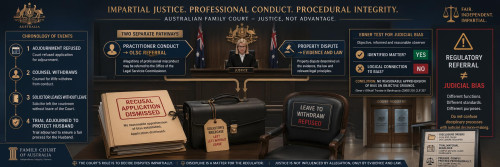
In Rahman & Rahman (No 2) [2026] FedCFamC2F 998, Judge Murdoch dismissed the husband’s application for the trial judge to recuse herself from property proceedings. The husband argued apprehended bias based on two matters: first, the refusal of his adjournment application and the possibility the trial might proceed in his absence; second, the judge’s treatment of his solicitor, including referral of that solicitor to the Office of the Legal Services Commissioner. The judgment refers to the OLSC, not the Legal Services Board. The recusal application failed because the referral concerned the solicitor’s courtroom conduct and did not decide, or logically affect, the parties’ substantive property dispute.
🧩 Facts and Issues
Facts:
The husband commenced property proceedings seeking 55% of the parties’ net property, including superannuation. The wife sought dismissal of his application. The husband was represented throughout by D Law Firm, and the wife by Dina Lawyers.
The litigation history was poor from the husband’s side. Earlier orders required full and frank disclosure and an Undertaking as to Disclosure. The wife complied, but the husband did not. His time for disclosure was extended, but he again failed to comply. There was then no appearance by or for the husband at a later court date, and directions were made for his legal representative to explain why a personal costs order should not be made, although no personal costs order was ultimately made at that stage.
The matter was listed for final hearing. The husband filed adjournment applications, but the matter remained listed. On 5 March 2026, there was no appearance by or for the husband, and the final hearing dates were confirmed. The wife was granted leave to proceed undefended if the husband did not appear at trial.
On 12 March 2026, the matter came before Judge Murdoch for final hearing. Counsel appeared for the husband, instructed by Mr E, but the husband himself was not present and had filed no trial material. The husband’s adjournment application was refused. Counsel for the husband then obtained leave to withdraw. The solicitor, Mr E, also sought leave to withdraw, but that application was refused. Mr E then absented himself from the courtroom without leave, and the Associate’s attempts to have him return were futile. Judge Murdoch then declined the wife’s application to proceed undefended, adjourned the final hearing, and referred the solicitor to the OLSC.
The husband later filed a recusal application, arguing that the judge’s refusal of the adjournment, the treatment of Mr E, and the referral to the regulator created apprehended bias. That application was not filed until 17 June 2026, about three months after the impugned conduct.
Issues:
- Did the refusal of the adjournment application create apprehended bias?
- Did the judge’s treatment of the husband’s solicitor create apprehended bias?
- Did referring the solicitor to the OLSC mean the judge had descended into the arena or become a “co-prosecutor”?
- Was there any logical connection between the solicitor referral and the judge’s ability to determine the property dispute impartially?
- Had the husband waived any recusal complaint by waiting three months before filing the application?
- Why was the solicitor’s conduct serious enough to justify referral to the regulator?
⚖️ Applicable Law – Legislation, Regulations, Rules
Family Law Act 1975 (Cth)
- Part VIII — property proceedings.
Federal Circuit and Family Court of Australia Act 2021 (Cth)
- s 28(1)(c) — relevant to leave to appeal from a decision refusing recusal.
- s 36(5) — relevant to appeal limitations referred to by the Court.
Federal Circuit and Family Court of Australia (Family Law) Rules 2021 (Cth)
- r 2.23(4)(b) — relevant to the filing of written submissions.
The key legal test was apprehended bias: whether a fair-minded lay observer might reasonably apprehend that the judge might not bring an impartial and unprejudiced mind to the determination of the dispute. The Court applied the Ebner “double might” test: identify the matter said to give rise to possible bias, then explain the logical connection between that matter and the feared departure from impartiality.
📌 Precedents Relied On
- Ebner v Official Trustee in Bankruptcy — the “double might” test for apprehended bias.
- Johnson v Johnson — fair-minded lay observer test.
- Charisteas v Charisteas — apprehended bias principles.
- Vakauta v Kelly, Shipton & Garwood, Cassegrain, and Michael Wilson & Partners v Nicholls — delay in bringing a recusal application may amount to waiver.
- Newett & Newett (No 2) — dissatisfaction with judicial decisions is not bias.
- Meyrick & Meyrick — cumulative assessment of alleged bias matters.
- Re JRL; Ex parte CJL, Livesey, and British American Tobacco v Laurie — broader apprehended bias principles.
🧠 Analysis
Issue
Did the judge’s referral of the husband’s solicitor to the OLSC create apprehended bias requiring recusal, and what did the solicitor do that caused the referral?
Rule
A judge is not disqualified merely because they make robust case-management decisions, refuse an adjournment, criticise a practitioner, or refer a practitioner’s conduct to a regulator.
The question is not whether the party dislikes the ruling. The question is whether a fair-minded lay observer, properly informed, might reasonably apprehend that the judge might not decide the substantive dispute on its legal and factual merits. It is not enough to identify something uncomfortable or adverse. There must be a logical connection between the impugned conduct and the feared departure from impartiality.
Application
1. The solicitor’s conduct occurred against a history of non-compliance
The solicitor issue did not arise in a vacuum. The husband had failed to comply with disclosure obligations, failed to file an Undertaking as to Disclosure, failed to comply with extended directions, failed to appear on an earlier listing, filed adjournment applications, and still had not filed trial material by the final hearing date.
That history mattered because the Court was managing a final hearing in circumstances where the husband’s side had repeatedly failed to put the case in proper order.
The solicitor’s later conduct therefore occurred in the context of a proceeding already affected by delay, non-compliance, non-appearance and adjournment attempts.
2. The triggering conduct was the solicitor leaving court without permission
The critical event was on 12 March 2026. After the husband’s adjournment application was refused, counsel for the husband successfully sought leave to withdraw. The husband’s solicitor also applied for leave to withdraw, but the judge refused that application.
At that point, the solicitor absented himself from the courtroom without leave. The judge’s Associate tried to have him return, but those attempts were futile.
That is the conduct that appears to have triggered the referral. The judgment does not reproduce the referral letter or make disciplinary findings. But the chronology makes clear that the referral followed the solicitor leaving the courtroom without leave after the Court refused his application to withdraw.
For a legal practitioner, that is serious. A solicitor on the record is not free to simply walk out because leave to withdraw has been refused. The Court had refused withdrawal, meaning the solicitor remained professionally involved in the conduct of the matter unless and until properly released.
3. The judge protected the husband despite the solicitor’s conduct
Importantly, Judge Murdoch did not punish the husband by immediately letting the wife run the trial undefended.
After the solicitor left and could not be brought back, the wife applied to proceed with the substantive hearing on an undefended basis. The judge declined that application. Her Honour considered that the husband was likely unaware of what was happening in Court and that it would be unjust to proceed in his absence. The final hearing was adjourned and marked “with priority”.
This point was fatal to the husband’s bias argument. The judge’s actual conduct protected the husband’s procedural position. Rather than proceeding against him in his absence, the Court stopped the trial and gave him another opportunity.
That is difficult to reconcile with an allegation that the judge had lost impartiality against him.
4. The husband tried to convert a practitioner referral into a judicial bias argument
The husband argued that the treatment of Mr E and the referral to the OLSC were aggravating factors creating apprehended bias. He submitted that Mr E had not been afforded procedural fairness, that his evidence had been discarded, and that the judge had allegedly described it as “fantastical”.
The Court rejected that foundation. The husband had not obtained the transcript when making the allegation about the word “fantastical”. The reasons, transcript and audio record did not reveal use of that word. The argument built around that alleged descriptor was therefore misconceived.
The husband also argued that Mr E was deprived of cross-examination. The Court found that no party had asked for Mr E to give oral evidence, and no proper particularisation was provided for the claim that his evidence had been summarily discarded without cross-examination.
5. The referral satisfied the first Ebner step but failed the second
Judge Murdoch accepted that the referral of the solicitor to the OLSC satisfied the first step of Ebner. In other words, it was an identifiable matter that could be considered in the apprehended bias analysis.
But the application failed at the second step. There was no logical connection between the referral and the feared departure from impartiality.
The Court held that a referral of practitioner conduct to a regulator does not determine any issue between the parties and does not adjudicate their substantive rights. No adverse finding was made about either party, their credit, the reliability of their evidence, or the merits of their competing property claims.
That is the key legal distinction:
the solicitor’s conduct may raise professional-regulatory concerns, but that does not mean the judge is biased against the client’s property case.
6. The Court rejected the “co-prosecutor” argument
The husband argued that by referring Mr E to the OLSC, the judge had metaphorically descended from the bench into the advocate’s arena and assumed a “co-prosecutorial” role.
Judge Murdoch rejected that submission. The Court said there was no identified conduct showing advocacy or partiality, and no reasoning explaining how the referral would influence fact-finding. The suggestion that the solicitor’s ongoing involvement might affect the judge’s assessment of the evidence was no more than subjective speculation.
The fair-minded lay observer would understand that judges can distinguish between two separate functions:
- referring possible practitioner misconduct to a regulator; and
- deciding the parties’ property dispute according to evidence and law.
The first does not automatically contaminate the second.
7. The referral was about professional conduct, not the merits of the husband’s claim
This is the practical heart of the decision. The Court did not refer the husband. It referred the solicitor.
Nor did the Court find that the husband’s property claim was false, dishonest or hopeless because of the solicitor’s conduct. The referral did not resolve valuation, contributions, financial disclosure, superannuation, property pool issues, or any other substantive issue under Part VIII.
The solicitor’s conduct was collateral to the property dispute. It concerned the proper administration of the proceeding and the professional obligations of a practitioner who remained on the record after leave to withdraw was refused.
8. The adjournment refusal was also not bias
The husband also complained that the judge had contemplated the trial proceeding in his absence after refusing the adjournment application.
Judge Murdoch rejected that too. Refusing an adjournment is an ordinary procedural decision involving delay, prejudice and efficient administration of justice. It does not, without more, determine substantive rights or show prejudgment.
Further, the factual premise failed because the trial did not proceed in the husband’s absence. Once the solicitor left and the husband had no representative protecting his interests, the judge declined to proceed undefended.
Again, the judge’s actual conduct was protective, not prejudicial.
9. The cumulative bias argument failed
The husband tried to rely on the combined effect of the adjournment refusal, the treatment of the solicitor and the referral to the OLSC.
The Court rejected the cumulative argument. Viewed together, the matters concerned case management and practitioner conduct, not the merits of the property dispute. None showed prejudgment of the substantive issues or adverse findings about either party’s credibility.
The asserted apprehension depended on speculation, not reasoned analysis.
10. The recusal application was also waived by delay
Even if the husband had otherwise established a basis for apprehended bias, the application failed because of waiver.
The impugned conduct occurred on 12 March 2026. The recusal application was not filed until 17 June 2026, about three months later and immediately before the substantive hearing was to recommence. The husband remained legally represented throughout. Written submissions supporting the recusal application had been prepared by experienced counsel as early as 7 April 2026, yet no application was filed and no complaint was raised until just before the adjourned trial.
Judge Murdoch held that a party aware of facts said to justify recusal must act promptly. A litigant cannot generally wait, watch how the forensic landscape develops, file trial material, and then seek disqualification shortly before hearing.
Conclusion
The husband’s recusal application was dismissed.
The solicitor’s conduct was serious because, after the Court refused his application for leave to withdraw, he left the courtroom without leave and could not be brought back despite the Associate’s attempts. That conduct prompted referral to the Office of the Legal Services Commissioner.
However, the referral did not create apprehended bias. It did not determine the parties’ substantive property rights, did not involve findings about either party’s credit or the merits of their property claims, and did not logically suggest that the judge would decide the property case otherwise than according to law and evidence.
In any event, the husband had waived the complaint by waiting about three months before filing the recusal application, despite remaining legally represented and having recusal submissions prepared more than two months earlier.
🧠 Take-Home Lesson
This case is a warning on two fronts.
First, for lawyers: you do not simply walk out of Court when leave to withdraw has been refused. If the Court refuses withdrawal, the practitioner remains before the Court and must deal with that position professionally. Leaving without leave can raise serious regulatory concerns because it may abandon the client, disrupt the hearing, and interfere with the orderly administration of justice.
Second, for litigants: a complaint about your lawyer being referred to a regulator is not automatically a recusal point. The appeal or recusal question is not whether the judge was unhappy with the lawyer. The question is whether that event would cause a fair-minded observer to reasonably apprehend that the judge might not decide the actual dispute impartially.
Here, the judge’s conduct actually protected the husband. Rather than proceed undefended after the solicitor left, the Court adjourned the trial and marked it with priority. That was inconsistent with the suggestion that the Court was biased against him.
The sharp practical lesson is this: professional misconduct concerns and substantive party rights are different things. A judge may refer a lawyer to a regulator while still remaining impartial in the case between the parties.

In Gaddy & Gaddy (No 3) [2026] FedCFamC2F 1245, Judge Suthers dismissed the mother’s application to reconsider final parenting orders. The Court found there had been no significant change in circumstances since the final parenting orders were made. Instead, the later events showed a continuation of the same concerns that had justified the original protective orders: serious mental health issues, lack of insight, ongoing persecutory beliefs, repeated ADVO breaches, bail breaches, police intervention, and litigation conduct that exposed the father to psychological harm and oppression. The Court also made a harmful proceedings order restraining the mother from instituting further proceedings against the father without leave, restricted her ability to file documents and email the Court, and directed targeted information-sharing with police and mental health services for welfare and safety purposes.
🧩 Facts and Issues
Facts:
The parties were the parents of three children, X, Y and Z. Final parenting orders had already been made in December 2022 after defended trial. Those orders placed the children with the father and gave him sole discretion about the children spending time with the mother, because the Court had found that although the children had meaningful relationships with both parents, the need to protect them from harm outweighed the benefit of time with the mother.
The mother later sought to reopen or reconsider the final parenting orders. By closing submissions, she sought fresh parenting orders for the children to live with her and spend supervised time with the father. The father opposed the application, arguing it was vexatious or failed the statutory threshold under s 65DAAA, and he sought a harmful proceedings order.
The original parenting decision had been based on findings that the mother had a long history of serious mental health difficulties, including psychotic episodes, hospital admissions, poor insight and non-compliance with treatment. The original findings also included that the mother had perpetrated family violence against the father, including physical assault and repeated breaches of an ADVO, and that her lack of insight created a material possibility of continuing family violence and emotional risk to the children.
The mother argued that circumstances had changed. The Court rejected that. Judge Suthers found her presentation remained substantially consistent with the concerns identified at trial. She continued to show dysregulation, persecutory beliefs about the father and his partner, denial of mental health difficulties, minimisation of family violence, and repeated ADVO/bail-related conduct.
Issues:
- Had there been a significant change in circumstances since the final parenting orders?
- If so, was reconsideration of the final parenting orders in the children’s best interests?
- Did the mother’s later mental health admissions, ADVO breaches, bail breaches and police involvement support reopening the matter, or confirm the original risk findings?
- Had the mother’s procedural conduct caused harm to the father?
- Should a harmful proceedings order be made restraining the mother from commencing further proceedings without leave?
- Should the Court restrict the mother’s communications with the Registry to protect the administration of justice?
- Was information-sharing with police and mental health services necessary for welfare and safety purposes?
⚖️ Applicable Law – Legislation, Regulations, Rules
Family Law Act 1975 (Cth)
- s 65DAAA — threshold for reconsideration of final parenting orders; the Court must consider whether there has been a significant change in circumstances since the orders were made.
- s 102QAC — harmful proceedings orders.
- s 102QAG — leave process where a harmful proceedings order restrains further proceedings.
- s 114S — permission for the mother to provide the judgment to treating medical or allied health professionals.
Federal Circuit and Family Court of Australia Act 2021 (Cth)
- s 95 — overarching purpose, including safety and efficient use of judicial and administrative resources.
- s 140 — power to make orders appropriate to the proceeding.
- s 192 — power to give directions about practice and procedure.
Federal Circuit and Family Court of Australia (Family Law) Rules 2021 (Cth)
- r 1.31 — power to make orders in the interests of justice.
- rr 2.24 and 8.18 — relevant to managing prolix, scandalous, abusive, irrelevant or inappropriate material.
Mental Health and Cognitive Impairment Forensic Provisions Act 2020 (NSW)
- Relevant because some criminal charges involving the mother were dealt with under mental health/cognitive impairment processes rather than ordinary sentencing.
📌 Precedents Relied On
- Radecki & Radecki — binding authority on s 65DAAA; the Court must make findings about whether there has been a significant change of circumstances since the earlier parenting orders. If there is no positive finding of changed circumstances, that is the end of the matter.
- Ferreday & Layh — harmful proceedings provisions can spare children and carers from unnecessary litigation by requiring leave before further proceedings are instituted.
- Hays & Hays (No 4) — for harmful proceedings orders, proof of harm is not required; reasonable grounds to believe harm would be suffered may be enough, and expert evidence is not always necessary.
- Vasquez & Vasquez — relevant to the statutory framework for harmful proceedings orders and the meaning of harm, including mental or emotional detriment and oppression.
- Reeve v Fair Work Commission — cited by analogy regarding finite court resources and the need to protect court processes from being consumed by inappropriate or repetitive conduct.
🧠 Analysis
Issue
Should the mother be permitted to reopen final parenting orders where she claimed changed circumstances, but the evidence showed continuing mental health instability, ongoing family violence-related conduct, repeated ADVO breaches and harmful litigation behaviour?
Rule
Under s 65DAAA, the Court cannot reconsider final parenting orders unless it first considers whether there has been a significant change of circumstances since the making of those orders. The Court must make findings about what, if anything, has changed. If no significant change is found, the application must be dismissed.
A later event is not automatically a “change” just because it occurred after the final orders. If the later event is merely a continuation or manifestation of the same risks that underpinned the final parenting orders, it may confirm the original order rather than justify reopening it.
For a harmful proceedings order, the Court does not need to be satisfied that harm has already been proven to the civil standard. It is enough to identify reasonable grounds to believe that further proceedings would cause the protected person harm, including psychological harm or oppression.
Application
1. The mother’s case failed at the s 65DAAA threshold
The mother needed to show a significant change of circumstances since the 2022 final parenting orders. She relied on claims including risk allegedly posed by the father or his household, harm caused by her exclusion from activities and places, emotional harm to the children caused by her absence, and her asserted employment, daily functioning and engagement with treaters.
Judge Suthers rejected that case. The mother’s claims about the father were largely found unreliable or implausible, and unsupported by independent business records. Her assertions about effective treatment engagement were inconsistent with the ongoing evidence of mental health instability, limited insight, and recent difficulties engaging even with her own doctor.
The Court accepted that, if the application was dismissed, the children were unlikely to spend time or communicate with the mother in the foreseeable future. But that outcome did not displace the risk analysis. The Court held that the final parenting orders continued to appropriately balance the family’s competing interests in the children’s best interests.
2. The later events confirmed the original risk findings
This is the central point of the case. The mother did not show that the risk landscape had improved. Instead, the Court found that the later events were continuations of the same problems that justified the final orders.
The mother’s presentation remained substantially unchanged from the earlier findings. She continued to demonstrate persecutory beliefs, dysregulated behaviour and lack of insight. She had been found in breach of bail conditions and in contravention of ADVOs, had been incarcerated for a fortnight, and had been diagnosed with delusional disorder.
Judge Suthers made the point expressly: although the frequency and seriousness of manifestations had fluctuated, the relevant circumstances had not materially changed. The later events were continuations of the same untreated illness, lack of insight, family violence and dysregulated conduct on which the final parenting orders were based.
That is why the mother’s application failed. It was not enough to point to new incidents. The incidents had to show a material change in the risk picture. They did the opposite.
3. Mental health remained unresolved and connected to risk
The Court reviewed the mother’s mental health history, including prior psychotic episodes, hospital admissions, bipolar affective disorder with psychotic features, delusional disorder and difficulties with treatment compliance and insight.
Since the final orders, there was no evidence of improvement in the mother’s management of her mental health or insight. She had two further mental health admissions, including a mid-2026 episode on a day connected with Local Court proceedings involving ADVO and bail charges. She sent multiple messages to police, including a belief that police wanted her dead, was scheduled under the Mental Health Act, transported by ambulance and discharged with diagnoses including acute stress reaction, grief and delusional disorder.
The Court was also concerned that the discharge summary recorded no past medical history despite the mother’s long public mental health history, and that her psychologist’s letter appeared to amplify the mother’s narrative of being a victim of the father and “systems abuse” without recording past or current diagnoses.
This was important because the Court saw a risk gap: the mother appeared not to be receiving proper therapeutic and medical support, which placed herself, the father and the children at risk because of spontaneous and harmful behaviours that caused fear for the father and trauma for the mother.
4. The Court treated the mother’s family violence and police history as continuing, not historic
The mother’s post-order conduct included substantial police involvement. NSW Police material showed that within a 12-day period in early 2023 she sent over 100 text messages to the father and made 35 FaceTime calls. Other material showed ADVO contraventions, use of a carriage service to menace/harass/offend, stalking/intimidation allegations, bail breaches, and a s 14 mental health/cognitive impairment order affecting multiple charges.
The Court also referred to a police bail decision describing the mother as a recidivist regarding breaches of protection orders and bail conditions, with repeated ADVO and bail breaches.
Her attempt to vary or revoke an ADVO was described as inconsistent and rambling, reflecting delusional disorder and an inability to consider her behaviours as causing fear to others or as acts of coercive control.
This was fatal to the reconsideration application. The evidence showed persistence of the same family violence and risk concerns, not rehabilitation or protective change.
5. The father remained the protective parent
The Court found no persuasive evidence that the father had endangered the children. Contact services and informal family supervisors had withdrawn from implementing the final parenting orders because of the mother’s behaviour, not the father’s. The final orders had anticipated these difficulties by giving the father sole discretion to arrange time safely.
Judge Suthers found that the father had continued to act protectively through the ADVO framework and that there was no persuasive evidence, other than the mother’s implausible accusations, that he posed any risk to the children’s emotional, psychological or physical safety.
That finding directly answered the mother’s attempt to reverse the parenting position. The protective premise of the 2022 orders remained intact.
6. The Court dismissed the reconsideration application
Because there was no positive finding of significant changed circumstances, the Court held that the threshold inquiry ended there. The mother’s initiating application was dismissed.
The Court also recognised immediate safety and welfare concerns flowing from the judgment itself, because the mother would need to process a decision that did not align with her narrative. Directions for information-sharing were therefore made for welfare, safety, first-responder awareness, continuity of care and management of acute post-judgment escalation.
This is a striking feature of the case: the judgment was not only deciding the legal application; it was managing the risk environment created by the likely impact of the judgment on the mother.
7. Harmful proceedings order was justified
The father sought a harmful proceedings order. The Court accepted there were reasonable grounds to believe the father would suffer harm if the mother instituted further proceedings against him.
The father’s evidence of fear was accepted as plausible and frank. He had not responded by bringing contravention proceedings in the Family Court, instead trying to protect himself and the children through the ADVO framework. The Court found that he had continued to be a victim of the mother’s conduct, including recent ADVO breach convictions.
Judge Suthers found the mother’s persistent, fixated and dysregulated litigation conduct had produced voluminous documents advancing a spurious and unreliable narrative that she was the victim and the father was the villain. This exposed the father to more voluminous documents and caused him to feel oppressed.
The resulting order restrained the mother from instituting further proceedings against the father without leave, and the Court was not required to notify the father of any leave application or any dismissal of such an application.
8. The Court also protected its own administrative processes
The mother had sent persistent, repetitive and voluminous emails to Registry and Chambers. Judge Suthers discussed the issue with her, noted that she apologised but showed little insight into the effect of her conduct on the administration of justice, and then made directions preventing email addresses controlled or used by her from delivering electronic communications to Court email addresses.
The purpose was not to prevent genuine safety concerns from being escalated. The orders expressly preserved the ability for Registry staff to escalate communications disclosing apparent risk of harm to the mother, father, children, Court staff or any other person through security, welfare or emergency pathways.
The Court relied on its powers under s 140, r 1.31, implied power to protect its processes, the overarching purpose in s 95, and s 192 of the Court Act.
Conclusion
The mother’s application to reconsider the final parenting orders was dismissed. The Court found no significant change in circumstances. The father remained the protective parent, and the mother’s later conduct confirmed rather than undermined the original risk findings.
The Court also made a harmful proceedings order restraining the mother from instituting further proceedings against the father without leave, restricted further filings without leave, permitted the mother to provide the judgment to her treating professionals, directed information-sharing with police and mental health services, and restricted the mother’s electronic communications with the Court.
The matter remained listed for a costs hearing on 13 November 2026.
🧠 Take-Home Lesson
This case is a powerful example of the difference between new events and a significant change in circumstances.
The mother had many later events to point to: mental health admissions, police contact, ADVO issues, bail issues, fresh allegations, treatment material and lengthy submissions. But those events did not show that the risk had reduced or that the 2022 parenting orders were now unsafe or inappropriate. They showed the opposite: continuing untreated illness, lack of insight, family violence, dysregulation and inability to respect protective boundaries.
The case also shows how the Court can move from parenting risk management into litigation risk management. Where a parent’s continued proceedings and communications become oppressive, repetitive and harmful, the Court may use harmful proceedings orders, filing restraints, email restrictions and information-sharing directions to protect the other parent, the children, court staff and public resources.
The hard practical lesson is this: a parent seeking to reopen final parenting orders must show real, material change — not simply repeat the same narrative in larger volume. Treatment, insight, compliance with ADVOs, compliance with bail, stable behaviour, child-focused communication and credible independent evidence matter far more than long submissions accusing the other parent of being the problem.

In Cadel & Galea [2026] FedCFamC1A 142, the mother appealed final parenting orders limiting her time with two very young children. Her central argument was that the primary judge wrongly characterised conduct arising from her mental health crisis — including self-harm, overdosing and suicidal ideation — as family violence. Schonell J rejected that argument. The appeal was dismissed, subject only to a slip-rule correction changing one word in the parenting orders. The case is important because it draws a hard line: a parent’s mental illness may explain context, but it does not automatically prevent self-harm-related conduct from being family violence if it causes another family member to be fearful and exposes children to emotional or psychological risk.
🧩 Facts and Issues
Facts:
The mother and father had two children, X, aged five, and Y, aged three. The parties separated in mid-2023, and the mother commenced parenting proceedings in November 2023. At the final hearing, it was common ground that the children should live with the father and that he should have sole long-term decision-making responsibility. The main dispute was the time the children should spend with the mother.
The primary judge accepted that the children enjoyed close and nurturing relationships with both parents and needed consistency, stability and an ongoing relationship with each parent if safe to do so. The mother’s treating psychiatrist gave evidence, and the primary judge found that the mother’s diagnoses included ADHD, complex PTSD and bipolar affective disorder.
Both parents alleged family violence. The primary judge accepted that the father had perpetrated family violence against the mother during one incident in early 2023 but rejected the balance of the mother’s allegations. The primary judge also found that the mother had perpetrated family violence against the father, including overdosing on Valium on multiple occasions, pushing him, and causing self-harm by grabbing his arm and using it to strike her own head.
The primary judge found that the mother lacked insight, remained capable of minimising or masking her mental health symptoms, continued to experience intrusive thoughts including self-harm and suicidality, and posed an unacceptable risk to the children through family violence and psychological or emotional harm associated with dysregulated behaviour.
Issues:
- Could self-harm and suicide attempts arising from mental illness be characterised as family violence under s 4AB?
- Did the primary judge wrongly conflate the father’s distress or concern for the mother with fear caused by family violence?
- Were the findings about the mother masking or minimising her symptoms open on the evidence?
- Was the future risk finding properly grounded, or was it speculation based on past mental health crisis?
- Did the primary judge wrongly exclude parts of the treating psychiatrist’s evidence and video recordings relied on by the mother?
- Did any alleged error justify appellate intervention?
⚖️ Applicable Law – Legislation, Regulations, Rules
Family Law Act 1975 (Cth)
- Part VII — parenting orders.
- s 4AB — definition of family violence.
- s 114UB — costs.
Evidence Act 1995 (Cth)
- s 135 — discretion to exclude evidence where probative value is substantially outweighed by risks such as undue waste of time.
Federal Circuit and Family Court of Australia (Family Law) Rules 2021 (Cth)
- r 7.01 — limits the expert evidence that can be given by a treating medical practitioner outside the single-expert framework.
- r 10.13 — slip-rule correction of accidental slips, omissions or clerical errors.
📌 Precedents Relied On
- House v The King — discretionary appellate error.
- Norbis v Norbis — broad discretionary ambit in family law decisions.
- Pickford & Pickford — the definition of family violence is broad and should not be read narrowly so as to create unnecessary hurdles to proving family violence.
- Edwards v Noble, Lee v Lee, and Aldi Foods v Moroccanoil — appellate restraint on factual findings where findings were reasonably open on the evidence.
- CDJ v VAJ, Bugmy v The Queen, and Gronow v Gronow — challenges to weight rarely justify appellate intervention unless the result is unreasonable or plainly unjust.
- Isles & Nelissen — distinction between proving past abuse and assessing future risk; risk is predictive and may be based on possibilities, not certainties.
- Metwally v University of Wollongong — a party is bound by the way the case was conducted at trial and cannot use appeal to fix forensic choices.
- DL v The Queen, Soulemezis v Dudley, and Sun Alliance v Massoud — adequacy of reasons.
- Noetel and Quealey, Pawley & Pawley (No 2), and DJL v The Central Authority — slip-rule correction.
🧠 Analysis
Issue
Was the mother right to say that her conduct should have been treated as mental health crisis behaviour rather than family violence, and that the parenting restrictions were therefore based on a flawed risk assessment?
Rule
Family violence under s 4AB is not limited to direct physical assaults or deliberate coercive conduct. The definition is broad. It focuses on whether behaviour causes a family member to be fearful, and that fear may include being fearful of the behaviour as it impacts them or fearful for another person, including the person engaging in self-harm.
Mental illness is relevant context. It may explain why behaviour occurred. But it does not automatically remove the behaviour from the family violence framework. If the conduct causes fear, affects safety, exposes children to distress, or creates psychological and emotional risk, the Court may still characterise it as family violence and consider it in parenting risk assessment.
Application
1. The mother’s position was emotionally understandable but legally unsuccessful
The mother’s appeal was built around a distinction between domestic violence and mental health crisis. She argued that her overdosing, self-harm and suicidality were symptoms of genuine mental illness, not family violence. She said the primary judge wrongly treated the father’s distress, concern or anguish about her welfare as fear of her as a perpetrator.
That was the mother’s strongest human point. A person in crisis may not be trying to control, threaten or intimidate anyone. The conduct may be inwardly directed. It may arise from illness, trauma, desperation or dysregulation.
But the appeal failed because the legal question was not confined to the mother’s subjective intention. Schonell J held that s 4AB focuses on the affected family member’s state of mind, not only the intention of the person engaging in the conduct.
2. Self-harm can be family violence if it causes fear
Schonell J expressly held that the definition of family violence is wide enough to encompass acts of self-harm. The Court rejected a narrow interpretation that would exclude self-harm because it is directed at the person themselves.
That is the key legal point. The Court did not say every act of self-harm is family violence. It said self-harm can be family violence where the statutory elements are satisfied.
The relevant fear may be:
- fear of what the behaviour is doing to the affected family member;
- fear for the safety of the person self-harming;
- fear of the escalation or unpredictability of the conduct; or
- fear arising from being drawn into, exposed to, or impacted by the crisis behaviour.
Here, the father’s evidence was that he was afraid for the mother’s safety and risk of self-harm, scared when she took prescribed medication with alcohol, and did not feel safe because of her behaviour. That was enough to support a finding that he was fearful.
3. The mother’s conduct was not treated only as private suffering
The appeal tried to frame the mother’s conduct as internal mental suffering rather than conduct directed toward the father. But the evidence went further.
The mother admitted using the father’s arm to strike her own head and pushing him. Schonell J held that those admissions clearly constituted family violence and were capable of supporting the primary judge’s findings.
That made the appeal harder. This was not only about suicide attempts or private distress. The findings included physical conduct involving the father and conduct that caused him fear.
4. The Court did not ignore the mother’s mental illness
The Court did not deny that the mother had serious mental health conditions. Her diagnoses were recorded: ADHD, complex PTSD and bipolar affective disorder. The mother argued that her conduct arose from mental illness and treatment history.
But Schonell J held that context does not preclude characterisation as family violence. The fact that acts of self-harm occurred during a mental health crisis and were symptomatic of broader mental health conditions did not stop the behaviour from meeting the definition if it caused a family member to be fearful.
This is the central “DV vs mental health” lesson:
mental health may explain the behaviour, but it does not necessarily neutralise the risk impact on the other parent or the children.
5. The masking/minimising finding was open
The mother argued that the primary judge’s finding that she could minimise or mask her symptoms was wrong because she had been candid with treating professionals and the Court about very personal mental health matters.
Schonell J rejected that. Evidence that the mother had been frank on some occasions did not prevent the judge from finding that she had minimised or masked symptoms on others. The appeal court emphasised that pointing to an alternative available finding is not enough. The question is whether the finding made was reasonably open.
There was evidence that the mother had said she manipulated the medical system and knew how to answer questions; that her psychiatrist had recorded she could put on a “good face”; that she accepted in cross-examination that she had masked aspects of her mental health difficulties; and that she had not disclosed an intentional overdose during pregnancy to her psychiatrist. That evidence supported the primary judge’s finding.
6. The future-risk finding was predictive, not a new finding that future violence was probable
The mother argued that even if there had been historical conduct, it did not justify a more serious predictive finding that she might perpetrate family violence in the future. She said the interpersonal relationship had ended and there had been no sufficient basis to predict future family violence.
Schonell J rejected that too. Risk assessment in parenting is not the same as proving a past event on the balance of probabilities. Risk is prospective. It deals with possibilities, not certainties. Historical family violence, lack of insight, limited acknowledgement to treating professionals, ongoing mental health risks, and unavoidable future contact at changeovers could cumulatively support a future-risk assessment.
This is important for the mother’s position. The Court was not saying she would definitely harm the children or definitely perpetrate future family violence. It was saying the evidence supported a possibility of future risk that had to be managed in the children’s best interests.
7. The children’s risk was emotional and psychological, not just physical
The primary judge’s risk analysis was not limited to physical danger. The concern was that the mother might become dysregulated, withdraw, act irregularly, or expose the children to emotionally unsafe situations. Given the children’s young ages and developmental needs, that was enough to justify caution.
The appeal court accepted that the primary judge’s reasons showed a pathway from the evidence to the conclusion that there was a meaningful possibility the mother would not be able to manage herself in front of the children so as to keep them emotionally and psychologically safe.
This is where the case moves beyond “DV label” into practical parenting risk. The Court’s concern was not punishment. It was whether the children’s time with the mother needed structure, limits and breaks to reduce the risk of psychological harm.
8. The parenting orders still preserved the mother-child relationship
The appeal failed, but the mother was not cut out of the children’s lives. The primary judge rejected both parents’ proposals and preferred the ICL’s proposal because it best balanced the children’s relationship with their mother against the identified risks.
The orders gave the mother structured time, including weekly overnight time and alternate Friday to Saturday time. The appeal court corrected a drafting error so that the ongoing arrangement would operate from the relevant point, not end “until” that point.
That matters. The Court did not accept the mother’s appeal, but the structure of the orders recognised that the children had a meaningful relationship with her and should continue to spend regular time with her in a way designed to manage risk.
9. The treating psychiatrist evidence did not rescue the appeal
The mother also challenged the exclusion of parts of her treating psychiatrist’s evidence. The appeal failed because the excluded answers went beyond the limited scope permitted for treating practitioner evidence under r 7.01. The questions invited opinions about the mother’s situation with the children and father, her openness and reliability, whether she had intentionally withheld information, and her parenting capacity. Those matters fell outside the treating exception and were properly matters for the trial judge or a single expert.
This is a practical warning. A treating psychiatrist can give evidence about treatment, observations, prognosis and treatment consequences. But they cannot simply become a partisan parenting-capacity expert through a solicitor’s letter.
10. The video recordings were also properly excluded
The mother argued that the excluded video recordings were relevant to the father’s credibility and the relationship dynamics. Schonell J held that the primary judge had undertaken the required s 135 balancing exercise and was entitled to exclude them because their probative value was substantially outweighed by the danger of undue waste of time. The father had still been cross-examined on the relevant events, so the mother was not denied the opportunity to test his credibility.
Again, the appeal failed because the mother could not show material error.
Conclusion
The appeal was dismissed. The mother failed to show that the primary judge erred by treating her self-harm-related conduct as capable of constituting family violence, failed to dislodge the findings about the father’s fear, failed to overturn the findings about masking/minimising symptoms and emotional dysregulation, and failed to prove error in the exclusion of the psychiatrist evidence or video recordings.
The only change was a slip-rule correction. Order 5 was amended by replacing the word “until” with “from”, because the reasons made clear that ongoing time with the mother was intended from the commencement of Term 3 of X’s first year of formal schooling. No order as to costs was made.
🧠 Take-Home Lesson
This case is a difficult but important warning for parenting matters involving mental health and family violence.
The mother’s position was not simply dismissed because she had diagnoses. The Court accepted that her mental health history was real. But the legal question was not whether the conduct arose from illness. The question was whether the conduct caused fear, created emotional or psychological risk, and affected the children’s safety.
The key lesson is: mental health crisis may explain behaviour, but it does not automatically prevent that behaviour from being family violence.
For mothers or fathers relying on mental health evidence, the strategic focus should be practical and forward-looking: insight, treatment compliance, safety planning, crisis planning, changeover safeguards, parenting supports, and evidence that the children can be kept emotionally safe. Simply saying “that was mental illness, not domestic violence” may not be enough if the other parent was fearful and the children were exposed to risk.
This case also shows the danger of treating professional evidence being stretched too far. A treating psychiatrist can support the Court’s understanding of diagnosis, treatment and prognosis, but parenting capacity and credibility opinions need to be carefully framed within the Rules.

In Massey & Carmichael [2026] FedCFamC1A 139, Campton J allowed the appellant’s property appeal because the primary judge’s reasons did not adequately explain the separate 75/25 contribution assessment applied to the respondent’s superannuation pool. The appellant failed on procedural fairness, failed to prove that a two-pool approach was legally unavailable, and failed on the valuation challenge to the respondent’s C Street property. But she succeeded because the reasoning pathway from the evidence to the superannuation percentage was missing. That defective reasoning affected the overall property division, so Orders 1 to 7 were set aside. On re-exercise, the Court adopted a single-pool approach, assessed contributions at 62% to the appellant and 38% to the respondent, made a 1% s 90SM(5) adjustment to the respondent, and ordered an overall division of 61% to the appellant and 39% to the respondent.
🧩 Facts and Issues
Facts:
The parties were in a long de facto relationship from about 1999 to early 2022. The appellant was aged 70 and the respondent aged 62 at the appeal. There were no children of the relationship.
At the start of the relationship, the appellant owned several real properties, including the J Street properties, which remained in specie at trial and had substantial value. She had been an educator but sustained a workplace injury in 1999 and thereafter received an invalidity superannuation pension of $778 per week, which could not be commuted to a lump sum and was treated as a financial resource, not property available for division.
The respondent worked throughout the relationship and accumulated superannuation. She also owned the C Street property, which she purchased in 1999. During the relationship, the parties acquired, renovated and sold multiple properties, including jointly owned property at Suburb H. The primary judge found that both parties contributed, but that the appellant made substantially greater renovation and project-work contributions.
At trial, both parties ran their cases on a global assessment basis, combining superannuation and non-superannuation property. The appellant sought an overall 90/10 division in her favour, including a $200,000 superannuation split from the respondent’s Super Fund 1 entitlement. The respondent sought equality and opposed any superannuation splitting order.
The primary judge instead adopted a two-pool approach:
- non-superannuation assets and liabilities; and
- the respondent’s superannuation entitlements.
The primary judge assessed contributions to the non-superannuation pool at 65/35 in favour of the appellant, but assessed contributions to the respondent’s superannuation pool at 75/25 in favour of the respondent. A superannuation splitting order of $101,939.50 was made in favour of the appellant.
Issues:
- Was the appellant denied procedural fairness because the primary judge adopted a two-pool approach without warning the parties?
- Was it legally or evidentially wrong to treat superannuation separately from non-superannuation property?
- Were the reasons inadequate because they failed to explain the 75/25 superannuation contribution assessment?
- Did that inadequate reasoning affect the overall property division?
- Did the primary judge err in valuing the respondent’s C Street property at $2 million instead of $2.4 million?
- Should the appeal court remit the matter or re-exercise discretion?
- How should the already-implemented superannuation split be treated on re-exercise?
⚖️ Applicable Law – Legislation, Regulations, Rules
Family Law Act 1975 (Cth)
- Pt VIIIAB — financial matters relating to de facto relationships.
- s 90SM — alteration of property interests between de facto parties.
- s 90SM(3) — identification of existing property and liabilities.
- s 90SM(5) — adjustment factors, including future financial circumstances.
- s 114UB — costs in family law proceedings.
Federal Circuit and Family Court of Australia Act 2021 (Cth)
- s 35 — appellate power to draw inferences and receive further evidence.
- s 36 — appellate power to affirm, reverse, vary, or make orders the Court thinks fit.
Federal Proceedings (Costs) Act 1981 (Cth)
- Costs certificates were granted to both parties because the appeal succeeded by reason of legal error.
📌 Precedents Relied On
- House v The King — discretionary appellate error.
- Warren v Coombes — appellate restraint unless error is shown.
- Allesch v Maunz, Kioa v West, SZBEL, Ex parte Lam, and Stead — procedural fairness principles.
- Calder & Calder — a judge is not necessarily required to warn parties before adopting a two-pool approach, unless the approach produces an outcome outside the parties’ competing claims or adopts an unargued approach to a pool.
- Norbis v Norbis and Coghlan & Coghlan — superannuation may be treated separately from other property in an appropriate case.
- Bennett and Bennett, Yarrow & Yarrow, and DL v The Queen — adequacy of reasons; reasons must reveal why critical findings were made.
- Steinbrenner & Steinbrenner — warns against an unexplained leap from words to percentage figures.
- Jabour & Jabour, Dickons & Dickons, and Horrigan & Horrigan — contributions are assessed holistically and should not be mechanically compartmentalised.
- Shinohara & Shinohara and Shehu & Vicario — relevant to identifying existing property and liabilities under the amended property framework.
- Trevi & Trevi (Re-Exercise) — appellate court may re-exercise discretion using the facts and law as they stand at the appeal.
🧠 Analysis
Issue
Why did the appeal succeed when the appellant failed on procedural fairness, failed to show that a two-pool approach was unavailable, and failed on the valuation challenge?
Rule
A property appeal does not succeed merely because another percentage could have been chosen. The appellant must establish legal, factual, discretionary or procedural error, or inadequate reasons.
A trial judge has discretion to treat superannuation separately from non-superannuation property. Superannuation can have a different character from other assets, particularly where one party is nearing retirement, one party has an accumulation interest, and the other has a different retirement structure such as an invalidity pension.
But if the judge adopts a separate superannuation pool and assigns a distinct contribution percentage to that pool, the judge must explain the reasoning pathway. The parties must be able to understand why the figure was chosen. A bare conclusion such as “75/25” is not enough where the evidence does not clearly disclose how that figure was reached.
Application
1. The procedural fairness ground failed
The appellant argued that the primary judge denied procedural fairness by adopting a two-pool approach when both parties had argued for a global approach.
That argument failed. Campton J held that the live issue at trial included whether there should be a superannuation split from the respondent’s accumulation interest, and if so, how much. The appellant herself sought a superannuation split of up to $200,000, while the respondent opposed any split.
The primary judge was not required to tell the parties in advance exactly how he intended to reason through the discretion. The outcome — a split of $101,939.50 — was within the range between nil and $200,000.
So the appellant did not win because the two-pool approach was sprung on her unfairly.
2. The two-pool approach was not legally wrong
The appellant also argued that there was no legal or evidentiary basis for treating the respondent’s superannuation separately.
That failed too. Campton J accepted that well-established authority permits a judge to treat superannuation separately from non-superannuation property. It is a discretionary methodology available in appropriate cases.
The relevant considerations included:
- the respondent had some superannuation at cohabitation, although its value was unknown;
- the respondent remained employed during and after the relationship;
- her employment generated further superannuation;
- the appellant’s support enabled the respondent to remain employed; and
- the appellant’s own invalidity pension was of a different character and not property available for division.
So the appellant did not win because superannuation can never be separated. Superannuation can be separated. The problem was the explanation.
3. The appeal succeeded because the reasons did not explain 75/25
The critical error was in the reasons for assessing the respondent’s superannuation pool 75% to the respondent and 25% to the appellant.
The primary judge said the respondent had superannuation at the start of the relationship, worked throughout the relationship, and that the appellant’s support enabled her to keep working and accumulating superannuation. But those observations did not explain why the correct division of the superannuation pool was 75/25.
There was also no evidence of the value of the respondent’s superannuation at cohabitation or separation. That made the segmented assessment difficult to justify. Without knowing how much superannuation existed at the start, how much accumulated during the relationship, and how much accumulated after separation, the reasons needed to be especially clear. They were not.
Campton J held that the broad observations in the reasons failed to reveal the pathway from the evidence to the intermediate conclusion. That was the winning appeal point.
4. The defect mattered because the super finding affected the whole result
This was not a harmless reasoning defect. The separate superannuation assessment was carried through into the final property division.
The primary judge’s non-superannuation contribution finding favoured the appellant 65/35, but the superannuation contribution finding favoured the respondent 75/25. That reduced the appellant’s overall position compared with a global application of the 65/35 assessment. The appellant estimated the difference at about $160,000, broadly equivalent to just over 2% of the total pool.
Because the unexplained 75/25 superannuation finding was a component of the final orders, the reasoning defect infected the overall result. That is why Orders 1 to 7 were set aside.
5. The C Street valuation challenge failed
The appellant argued that the respondent’s C Street property should have been valued at $2.4 million on a highest-and-best-use basis rather than $2 million on an “as is” basis.
That ground failed. The valuation evidence showed two possible approaches. The single expert valued the property as a whole at $2 million, but also gave a hypothetical separate-lot valuation of $2.4 million if the lots were sold separately. That separate-lot approach depended on assumptions and unknowns about development, separate sale, costs, risk and market demand.
Campton J held that the primary judge had considered the expert evidence, the survey and sewerage material, the development uncertainties and the likely market. The finding of $2 million was reasonably open.
So the appeal was not won on valuation. It was won on inadequate reasons concerning superannuation.
6. The superannuation split itself was not disturbed
This is an important practical point. The appellant limited the appeal to Orders 1 to 7. The superannuation splitting orders — Orders 8 to 12 — had already been implemented and were not disturbed.
On re-exercise, the Court therefore treated the implemented split as part of the existing property position. The balance sheet showed:
- respondent’s Super Fund 1: $258,646;
- respondent’s Super Fund 2: $47,172;
- appellant’s Super Fund 1: $101,940;
- total superannuation property: $407,758.
That is a critical superannuation consideration: once a super split has been implemented and is not challenged or disturbed on appeal, the re-exercise proceeds on the property position as it then exists.
7. The appellant’s invalidity pension was treated differently
The appellant received an invalidity superannuation pension of $778 per week. It was agreed that this pension could not be commuted to a lump sum and was not property amenable to adjustment. It was treated as a financial resource, not divisible property.
This mattered because the parties’ retirement resources were structurally different. The respondent had accumulation superannuation capable of being split. The appellant had an income stream that could not be converted into a lump sum.
The primary judge was entitled to consider those differences. But when those differences were used to support a separate superannuation contribution assessment, the reasons still had to explain the actual percentage chosen.
8. On re-exercise, the Court returned to a holistic single-pool approach
On re-exercise, both parties accepted that the Court should use a single pool of superannuation and non-superannuation property and liabilities. Campton J accepted that approach as just and equitable, while still having regard to the nature and character of each asset.
The net property pool was identified as $7,014,309. This included existing superannuation interests after implementation of the earlier super split.
Campton J assessed contributions at 62% to the appellant and 38% to the respondent. The appellant’s initial property contributions, the use of those properties to build wealth, and her greater renovation contributions carried significant weight. But the respondent’s employment, homemaker contributions, initial C Street property, and continued post-separation superannuation contributions also mattered.
9. The respondent received a 1% adjustment because of future financial circumstances
After contributions, the Court considered s 90SM(5) factors.
The appellant would hold superior property interests, including income-producing real estate, and would continue to receive her superannuation pension. The respondent was likely to retire in the foreseeable future and would need to support herself from her now-reduced superannuation entitlements. She would not have potential rental income from C Street if she lived there.
Campton J also compared benefits each party had already received from liquidated property and capital used for legal fees. The appellant had received or used about $224,488, while the respondent’s comparable benefit was $117,447.
Those factors justified a 1% adjustment to the respondent, producing a final division of 61% to the appellant and 39% to the respondent.
Conclusion
The appeal was allowed because the primary judge failed to give adequate reasons for the 75/25 superannuation contribution assessment.
The appellant failed to prove procedural unfairness, failed to show that the two-pool methodology was unavailable, and failed on the C Street valuation challenge. But Grounds 3 and 4 succeeded because the reasons did not reveal how the primary judge moved from the evidence to the separate superannuation percentage. That unexplained finding was carried into the overall property result, making the reasoning process defective.
On re-exercise, Campton J:
- set aside Orders 1 to 7;
- left the implemented superannuation split undisturbed;
- used a single pool including superannuation and non-superannuation property;
- assessed contributions 62/38 in favour of the appellant;
- made a 1% s 90SM(5) adjustment to the respondent;
- ordered an overall division of 61% to the appellant and 39% to the respondent; and
- ordered the appellant to pay the respondent $634,126 if she retained the Suburb H property.
Both parties received costs certificates. The appellant’s application for the respondent to pay her appeal costs of $21,080.83 was dismissed.
🧠 Take-Home Lesson
This case is not authority for the proposition that superannuation must always be treated globally with the rest of the pool. It confirms the opposite: a judge may treat superannuation separately where that is a proper way to achieve justice and equity.
But if the Court creates a separate superannuation pool, it must explain why the selected percentage is justified. That is especially important where:
- the value of superannuation at cohabitation is unknown;
- the value at separation is unknown;
- one party’s superannuation is an accumulation interest;
- the other party has a non-commutable pension treated as a financial resource; and
- the percentage applied to superannuation materially changes the final outcome.
The winning appeal point was the missing reasoning bridge. The primary judge could say superannuation should be looked at separately. What the primary judge could not do was leap from broad findings to 75/25 without explaining the evidentiary pathway.
For property appeals, the lesson is sharp: a superannuation split may be discretionary, but the reasons for it must still be intelligible.

In Tyrell & Tyrell [2026] FedCFamC1A 137, Schonell J dismissed the mother’s Application in an Appeal after her Notice of Appeal had been summarily dismissed. The central problem was that most of the parenting orders she sought to challenge were made by consent at trial, after she had been represented by both solicitor and counsel. She later argued that her consent was not truly voluntary, informed or procedurally fair, and that she had been pressured by the circumstances of trial, perceived prejudgment, possible costs consequences, and the risk that existing parenting arrangements would remain in place. The Court rejected that argument. The mother’s regret, even if genuine, was not enough. Parties are generally bound by the way they choose to run their case — including decisions to compromise at the courtroom door.
🧩 Facts and Issues
Facts:
The matter involved parenting proceedings under Part VII of the Family Law Act 1975 (Cth) concerning two children, aged 10 and 12 at the time of the final hearing. The hearing was listed for three days. On the first morning, both parents appeared represented by solicitor and counsel, and an Independent Children’s Lawyer also appeared for the children.
The mother later said that comments made by the primary judge at the beginning of the hearing gave her the impression that the judge had prejudged the matter. After that initial appearance, negotiations occurred across the first day and into the second day. By the afternoon of the second day, the parties told the Court they had reached agreement on many issues.
The Court was invited to make 40 orders by consent. Those orders included the children living with the father, spending time with each parent, school holiday arrangements, overseas travel, passports, communication, school and extracurricular issues, and restraints. The parties did not reach agreement on long-term decision-making and changeover location. They invited the judge to determine those remaining issues on brief submissions and affidavit material, without a full contested factual hearing.
The mother then sought to appeal all orders, including the consent orders. Her Notice of Appeal was summarily dismissed by an appeal judicial registrar. She sought review before Schonell J.
Issues:
- Could the mother appeal parenting orders she had agreed to?
- Was her consent vitiated by pressure, duress, procedural unfairness or lack of proper information?
- Did the primary judge’s early comments create procedural unfairness or apparent prejudgment?
- Could the mother later complain that disputed factual issues were not determined when the parties themselves invited the judge to decide the remaining issues on submissions?
- Did the appeal have reasonable prospects of success?
- What is the practical danger of consenting at trial under pressure from lawyers, costs risk or courtroom pressure?
⚖️ Applicable Law – Legislation, Regulations, Rules
Family Law Act 1975 (Cth)
- Part VII — parenting proceedings.
Federal Circuit and Family Court of Australia Act 2021 (Cth)
- s 32 — power of a single judge in appeal proceedings.
- s 46(2)–(3) — summary dismissal where an appeal has no reasonable prospect of success.
The Court emphasised that different principles apply to:
- orders made by consent; and
- orders determined by the judge after submissions.
For consent orders, an appeal based merely on the merits of the order will not succeed. The appellant must show something more serious, such as fraud, mistake, duress, procedural miscarriage, absence of jurisdiction, or some other vitiating factor affecting the agreement itself.
📌 Precedents Relied On
- Harris v Caladine — review of a registrar’s decision proceeds as a fresh hearing, not merely a review for registrar error.
- House v The King — discretionary appellate error.
- DS and DS — in parenting consent orders, the Court need not deeply investigate the integrity of the orders where both parties are apparently adequately represented and consent appears informed and freely given.
- Robinson and Willis — appeal from consent orders requires more than dissatisfaction with the result.
- Babington & Livesey (No 3) — consent orders require a vitiating factor such as fraud, mistake or jurisdictional error; regret is not enough.
- Tamas & Spanou (No 2) — parties often settle at the courtroom door because of legitimate pressures, including costs risk; that does not invalidate consent unless the procedure itself miscarried.
- Ebner v Official Trustee in Bankruptcy and Vakauta v Kelly — a party may waive a complaint about apparent bias or prejudgment by continuing without making a recusal application.
- Metwally v University of Wollongong — a party is bound by the way they conduct their case and cannot usually raise a new argument after losing.
- Suttor v Gundowda — appeal is not a mechanism to correct tactical mistakes or inadvertence at first instance.
- Whisprun v Dixon and Perdicari & Perdicari — ex tempore reasons are read in context; the judge is not required to address every fact or argument exhaustively.
- Bugmy v The Queen, Hamish & MacPherson, and Kellerman & Kellerman — complaints about weight in discretionary parenting decisions generally do not establish appealable error.
🧠 Analysis
Issue
Can a party undo parenting consent orders after trial by arguing that they were pressured into consent by lawyers, perceived judicial pressure, costs risks, and fear of a worse outcome?
Rule
A consent order is not easily appealed. A party cannot simply say, “I regret agreeing,” or “I felt pressured by the reality of litigation.”
The law recognises that parties often compromise at the courtroom door under intense pressure. That pressure may include:
- fear of costs consequences;
- concern about judicial comments;
- anxiety about how the evidence will be received;
- fear that the existing parenting arrangement will continue;
- advice from lawyers that the case is risky;
- pressure to avoid a contested hearing; and
- exhaustion after prolonged litigation.
Those pressures may be real. But they are not automatically unlawful duress. To overturn consent orders, the party must show a vitiating factor affecting the agreement itself — not merely later regret, disappointment, fear, or dissatisfaction with the advice received.
Application
1. The mother’s central problem was that she consented while legally represented
The mother was not unrepresented at the final hearing. She had both solicitor and counsel. That mattered heavily.
The Court applied the principle that where parties are apparently properly represented and their consent appears informed and freely given, the Court does not need to deeply investigate every parenting consent order as though the matter were fully contested.
This is the first danger: once lawyers announce consent orders in Court, the appeal court will usually treat that consent as real unless there is strong evidence that something legally vitiated it.
A party may later feel that they were “talked into it”, “scared into it”, “worn down”, or “told they would get costs against them.” But those feelings do not automatically prove duress.
2. Pressure from costs risk is usually legitimate litigation pressure
The mother argued, in substance, that her consent was not voluntary or informed because pressure was placed on her. The alleged pressure included the risk of adjournment, the risk of existing arrangements continuing, limited time to consider material, and the general courtroom dynamics.
Schonell J relied on Tamas & Spanou (No 2) for the blunt reality: people settle litigation at the courtroom door for many reasons, including fear of costs consequences and other legitimate pressures. That does not mean the procedure miscarried.
This is the second danger: a lawyer warning you about costs risk is not, by itself, duress. It may be forceful. It may be stressful. It may feel coercive. But unless the advice crosses into something that destroys free and informed consent, the Court is likely to treat it as part of ordinary litigation pressure.
That is why parties must be extremely careful before saying “yes” in Court. Once consent is announced, the law may treat the decision as a deliberate compromise, not as something lightly reversible.
3. Regret is not appealable error
The Court found that the mother’s real complaint was that she regretted entering the consent orders. That was not enough.
This is the harsh lesson of the case. A party may later believe:
- “I should have run the hearing”;
- “I should have tested the evidence”;
- “I should not have trusted the advice”;
- “I only agreed because I was scared of costs”; or
- “I felt trapped.”
But unless the legal threshold is met — fraud, mistake, duress, jurisdictional error, procedural miscarriage or another vitiating factor — the consent order stands.
The appeal court is not a second chance to undo a compromise because the emotional reality of the decision later feels unbearable.
4. The mother waived any prejudgment complaint by continuing
The mother complained that comments made by the primary judge at the start of the hearing suggested prejudgment. The Court rejected that ground.
The judge’s comments were treated, at their highest, as preliminary views before evidence and cross-examination. More importantly, the mother formed her concern at or shortly after the comments were made, yet she continued with the hearing, negotiated consent orders, and did not apply for the judge to recuse herself.
That conduct waived the complaint.
This is the third danger: if a party believes the judge has prejudged the case, they cannot usually stay silent, negotiate consent orders, and then raise the complaint only after the outcome becomes unsatisfactory.
The issue must be raised at the time, usually through a recusal application. That is a serious step, but failing to take it can close the appeal door later.
5. The parties chose not to have disputed facts determined
A major appeal complaint was that the primary judge relied on the existing parenting arrangements without investigating how they came about, including allegations of withholding, coercive control, systems abuse, ADVO reliance, untested allegations and interim processes.
The Court rejected that argument because the parties had not asked the primary judge to conduct that factual inquiry. They agreed to substantial consent orders and asked the judge to determine only the remaining issues on submissions.
This is the fourth danger: once parties choose a paper/submissions pathway, they may lose the ability to complain that the judge did not make findings that would have required a contested evidentiary hearing.
A party cannot usually say on appeal: “The judge should have determined disputed facts,” when the party’s own trial conduct invited the judge not to do that.
6. Consent orders can freeze a harmful status quo
The mother argued that the primary judge treated the children’s residence with the father as a determinative status quo without deciding whether that status quo had been created by improper conduct.
That argument failed procedurally because the residence/time orders were largely made by consent. But strategically, it highlights a very real danger.
When a party consents at trial, the consent order may lock in an existing arrangement even if that party believes the arrangement came about unfairly. The appeal court may not later investigate the history unless the issue was preserved and properly litigated below.
This is especially dangerous in parenting matters involving allegations of coercive control, withholding, systems abuse or litigation pressure. If those allegations are not tested before consent is given, they may never be tested.
7. Lawyers’ pressure can create practical danger even if it is not legal duress
This case does not say lawyers may improperly pressure clients. Nor does it say that every consent given under lawyer pressure is valid.
But it does show the difference between practical pressure and legal duress.
A lawyer may say:
- “You are at risk on costs”;
- “The judge may make a worse order”;
- “You may lose more if you run the hearing”;
- “The ICL is against you”;
- “The family report is damaging”;
- “The Court may not accept your allegations”; or
- “You should settle now.”
Those statements may be confronting, but they may also be legitimate advice. The appeal court will not automatically treat that kind of pressure as invalidating consent.
The protective lesson is this: before consenting, a party should insist that their lawyer clearly explains:
- what orders they are consenting to;
- what rights or arguments they are giving up;
- what factual issues will never be tested;
- what the costs risk actually is;
- whether the advice is recommendation or instruction;
- whether there is any alternative order or fallback proposal; and
- whether the party needs time to consider the proposed compromise.
8. The appeal court treated the remaining contested orders as discretionary and properly made
The only issues not resolved by consent were long-term decision-making and changeover. The parties invited the primary judge to decide those issues on submissions.
The mother later argued that the judge failed to properly consider family violence, coercive control, trauma, the children’s views, and the factual matrix. The appeal court rejected those grounds. The reasons were ex tempore, brief, and given in the context of a limited determination after consent orders had been made. The judge was not required to resolve every disputed factual issue when the parties had not asked her to do so.
This reinforces the same core lesson: the appeal court looks at the case that was actually run, not the case a party later wishes had been run.
Conclusion
The mother’s Application in an Appeal was dismissed.
Schonell J held that the Notice of Appeal had no reasonable prospects of success. Most of the orders were made by consent. The mother did not establish fraud, mistake, duress, jurisdictional error, procedural miscarriage or any other vitiating factor sufficient to undermine those consent orders.
The remaining contested orders were discretionary parenting orders made after the parties invited the primary judge to determine limited issues on submissions. The mother was bound by that forensic choice. She could not appeal in order to correct tactical decisions, regret, or the consequences of the way her case had been conducted.
🧠 Take-Home Lesson
This case is a serious warning: do not consent at trial unless you are prepared to live with the orders.
A party may feel enormous pressure at the courtroom door. Lawyers may warn about costs. Counsel may say the case is risky. The ICL may support a different outcome. The judge may make comments that feel discouraging. The family report may be damaging. The other side may offer a compromise that feels like the “least worst” option.
But once consent orders are made, the appeal court will usually treat them as binding. Later saying “I felt pressured”, “I regret it”, “I wanted my day in Court”, or “I was scared of costs” will usually not be enough.
The safest practical approach is:
Before consenting, say clearly to your lawyer:
“I need you to explain exactly what I am giving up, what findings will not be made, what evidence will not be tested, what costs risk I actually face, and whether I can ask the Court for time before agreeing.”
The most dangerous mistake is consenting to avoid immediate pressure, then discovering later that the very allegations you wanted tested — family violence, coercive control, withholding, systems abuse, children’s views, or the origins of the current arrangements — may never be determined because you agreed to orders without requiring those findings.

In Kunkle & Suss (No 2) [2026] FedCFamC1F 346, Stewart J admitted a series of audio recordings made by the mother for use in parenting proceedings. The father did not expressly consent to being recorded, and the Court was not satisfied that his apparent awareness of some recordings amounted to implied consent. However, the Court accepted, on a prima facie basis, that the recordings were reasonably necessary for the mother’s protection in the context of alleged family violence. The recordings were therefore admitted under the exception in the Surveillance Devices Act 2016 (SA), and Stewart J added that, even if that conclusion were wrong, the recordings would have been admitted under s 138 of the Evidence Act 1995 (Cth).
🧩 Facts and Issues
Facts:
The matter came before the Court during parenting proceedings involving one child, X, born in 2018. The mother sought to rely on a number of audio recordings and transcripts said to support her allegations of family violence. The recordings were made covertly, or at least treated by the Court as covert on a prima facie basis.
The father did not expressly consent to the recordings. Some later recordings suggested he may have known he was being recorded, because he spoke as though he was aware of it and expressed his view that the recordings would not be admissible in Court. Stewart J considered whether that awareness could amount to implied consent, but found that it did not, at least on the facts of this case.
The mother’s position was that the recordings were made because they were necessary for her protection from family violence. The father largely denied the allegations or placed a different context around them. The Court treated the matter as a discrete evidentiary hearing — effectively a voir dire — about admissibility, not a final determination of the truth of the family violence allegations.
The recordings admitted included 12 recordings dated between 11 June 2022 and 13 July 2022, ranging from about two and a half minutes to more than one hour. The Court also made procedural orders re-listing the final hearing for 13 August 2025, giving the parties permission to provide the recordings and transcripts to the family report psychologist, and making interim parenting orders.
Issues:
- Were the recordings prima facie contrary to the Surveillance Devices Act 2016 (SA)?
- Did the father expressly or impliedly consent to being recorded?
- Were the recordings reasonably necessary for the protection of the mother’s lawful interests?
- Should the recordings be admitted despite their covert nature?
- If the recordings were improperly obtained, should they nevertheless be admitted under s 138 of the Evidence Act?
- How should the Court avoid prejudging the substantive family violence issues before final hearing?
⚖️ Applicable Law – Legislation, Regulations, Rules
Surveillance Devices Act 2016 (SA)
- s 4(2)(a) — relevant to whether use of a listening device to record a private conversation is prohibited or permitted.
- s 4(2)(a)(i) — permits recording where parties expressly or impliedly consent.
- s 4(2)(a)(ii) — permits recording where use of the listening device is reasonably necessary for the protection of the lawful interests of the person using it.
Evidence Act 1995 (Cth)
- s 138 — discretion to admit improperly or illegally obtained evidence, depending on whether the desirability of admitting the evidence outweighs the undesirability of admitting evidence obtained in that way.
Federal Circuit and Family Court of Australia (Family Law) Rules 2021 (Cth)
- Part 10.2 — relied upon in making interim orders.
- r 8.15(3)(e) — relevant to admission/exhibiting of annexures to affidavit material.
Family Law Act 1975 (Cth)
- ss 65DA(2) and 62B — particulars of obligations and consequences of parenting orders.
- s 114Q — publication restriction; the judgment notes the criminal offence for communicating to the public identifying accounts of family law proceedings unless authorised.
📌 Precedents Relied On
This short ex tempore ruling did not turn on detailed case authority. The judgment focused on the statutory framework under the Surveillance Devices Act 2016 (SA) and s 138 of the Evidence Act 1995 (Cth).
The practical legal principle is that covert recordings are not automatically excluded in family law proceedings. The Court must examine why the recording was made, whether any statutory exception applies, and whether the evidence should be admitted despite the manner in which it was obtained.
🧠 Analysis
Issue
Should the mother be permitted to rely on covert audio recordings said to support her family violence allegations, where the father did not expressly consent to being recorded and disputed the allegations?
Rule
A private conversation recorded without consent may offend surveillance devices legislation unless an exception applies. One important exception is where the recording is reasonably necessary for the protection of the lawful interests of the person making it.
In a family violence context, protection from violence, coercion, threats or abuse may constitute a lawful interest. Family violence often occurs behind closed doors, and evidence may be difficult to obtain. That does not mean all secret recordings are automatically admissible, but it does mean the Court will carefully examine whether recording was reasonably necessary for protection.
Even if evidence was improperly or illegally obtained, the Court may still admit it under s 138 of the Evidence Act if the desirability of admitting it outweighs the undesirability of admitting evidence obtained in that manner.
Application
1. The Court treated the recordings as covert
Stewart J approached the recordings as covert on a prima facie basis, even though there were suggestions in some recordings that the father may have known he was being recorded.
That distinction mattered. If the recordings had been made with express or implied consent, the statutory problem would have been reduced. But the Court did not accept that the father’s apparent awareness or comments about admissibility amounted to implied consent.
The father saying, in effect, that the recordings were not admissible or that the mother should have obtained legal advice did not mean he was consenting to being recorded. Stewart J left open that other factual scenarios might support implied consent, but this case did not.
2. The decisive exception was protection of the mother
The real issue was whether the recordings were reasonably necessary for the mother’s protection. Stewart J accepted, on a prima facie basis, that they were.
The Court expressly recognised family violence as a serious social problem that often occurs behind closed doors and can be difficult to prove. Stewart J also noted that family violence organisations commonly advise people to keep family violence diaries, sometimes including recordings.
That reasoning was important. The Court did not treat the recordings as merely litigation tactics. It accepted that, if the mother’s allegations were taken at their highest at this stage, making recordings could be connected to her protection.
3. The Court did not make final family violence findings at this stage
Stewart J was careful not to determine the truth of the family violence allegations during the admissibility ruling.
The mother alleged family violence in different forms. The father denied much of it or placed a different context around events. The judge said the first and second recordings were “fairly compelling”, but made clear that the substantive findings remained a matter for trial.
That is a key procedural point. Admitting the recordings did not mean the mother had proved her case. It meant the evidence could be used at trial, where it would be assessed with all other evidence.
4. Family violence was treated as a continuum
Stewart J rejected the idea that the recordings should be assessed as isolated fragments. His Honour observed that family violence does not allegedly occur in discrete silos but on a continuum.
That supported admitting all of the recordings, not just one or two. The Court considered that the recordings could provide context for the alleged pattern or course of conduct.
This matters in family law evidence. A single incident may not reveal the whole dynamic. A series of recordings may assist the Court to understand whether conduct is isolated, contextual, repeated, escalating or part of a broader pattern.
5. Section 138 provided an alternative pathway
Stewart J held that the recordings were admitted primarily under the exception in the Surveillance Devices Act. However, his Honour added that, even if wrong about that, he would have admitted them under s 138 of the Evidence Act.
That alternative finding is significant. It means the Court considered the recordings sufficiently important and probative that, even if obtained unlawfully or improperly, the balance still favoured admission.
The judgment does not set out a detailed s 138 balancing exercise, but the reasoning makes clear the underlying considerations: the recordings were potentially significant evidence of family violence, the mother said she recorded for protection, and the issues were central to the parenting case.
6. The recordings were allowed to inform the family assessment process
The Court did not merely admit the recordings for trial. It also allowed the parties and the ICL to provide the recordings and transcripts to the psychologist who had prepared the family assessment report.
The parties and ICL were permitted to request that the psychologist read some or all of the transcripts and/or listen to discrete parts of the audio recordings. The mother’s solicitor was required to forward the recordings to the psychologist within seven days.
That shows how evidentiary rulings can affect the expert process. Once admitted, the recordings could potentially influence the expert’s understanding of family violence allegations, parenting dynamics and risk.
7. The Court preserved the final hearing process
The Court re-listed the matter for final hearing on 13 August 2025, with eight days allocated, and made directions for amended applications, affidavits, reply material, ICL material, case outlines and a paginated searchable court book.
The Court also noted that the matter was not regarded as part-heard in the substantive proceedings. That was important because the admissibility hearing did not finally determine the parenting dispute.
The ruling put the evidence in, but left the weight and final findings for trial.
Conclusion
The recordings were admitted.
The Court found, on a prima facie basis, that although the father did not expressly or impliedly consent to the recordings, they were reasonably necessary for the protection of the mother and therefore fell within the relevant exception in the Surveillance Devices Act 2016 (SA).
In the alternative, Stewart J would have admitted the recordings under s 138 of the Evidence Act 1995 (Cth). The recordings and transcripts could be provided to the family report psychologist, the final hearing was re-listed, and interim parenting orders were made.
🧠 Take-Home Lesson
This case is a useful authority for the practical admissibility of covert recordings in family law proceedings involving family violence allegations.
The key point is not that covert recordings are always allowed. They are not. The key point is that where a party can show the recordings were reasonably necessary for their protection, particularly in a family violence context, the Court may admit them despite the absence of consent.
The case also shows why covert recordings can be powerful but risky. The Court may admit them where they are probative and protective, but the party still has to prove the underlying allegations at trial. Admission is not the same as acceptance.
For litigants, the strategic lesson is this: if relying on covert recordings, be ready to explain why they were made, why they were necessary, how they relate to safety, and why the Court should receive them despite privacy and surveillance concerns.

In Bekker & Lantosca [2026] FedCFamC1F 344, Parker J determined parenting, property and de facto spousal maintenance issues after a short de facto relationship involving a young child, X, with significant special needs. The mother sought to exclude the father from X’s life. The Court rejected that position, finding that the father did not pose an unacceptable risk and that the evidence did not support the mother’s claim that X’s dysregulation was caused by time with the father. However, the Court also recognised X’s autism, sensory sensitivities, dysregulation and reliance on the mother as coregulator. The result was a cautious reintroduction regime: X lives with the mother in Adelaide, the mother has sole major long-term decision-making responsibility, and the father spends gradually increasing daytime time with X, initially supervised and subject to therapeutic and educational conditions. The Court also divided non-superannuation assets 80/20 in the mother’s favour, equalised superannuation, and ordered the father to pay $510 per week spousal maintenance until 1 February 2028.
🧩 Facts and Issues
Facts:
The parties commenced cohabitation in Victoria in January 2020 and separated on 4 December 2022, after a relationship of just under three years. Their child, X, was born in 2021 and was aged five by the end of the trial. X has significant special needs, including an autism spectrum disorder diagnosis, speech delay, emotional regulation difficulties, sensory sensitivities, self-harming behaviours when dysregulated, and heavy reliance on the mother for coregulation.
After separation, the mother unilaterally relocated with X from Victoria to South Australia. The father remained in Victoria. X spent 10 periods of professionally supervised time with the father between November 2023 and May 2024, but otherwise had not spent time with him for close to two years by the end of the trial.
Both parties made serious allegations of family violence and poor mental health. The mother alleged physical, sexual, emotional, coercive and financial abuse by the father. The father denied the more serious allegations and alleged that the mother had also been verbally abusive, controlling and emotionally dysregulated. The Court accepted that the relationship had been volatile, toxic and mutually abusive, but did not accept that either party was established as the sole perpetrator or victim in the way alleged by the mother.
On parenting, the mother sought sole parental responsibility and essentially no time between X and the father. The father sought a gradual reintroduction of time. The ICL supported the mother having sole decision-making responsibility, but also supported a cautious reintroduction of time with the father, subject to conditions.
On property, the parties had a modest net non-superannuation pool after the major real property, the Town G land, had gone into the possession of the mortgagee. The main dispute was how the residue of that property should be divided, and whether the mother should receive an additional adjustment because of arrears associated with the mortgage.
On maintenance, the mother sought $771.50 per week until 1 February 2029 and continuation of private health insurance. The father opposed periodic maintenance and instead proposed a lump-sum-style adjustment from the proceeds of sale.
Issues:
- Did the father pose an unacceptable risk to X or the mother?
- Was X’s dysregulation linked to time with the father?
- Should X have no time with the father, or should the relationship be reintroduced with safeguards?
- Should the mother have sole decision-making responsibility?
- How should the Court treat the mother’s unilateral relocation and poor facilitation of the father-child relationship?
- How should the modest property pool be divided after the mortgagee sale?
- Should the father receive responsibility for mortgage arrears, or had both parties contributed to the loss of equity?
- Was the mother entitled to spousal maintenance, and if so, in what amount and for how long?
⚖️ Applicable Law – Legislation, Regulations, Rules
Family Law Act 1975 (Cth)
- s 4AB — definition of family violence.
- s 60CA — the child’s best interests are the paramount consideration.
- s 60CC — best-interests factors, including safety, the child’s needs, parental capacity and benefit of relationships where safe.
- s 60CG — orders should, so far as possible consistently with best interests, not expose a person to unacceptable risk of family violence.
- s 65D(2) — power to make parenting orders.
- s 68B — injunctions for personal protection of a child or party.
- s 68LA(5B) — ICL meeting with the child; exceptional circumstances accepted here because of X’s age and developmental challenges.
- Pt VII — parenting framework.
- Pt VIIAB — property and financial matters for de facto relationships.
- s 90SM — alteration of property interests between de facto parties.
- s 90ST — clean-break principle.
- s 90XT — superannuation splitting orders.
- s 90SE — de facto spousal maintenance orders.
- s 90SF — threshold and factors for de facto maintenance.
- s 90SH — lump sum maintenance.
- s 114UB — costs provision.
Evidence Act 1995 (Cth)
- s 140 — findings made on the balance of probabilities, with regard to the seriousness of allegations.
Federal Circuit and Family Court of Australia (Family Law) Rules 2021 (Cth)
- rr 6.01 and 6.05 — disclosure obligations.
- r 8.15(3)(e) — dispensed with for certain expert/professional reports.
- r 8.19 — relied upon in admitting Dr U’s report despite the psychologist not being available for cross-examination.
Superannuation legislation and regulations
- Family Law (Superannuation) Regulations 2025 (Cth), Pt 7.
- Superannuation Industry (Supervision) Regulations 1994 (Cth), regs 7A.03, 7A.06 and 7A.12.
📌 Precedents Relied On
Parenting / safety / unacceptable risk:
- Pierce & Pierce (No 2) — safety is a focused starting point under the amended Part VII framework.
- Fiedler & Vitale — safety will ordinarily be prominent where the Court considers a child unsafe or at risk.
- M & M — unacceptable risk principles.
- N & S & The Separate Representative — the Court must give real and substantial consideration to whether facts raise unacceptable risk.
- Vasser & Taylor-Black — unacceptable risk is the touchstone in risk cases.
- Blinko, Keane, and McDevitt & Duchamps — risk may be managed by protective measures such as supervision, where proportionate.
- Pascoe & O’Keefe — exposure to family violence can have destructive psychological consequences for children.
- Friseal & Friseal and Paintal & Paintal — victims of family violence do not always present as meek or timid.
- Lainhart & Ellinson — the Court cannot leave critical parenting progression decisions to a supervisor.
- Arrighetti & Qodirova, Beridze & Beridze, Fiedler & Vitale, and Horwitz & Tavares — where a party refuses to propose fallback parenting orders, the Court is not required to invent every hypothetical alternative.
Property:
- Stanford & Stanford — the Court must first be satisfied it is just and equitable to alter property interests.
- Bevan & Bevan and Costello & Langdon — justice and equity must not be conflated with contribution and future-needs analysis, though those matters may inform it.
- Aleksovski & Aleksovski — contributions must be weighed and assessed across the relationship.
- Jabour & Jabour, Dickons & Dickons, Bolger & Headon, Fields & Smith, and Bachman & Self — contribution assessment is holistic, not mathematical.
- De Angelis & De Angelis — gambling is not automatically wastage; context matters.
- Chorn & Hopkins and Farnell & Farnell — legal-fee loans ordinarily treated with caution and not simply included as liabilities without proper foundation.
Maintenance:
- Hall & Hall, Kajewski & Kajewski, and Bevan & Bevan — maintenance requires threshold findings of need and capacity.
- Nutting & Nutting — “adequately” means a standard reasonable in all the circumstances.
- Saxena & Saxena — structured maintenance inquiry: can the applicant support themselves, what are their reasonable needs, what capacity does the respondent have, and what order is proper?
- Redman & Redman, Padnall & Padnall, and Drysdale & Drysdale — some household expenses overlap between parent and child, but caution is required so maintenance does not become a backdoor child-support claim.
- Freestone & Freestone — respondent’s unavoidable expenses and reasonable living costs must be considered.
- Clauson & Clauson, Spano & Spano, Anast & Anastopoulos, Vaughan & Vaughan, Bolton & Bolton, and Branchflower & Branchflower — lump sum maintenance may be appropriate in some cases but creates difficulty because it is less amenable to later variation.
🧠 Analysis
Issue
What orders best promoted X’s safety, stability and development where the mother sought to exclude the father, the father had been absent from X’s life for nearly two years, X had autism and significant regulation needs, and both parties had contributed to a volatile and damaging relationship dynamic?
Rule
The Court must treat X’s best interests as paramount. Safety is a focused starting point, but the Court still undertakes a broader best-interests assessment. The Court must consider whether a parent poses an unacceptable risk, whether any risk can be managed through supervision or conditions, the child’s developmental and emotional needs, each parent’s capacity, and the benefit of a relationship with each parent where safe.
In property, the Court must identify the parties’ property and liabilities, determine whether it is just and equitable to alter interests, assess contributions, consider current and future circumstances, and then make orders that are themselves just and equitable.
In maintenance, the Court asks whether the applicant can support herself adequately, what her reasonable needs are, what the respondent can reasonably pay, and what order is proper in all the circumstances.
Application
1. The Court rejected the mother’s “unacceptable risk” case
The mother made very serious allegations against the father, including physical violence, sexual violence, coercive control, threats, emotional abuse and financial abuse. The Court did not accept the allegations at the level alleged.
Parker J found that the relationship was volatile, dysfunctional and abusive on both sides. Both parties behaved poorly, both became hot-tempered, both said insulting things, and both failed to protect X from exposure to their conflict. But the evidence did not establish that one party was the sole coercive controller and the other merely the victim.
The Court was highly critical of the mother’s credibility. Her evidence was found to be exaggerated, hyperbolic, at times contradicted by independent evidence, and affected by a lack of insight into her own conduct. The father’s denials of the more serious allegations were accepted as credible in a number of important respects.
The Court ultimately found that the father did not pose an unacceptable risk to X and that exclusion from X’s life was not necessary to promote the safety of X or the mother.
2. The mother’s evidence about X’s dysregulation was seriously undermined
The mother’s case depended heavily on the claim that X’s supervised time with the father caused severe dysregulation, regression, appetite disturbance, sleep disturbance and self-harming behaviour.
That case failed. The Court found that the mother had actively influenced or orchestrated evidence from X’s occupational therapist and disability support worker in a way that overstated the alleged connection between father-time and X’s dysregulation. The occupational therapist’s own notes did not support the strong claims made in her later reports. The support worker had not even worked one-on-one with X until months after supervised visits had ceased, yet gave strong opinions about the effect of those visits.
Parker J accepted that X frequently becomes dysregulated. But the evidence did not establish that this was caused by spending time with the father. The Court agreed with the ICL that a conclusion linking X’s dysregulation to time with the father was simply not open on the evidence.
This was central. Once the alleged causal link failed, the mother’s no-time proposal became disproportionate.
3. X’s autism and special needs still required caution
The father won the risk issue, but he did not win unrestricted time. The Court accepted that X has significant developmental, sensory, emotional and regulation needs. He relies heavily on routine, predictability and the mother as his coregulator. He can self-harm when dysregulated and struggles with transitions.
The father also had limitations. He had been out of X’s day-to-day life for a long period and did not yet have the mother’s depth of experience in reading X’s cues and managing his needs. The family consultant observed misattunement in the father’s interaction with X, though also recognised that he lacked supports and guidance rather than capacity altogether.
The Court therefore needed a regime that reintroduced the relationship without overwhelming X. That meant supervision first, daytime-only time, gradual increases, and mandatory father engagement with X’s occupational therapist, autism education and school involvement.
4. The CCS reports helped the father
The Children’s Contact Service reports showed that X and the father had positive interactions during supervised time. X smiled, laughed, played, went to the father, used “Dadda” or “Daddy”, sought comfort from him, cuddled him, and was soothed by him. The father was observed engaging in child-focused ways, validating X’s distress and offering to end visits if X was tired or upset.
The mother dismissed these positive interactions as “masking”. The Court did not accept that blanket explanation. The evidence supported that the father had, at least at times, been able to coregulate X and interact sensitively.
That gave the Court confidence that a carefully managed reintroduction was viable.
5. The mother’s unilateral relocation and information control counted against her
The mother relocated X from Victoria to South Australia without the father’s consent and without seeking permission from the Court. She did not inform the father of the move. The Court rejected her claim that she had a sound basis for taking that step and found the relocation indicative of a lack of support for X’s relationship with the father.
The Court was also concerned that the mother failed to keep the father informed about X’s medical, NDIS, school and allied health issues. She had not complied with communication obligations through AppClose and had not shared strategies with the father despite criticising him for not understanding X’s needs.
This mattered because X’s special needs made information-sharing especially important. The mother was X’s primary carer and knew him best, but the Court found she had not used that position to support the father’s informed involvement.
6. Sole decision-making was still given to the mother
Despite those criticisms, the Court ordered that the mother have sole responsibility for major long-term decisions.
That was because the parties had no real capacity to co-parent. Joint decision-making would likely create a forum for conflict, delay important decisions and expose X to further stress. The mother was X’s primary caregiver and had demonstrated strong commitment to his medical, allied health and daily needs, except where the father-child relationship was concerned.
The Court balanced that by requiring the mother to notify the father in writing of decisions and by making orders enabling the father to obtain information directly from schools, medical practitioners and allied health providers.
7. The father’s time was reintroduced slowly and conditionally
The Court ordered that X live with the mother and that the mother be permitted to remain in Adelaide with X.
The father’s time was ordered to progress as follows:
- professionally supervised time each alternate Saturday for two hours for three months;
- then unsupervised alternate Saturday time from 12.00 pm to 3.00 pm for three months;
- then 12.00 pm to 4.00 pm for three months;
- then 10.00 am to 4.00 pm each alternate Saturday.
The father’s time was conditional on him contacting and attending appointments with X’s occupational therapist, completing an autism-related workshop, and attending parent-teacher interviews. Those conditions were designed to build his capacity, not punish him.
The Court refused the father’s broader proposal for further extension into both Saturday and Sunday. That was not supported by the evidence and risked pushing X too far.
8. The property pool was small because the main property had gone to mortgagee sale
The Town G land had been taken into possession by the mortgagee and sold for $465,000. The parties no longer had full control of the sale process; they effectively held only an equity of redemption or residual interest in any net proceeds.
The non-superannuation pool was very modest. The Court identified net non-superannuation assets of about $42,113, and superannuation of about $376,698. The father had far greater superannuation, and a splitting order of $130,780 was made to equalise superannuation.
The parties agreed that contributions should be assessed equally. Parker J accepted that was appropriate: the father was the primary income earner, and the mother was the primary homemaker and caregiver, particularly after X’s birth.
9. The mother received 80% of non-superannuation assets, but not the extra arrears adjustment
The mother sought a much larger outcome, including effectively holding the father responsible for the mortgage arrears and seeking up to 90% or 100% of the available net value.
The Court rejected that. The father had failed to comply fully with interim orders requiring him to pay the mortgage, but the Court found he had a coherent explanation: his income had reduced, he had substantial maintenance obligations, and he was also funding travel to Adelaide to see X. His non-compliance was unacceptable, but not wilful financial abuse.
The mother also contributed to the loss of equity by refusing to agree to a realistic listing price and obstructing the sale process. Parker J found that her conduct was at least reckless and also breached orders requiring the parties to do all things necessary to sell the property.
Because both parties contributed to the arrears and mortgagee sale, no separate adjustment was made in favour of either party. The Court found an 80/20 division of non-superannuation assets in the mother’s favour was just and equitable.
10. Maintenance was ordered because the mother could not support herself
The father did not seriously challenge that the mother could not support herself adequately. The Court accepted that, because of X’s care needs, the mother was unable to return to paid work in the immediate future. X’s schooling was unlikely to develop on an ordinary timetable, and it was unlikely the mother would be able to return to paid employment before the 2028 school year.
The mother’s reasonable needs were assessed at $1,092 per week, excluding expenses allocated specifically to X but including some overlapping household expenses such as rent.
The father’s capacity to pay was then carefully calculated. Parker J adjusted his income and expenses, removed expenses no longer being paid, accounted for child support, tax, garnishment of arrears, and estimated travel to South Australia to spend time with X. The father’s capacity to meet the mother’s needs was assessed at $510 per week.
The Court rejected the father’s lump-sum maintenance proposal because the precise sale proceeds were uncertain and because lump-sum maintenance is harder to vary if circumstances change. Periodic maintenance was therefore ordered.
Conclusion
The Court made final parenting orders providing that:
- X live with the mother;
- the mother be permitted to remain living in Adelaide with X;
- the mother have sole responsibility for major long-term decisions, with written notification to the father;
- the father spend gradually increasing time with X, beginning with supervised time and progressing to daytime unsupervised alternate Saturday time;
- the father’s time be conditional on engagement with X’s occupational therapist, completion of an autism workshop, and school involvement;
- the parties communicate through AppClose;
- injunctions restrain denigration, abuse, discussion of proceedings with X, and direct communication outside the orders; and
- the ICL’s appointment be discharged.
On property, the Court ordered an 80/20 division of non-superannuation assets in favour of the mother, a $130,780 superannuation split to equalise super, and retention by each party of remaining property not otherwise specified.
On maintenance, the father was ordered to pay the mother $510 per week until 1 February 2028 and maintain her private health insurance at her current level of coverage until the same date. Costs were not finally determined, with each party retaining the right to apply for costs after considering the reasons.
🧠 Take-Home Lesson
This case is important because it shows the Court refusing to collapse a complex parenting matter into a simple “risk equals no contact” narrative. X had real vulnerabilities. The father had real limitations. But the mother did not prove that the father posed an unacceptable risk, nor that X’s dysregulation was caused by spending time with him.
The Court’s answer was not to exclude the father, and not to rush the relationship. It was to build a scaffold: professional supervision first, gradual daytime time, occupational-therapy engagement, autism education, school involvement, information-sharing, and controlled communication.
The case is also a warning about evidence from treating professionals. Where a parent feeds a professional a narrative, assists in drafting reports, or encourages conclusions not supported by clinical notes, that can seriously damage the parent’s credibility and weaken the very case they are trying to prove.
On property and maintenance, the case is a practical reminder that a short de facto relationship can still produce significant adjustments where one party is caring full-time for a young child with special needs and has limited earning capacity. But the Court will still scrutinise both parties’ conduct. The mother received 80% of the non-superannuation pool and maintenance, but she did not get a windfall for mortgage arrears where her own conduct also contributed to the loss of equity.

In Potter (A Pseudonym) v The King [2026] HCA 25, the High Court unanimously dismissed an appeal concerning the admissibility of a covert audio recording made by a wife of a private conversation with her husband. In that recording, the husband admitted he had previously sexually assaulted her while she was asleep. The High Court held the recording was not unlawful because it was reasonably necessary for the protection of the complainant’s lawful interests, namely her right to bodily autonomy and integrity. This is a major authority for domestic and family violence contexts because it recognises that a victim-survivor may make a secret recording not merely to gather evidence, but to protect herself from real ongoing risk.
🧩 Facts and Issues
Facts:
The appellant was tried in the District Court of South Australia on four counts of rape. The complainant was his wife. The prosecution alleged that the appellant had sex with her without her knowledge and consent while she was asleep. He was convicted on counts 2 and 4.
Before the conduct alleged in count 4, the complainant secretly recorded a conversation with the appellant on her mobile phone. During that conversation, he admitted to having previously sexually assaulted her while she was asleep, including saying, “I sexually assaulted you” and that he started having sex with her while she was asleep.
The complainant’s evidence was that she made the recording so she could use it to convince herself never to go back to him, no matter what happened or how he tried to convince her. At the time, she said she did not intend to take the matter further.
The trial judge admitted the recording. The South Australian Court of Appeal majority held the recording was not covered by the statutory exception, but nevertheless admitted it under a discretionary approach. The High Court held that was wrong: if the recording was unlawful under the South Australian statute, there was no discretion to admit it. However, the High Court held the recording was lawful because the statutory exception applied.
Issues:
- Was the covert recording of a private conversation unlawful under the Surveillance Devices Act 2016 (SA)?
- Was the recording “reasonably necessary” to protect the complainant’s “lawful interests”?
- What was the lawful interest being protected: simply leaving a relationship, or bodily autonomy and protection from sexual assault?
- Did it matter that the complainant made the recording as a reminder to herself rather than for police or court proceedings?
- Could the recording be admitted if the statutory exception was not satisfied?
⚖️ Applicable Law – Legislation, Regulations, Rules
Surveillance Devices Act 2016 (SA)
- s 4(1) — prohibits a person from knowingly using a listening device to record a private conversation to which they are a party, unless an exception applies.
- s 4(2)(a)(ii) — the prohibition does not apply where the person is a party to the private conversation and the use of the listening device is reasonably necessary for the protection of the lawful interests of that person.
- s 9(1)(d) — permits use, communication or publication of material derived from a recording made to protect lawful interests in the course of, or for the purposes of, a relevant action or proceeding.
- s 12(1) — prohibits use, communication or publication of material derived from the use of a surveillance device in contravention of Part 2.
Criminal Law Consolidation Act 1935 (SA)
- s 48(1) — rape offences.
The High Court emphasised that the South Australian scheme is strict: if the recording was not protected by the s 4(2)(a)(ii) exception, it had to be excluded. There was no separate common law discretion to admit it anyway.
📌 Precedents Relied On
- MacPherson v The Queen — prosecution bears the burden of proving the facts necessary to satisfy admissibility where it seeks to rely on the evidence.
- Bunning v Cross — public policy discretion concerning illegally obtained evidence; the High Court confirmed that this discretion did not assist if the South Australian statute required exclusion.
- Violi v Berrivale Orchards Ltd — “lawful interests” is broader than strict legal rights, titles, duties or liabilities, but the recording must still protect the relevant lawful interest.
- Sepulveda v The Queen — “reasonably necessary” does not mean essential; it is enough that the recording is appropriate to protect the lawful interest.
- Thomas v Nash — private conversations are protected even where participants may later tell others about them; privacy and confidentiality are not the same thing.
- DW v The Queen — covert recording by a child sexual abuse victim was reasonably necessary to protect the child from further offending and to support her account.
- Levy v Bablis — recording for tactical pressure or leverage is not necessarily protective of a lawful interest.
- Marion’s Case, YBFZ, and related bodily integrity authorities — bodily autonomy and bodily integrity are fundamental rights deserving strong protection.
🧠 Analysis
Issue
Can a victim-survivor’s secret recording of a private conversation with an alleged perpetrator be lawful and admissible where the recording is made to protect herself from further sexual violence or coercive return to a dangerous relationship?
Rule
Under the South Australian legislation, recording a private conversation is generally prohibited unless an exception applies. One key exception applies where a party to the conversation uses a listening device and that use is reasonably necessary for the protection of their lawful interests.
The High Court clarified several points:
- “Lawful interests” are not limited to strict legal rights, titles, duties or liabilities.
- The interest must be identified accurately.
- The recording must protect that interest, not merely serve curiosity, leverage, revenge or tactical advantage.
- “Reasonably necessary” does not mean essential. It means the recording was appropriate in the circumstances to protect the lawful interest.
- The assessment is objective, but it is made by reference to the circumstances faced by the person making the recording at the time.
- The person’s reasons for recording inform the analysis, but do not finally determine it.
Application
1. The Court rejected a narrow characterisation of the wife’s purpose
The Court of Appeal majority characterised the wife’s purpose as protecting her interest in “escaping from her relationship”. The High Court said that was too narrow.
The real interest was not merely relationship autonomy. The wife was not simply recording to help herself leave a bad relationship. She was recording an admission about sexual assaults committed while she was asleep, in circumstances where she remained vulnerable and exposed to the risk of further rape.
The correct lawful interest was her bodily autonomy and integrity, and her associated personal wellbeing. That mattered because bodily integrity is a fundamental common law interest. Rape was described as a violent affront to that value. The interest in not being raped is an interest deserving of the strongest protection under the statutory test.
2. A recording can be protective even if it is a “reminder to self”
This is one of the most important findings for DV contexts.
The appellant argued that the recording was only a “note to herself” and was not made for police or court proceedings. The High Court rejected that as a reason to deny the exception.
The wife’s evidence was that she made the recording so she could remind herself not to return to the appellant, no matter how he tried to convince her. The Court accepted that, in context, the recording was a powerful audio reminder of the danger she faced if she remained in the same home or resumed the relationship.
For victim-survivors, that is significant. The protective function of a recording is not limited to building a prosecution brief. A recording may protect a person by helping them resist coercion, self-doubt, minimisation, trauma bonding, pressure to reconcile, or the risk of being drawn back into unsafe intimacy.
3. The wife’s vulnerability was central
The Court assessed the recording in light of the wife’s actual circumstances at the time.
Those circumstances included that the appellant had allegedly raped her while she slept on multiple occasions, had apologised but not stopped, and had allegedly raped her again as recently as August 2019. She had significant health issues, two small children, limited support, and was separated from the appellant but still living in the same home.
Those facts made the risk real, not hypothetical. The Court said the circumstances exposed her to the possibility of resuming the relationship or remaining in the same home with him for a sustained period. Both scenarios exposed her to the real risk of being raped again.
That is directly relevant to domestic violence dynamics. Ongoing proximity, dependency, children, poor health, limited support, and pressure to reconcile can make a covert recording protective even where the person is not yet ready or able to go to police.
4. “Reasonably necessary” does not mean there was no other possible option
The appellant argued that the complainant could have written a note to herself or gone to police. The High Court rejected that reasoning.
A handwritten note would not have had the same force as an audio recording of the appellant’s own admissions. The Court recognised that audio evidence can be “peculiarly communicative” and more powerful than a handwritten note.
The fact that she could have gone to police also did not defeat the exception. The police response, investigation pathway and timing were outside her control. The issue was whether recording the conversation was appropriate to protect her lawful interest in the circumstances she faced, not whether it was the only available option.
5. The ongoing risk mattered more than the age of some allegations
The appellant argued the recording concerned events from 2017 and therefore did not address an ongoing threat. The High Court rejected that.
The earlier assaults had to be seen in context. The parties were still living together in December 2019. The wife had alleged further offending in August 2019. The later count occurred in January 2020. The Court held that the fact the conversation concerned earlier events meant nothing in the context of a clear and ongoing risk created by the appellant’s presence in the home.
For DV cases, this is critical. Older incidents may still be relevant where the relationship, proximity, coercive dynamics or risk environment continue. A recording about past violence may be protective if it helps the victim-survivor understand or respond to continuing danger.
6. The Court preserved privacy protection — this is not open slather
The decision does not mean all secret recordings are lawful. The High Court was careful to emphasise that surveillance legislation protects private conversations. A private conversation remains private even if the participants are free to later tell others about it.
The exception is limited. A person must identify a lawful interest, show the recording was for protection of that interest, and show it was reasonably necessary in the sense of appropriate. The Court contrasted protective recordings with cases where recordings were made to trap someone, create leverage, threaten disclosure, or gain tactical advantage.
So the practical principle is not “secret recordings are fine in DV cases”. The principle is narrower: a secret recording may be lawful where, objectively assessed in the circumstances faced by the victim-survivor, it is appropriate to protect a serious lawful interest such as bodily integrity, safety, or protection from further violence.
7. If the statutory exception fails, admissibility may collapse
A major technical point is that the High Court accepted the parties’ common position: under the South Australian scheme, if s 4(2)(a)(ii) was not satisfied, there was no residual discretion to admit the recording. It had to be excluded.
This matters strategically. In South Australia, the admissibility fight may turn heavily on whether the recording was lawfully made under the statutory exception. It is not safe to assume a court can always admit an unlawful recording simply because it is probative or important.
The Court ultimately held the recording was lawful, so it was properly admitted.
Conclusion
The High Court dismissed the appeal.
It held that the complainant’s covert recording did not contravene s 4(1) of the Surveillance Devices Act 2016 (SA) because the exception in s 4(2)(a)(ii) applied. The recording was reasonably necessary to protect her lawful interest in bodily autonomy and integrity.
The evidence of the recorded conversation was therefore properly admitted at trial.
🧠 Take-Home Lesson
This is a powerful authority for victim-survivors and lawyers dealing with covert recordings in domestic and family violence matters.
The High Court recognised that a victim-survivor may make a secret recording for self-protection, not just for litigation. A recording can be protective where it helps the person remember the danger, resist pressure to reconcile, preserve their sense of reality, or protect themselves from further sexual violence.
The strongest point in the case is the Court’s characterisation of the lawful interest. The interest was not simply “leaving the relationship”. It was the complainant’s bodily autonomy and integrity — her fundamental right not to be sexually assaulted.
But this is not a licence to secretly record every difficult conversation. The recording must be connected to protection of a lawful interest, and the circumstances must make the recording appropriate. In DV and sexual violence cases, the factors likely to matter include: ongoing risk, vulnerability, proximity to the alleged perpetrator, coercive pressure, limited support, the seriousness of the threatened harm, and whether the recording captures material directly relevant to safety or protection.
For family law, the case is useful but must be used carefully. It is a High Court criminal appeal interpreting South Australian surveillance legislation. Other States and Territories have different statutes. Still, the reasoning gives strong support for the proposition that covert recordings made by victim-survivors for safety and self-protection should not be dismissed as merely tactical or improper.

In Cowden & Walsman [2026] FedCFamC1A 129, Campton J dealt with a late Application in an Appeal filed by the mother shortly before the substantive parenting appeal was due to be heard. The mother sought to fundamentally recast her appeal grounds, rely on amended appeal documents, and adduce further evidence. The father opposed the application, arguing prejudice and delay. The Court accepted that the amended grounds changed the nature of the appeal and that the father was prejudiced, but held that the interests of justice required the appeal to be determined on its “true merits”. Leave was granted in part, the appeal was adjourned to 29 September 2026, and the mother was required to pay the father’s thrown-away costs fixed at $15,241 as a condition of the indulgence.
🧩 Facts and Issues
Facts:
The mother appealed parenting orders made on 20 March 2026 concerning two children, X, born in late 2015, and Y, born in early 2018. The parents commenced cohabitation in 2011, married in late 2012, separated in early 2021, and divorced in late 2022.
X had significant additional needs. He was diagnosed with a neurological condition soon after birth, lived with epilepsy, had a mild intellectual disability, and was being assessed for autism spectrum disorder or ADHD. The parenting dispute included issues about schooling, treatment and therapy for X, extracurricular activities, the children’s needs, parental capacity, co-parenting capacity, and the role of the father’s fiancée, Ms D, in the children’s lives.
At trial, final orders were made for the children to live with the father, spend week-about time with the mother, and for the father to have sole decision-making responsibility for both children’s education and health, and for X’s extracurricular activities. The father was also to hold the children’s travel documents when not in use.
The mother’s original appeal challenged those orders on grounds including failure to consider Ms D’s harmful behaviour or lack of insight, inadequate reasons, lack of procedural fairness about the children living with the father, alleged error about the need for a single home address, and travel-document issues. Shortly before the appeal hearing, the mother sought leave to file a Further Amended Notice of Appeal that fundamentally changed the case.
Issues:
- Should the mother be granted leave to further amend her Notice of Appeal out of time?
- Should she be permitted to rely on an Amended Summary of Argument and Amended List of Authorities?
- Should the substantive appeal hearing proceed immediately or be adjourned?
- Was the prejudice to the father capable of being managed by time and costs?
- Should the mother’s application to adduce further evidence be dealt with immediately or at the substantive appeal?
- What costs and timetable orders were required to balance fairness between the parties?
⚖️ Applicable Law – Legislation, Regulations, Rules
Federal Circuit and Family Court of Australia (Family Law) Rules 2021 (Cth)
- r 13.10 — operation suspended for the purpose of permitting the filing of the further amended appeal documents.
- r 13.23 — governs filing of Summaries of Argument and Lists of Authorities in appeals.
- r 13.39 — relevant to the mother’s application to adduce further evidence on appeal.
- r 1.31 — relied upon in the procedural history concerning alteration of time limits.
- Sch 3 — scale costs, relevant to the father’s thrown-away costs fixed at $15,241 and later costs schedules.
The judgment is procedural. It does not decide the substantive parenting appeal or the mother’s further evidence application. It decides whether the mother may reshape the appeal shortly before hearing, and on what terms.
📌 Precedents Relied On
- Madden & Madden [2006] FamCA 1391 — late amendment to appeal grounds is an indulgence. After an appeal hearing has commenced, permission to amend grounds is extraordinary and will be granted only in limited circumstances where refusal would be contrary to the interests of justice. Relevant considerations include the importance of the amendment, whether the fault lies with legal representatives, whether fresh legal minds have identified an important new point, prejudice to the other party, failure to explain delay, breach of directions, and whether costs or conditions can rebalance justice.
- House v The King — relevant because the proposed amended grounds included discretionary error complaints, and the Court considered whether the proposed grounds raised a substantial issue capable of being argued on appeal.
🧠 Analysis
Issue
Should the mother be allowed, one week before the appeal hearing, to fundamentally recast her parenting appeal so that it could be determined on its true merits, despite prejudice to the father and wasted court time?
Rule
A party seeking late amendment of appeal grounds asks for an indulgence. The later the amendment, the heavier the burden. Where the amendment is sought in the shadow of the appeal hearing, the Court must consider whether the proposed new grounds raise a substantial issue, whether the change is properly explained, the prejudice to the other party, the effect on the appeal timetable, the interests of the children, and whether costs or conditions can remedy the prejudice.
The interests of justice are not one-sided. They include the applicant’s right to run the appeal properly, the respondent’s right not to be ambushed, the children’s interest in finality and timely determination, and the Court’s obligation to use appeal time efficiently.
Application
1. The mother’s proposed amendments fundamentally changed the appeal
The mother conceded that the further amended grounds “fundamentally recast and alter” the nature of the appeal. That concession mattered. This was not a minor refinement or typographical correction. It was a substantial restructuring of the appeal shortly before hearing.
The proposed new grounds shifted the appeal toward complaints that the trial judge failed to properly engage with the Family Consultant’s evidence, failed to consider evidence of the children’s exposure to conflict, made a material factual error about the mother’s position on Ms D’s role, unduly intervened in the trial process, and erred in treating extracurricular activities as long-term issues.
During argument, the mother abandoned the proposed ground concerning extracurricular activities. Further amendments were then made “on the run” to narrow Grounds 1 and 2. That increased the father’s prejudice because he had to respond to a moving target.
2. The father was plainly prejudiced
The father had prepared to meet the appeal as originally pleaded. The new grounds were served only one week before the hearing. His counsel had tried to respond quickly, but fairly told the Court that more time was needed to properly consider the amended case.
Campton J accepted that the father would suffer prejudice if leave were granted. That prejudice was compounded because the proposed grounds were being refined during the hearing itself.
The father’s fallback position was practical: if leave were granted, the appeal hearing should be vacated or adjourned so he could respond properly. The Court accepted that fairness required that course.
3. The mother’s explanation for the delay was weak
The mother’s solicitor’s affidavit did not adequately explain why the nature of the appeal was changed so late. The evidence suggested that when the appeal date was allocated, the mother’s original counsel was no longer available. New counsel was later briefed, reviewed the appeal material, conferred with the mother, and identified problems with the existing grounds.
Campton J accepted that new counsel had acted diligently once briefed and had “burnt the midnight oil” to prepare the new appeal documents. But the steps taken over the preceding month to secure alternate counsel were described as opaque.
This created real disquiet. The delay that produced the late application was not satisfactorily explained.
4. The existing appeal grounds had significant problems
One important feature was that the mother’s new counsel properly conceded that the mother would face significant challenges succeeding on the grounds as previously pleaded. That helped explain why amendment was sought.
The Court accepted that the interests of justice required the appeal to be determined on its true merits, not on defective grounds that may have obscured the real complaint.
That was the factor that saved the application. Although the delay was unsatisfactory, the Court was persuaded that the appeal should be heard on the grounds that properly captured the proposed challenge.
5. The interests of justice were described as a two-way street
Campton J made the key balancing point: the interests of justice are “at least a two-way street, if not a potentially busy intersection.”
That meant the mother’s interest in running the appeal properly had to be weighed against:
- the father’s right to a fair opportunity to answer the amended case;
- the children’s interest in the parenting appeal being resolved promptly;
- the public interest in appeal dates not being wasted; and
- the Court’s obligation to conduct appellate litigation quickly, efficiently and inexpensively.
This is the heart of the decision. The Court did not reward delay. It allowed the amendment only because the prejudice could be managed by adjournment, timetable orders and costs.
6. Costs were the price of the indulgence
The mother accepted that if she received the indulgence of leave to amend and an adjournment, she could not reasonably oppose paying the father’s thrown-away costs.
The father’s costs were fixed at $15,241, calculated by reference to his costs schedule and the scale under Sch 3 of the Rules. Payment of those costs by 24 September 2026 was made a condition of the leave granted to the mother.
That condition is important. The Court balanced fairness by allowing the mother to run the appeal properly, but making her bear the financial consequence of the late change.
7. The substantive appeal was adjourned
The appeal hearing was adjourned part-heard to 29 September 2026 at 10.00 am by Webex.
The mother was given until 30 July 2026 to file her Further Amended Notice of Appeal, Amended Summary of Argument and Amended List of Authorities. The father was given until 21 August 2026 to file his Amended Summary of Argument and Amended List of Authorities.
This preserved the father’s right to answer the amended grounds while keeping the appeal within a defined timetable.
8. The further evidence application was deferred
The mother also sought leave to adduce further evidence by affidavit affirmed on 14 July 2026.
Campton J did not decide that application. Instead, the further evidence issue was adjourned to be heard with the substantive appeal on 29 September 2026. That was sensible because the Full Court hearing the appeal would be best placed to decide whether the further evidence was admissible, relevant and material to the amended grounds.
Conclusion
The mother’s application was allowed in part.
She was granted leave, conditional on paying the father’s costs of $15,241 by 24 September 2026, to file a Further Amended Notice of Appeal, Amended Summary of Argument and Amended List of Authorities. The father was given time to file responding amended materials.
The substantive appeal was adjourned to 29 September 2026. The mother’s further evidence application and any remaining costs issues were also adjourned to be heard with the substantive appeal.
🧠 Take-Home Lesson
This case is a strong example of appellate pragmatism. The Court will not lightly allow a party to rewrite an appeal at the last minute, especially in parenting proceedings where delay affects children and wastes scarce appeal time.
But where the existing grounds appear to obscure the real issues, and the amended grounds may allow the appeal to be determined on its true merits, the Court may grant leave — especially if prejudice can be managed by adjournment and costs.
The practical lesson is clear: late amendments are expensive. A party who changes the appeal case at the last minute may get the indulgence, but the price can be immediate thrown-away costs, a strict timetable, and judicial criticism for the delay.
This is not a merits win. The mother did not win the substantive appeal. She won permission to run a better-framed appeal later.

In Suss & Kunkle [2026] FedCFamC1A 127, the Full Court dismissed the father’s parenting appeal. The father argued he was denied procedural fairness because audio recordings were admitted despite late disclosure, and because he was forced to continue with a solicitor appointed shortly before trial under the legal aid scheme connected with s 102NA. The Court rejected both arguments. The decisive point was that the father had been given a reasonable opportunity to arrange representation well before trial, but his lack of preparation resulted from his own choices, repeated changes of solicitors and late legal aid arrangements — not from any denial of procedural fairness. The father was ordered to pay the mother’s costs fixed at $13,723.60 and the ICL’s costs fixed at $7,764.
🧩 Facts and Issues
Facts:
The parties were both aged 34. They began living together in January 2016 and finally separated in June 2022. They had one child, X, born in June 2018. After separation, the father remained in the family home with the child. The mother initially saw the child only under limited supervised arrangements controlled by the father.
The mother commenced parenting proceedings on 19 August 2022. Interim consent orders later gave the mother increasing time with the child, first four nights per fortnight and then five nights per fortnight.
The final hearing was originally listed to commence on 16 June 2025. Shortly before that hearing, the mother disclosed 24 audio recordings, of which she sought to tender 12. The recordings appeared to contain admissions by the father to significant acts of family violence. The father objected to the recordings being admitted, relying on late disclosure and issues under surveillance and evidence legislation. The primary judge allowed time for the father’s counsel to listen to the recordings and take instructions, then heard the admissibility argument. The recordings were admitted.
The final hearing was relisted to 13 August 2025. By that time, the father was affected by a s 102NA order preventing him from personally cross-examining the mother. He had changed lawyers multiple times and ultimately appeared with a solicitor appointed through the legal aid scheme shortly before the hearing. His adjournment application was refused, but the primary judge gave additional time and allowed the ICL to cross-examine first so the father’s solicitor had more time to prepare.
At the end of the trial, the primary judge found significant family violence perpetrated by the father. Final parenting orders provided for the child to live with the mother, for the mother to have sole decision-making authority, and for the father to spend time with the child after a short moratorium and then under a gradually increasing regime.
Issues:
- Was the father denied procedural fairness by the late disclosure and admission of audio recordings?
- Did the primary judge err by refusing to adjourn the final hearing despite the father’s late-appointed solicitor and the operation of s 102NA?
- Did the father have a reasonable opportunity to arrange representation and present his case?
- Was the primary judge bound by what the father described as an agreement about school holiday time?
- Were adequate reasons given for the gradual increase of the father’s holiday time?
⚖️ Applicable Law – Legislation, Regulations, Rules
Family Law Act 1975 (Cth)
- s 102NA — prohibits personal cross-examination in certain circumstances, requiring cross-examination to be conducted by a legal representative.
Federal Circuit and Family Court of Australia Act 2021 (Cth)
- s 26(2)(b)(ii) — prevents an appeal from being brought directly against an interlocutory adjournment decision. However, an adjournment refusal may still be considered on appeal from final orders if it affected the final result and caused procedural unfairness.
Federal Circuit and Family Court of Australia (Family Law) Rules 2021 (Cth)
- r 6.17 — failure to disclose a document prevents reliance on it unless the Court grants leave. Late disclosure is not an absolute bar.
Evidence Act 1995 (Cth)
- s 138 — discretion to exclude improperly or illegally obtained evidence.
Surveillance Devices Act 2016 (SA)
- s 4 — relevant to whether the audio recordings were unlawfully obtained or should be excluded.
📌 Precedents Relied On
- House v The King — discretionary appellate error; the appeal court will intervene only where the primary judge acted on wrong principle, considered irrelevant matters, failed to consider material matters, made material factual mistakes, or reached an unreasonable/plainly unjust result.
- Gerlach v Clifton Bricks Pty Ltd — an interlocutory ruling can support an appeal from final orders if it affected the final result.
- Michael Wilson & Partners Ltd v Nicholls — procedural rulings can matter on appeal where they cause practical unfairness affecting outcome.
- Sullivan v Department of Transport — procedural fairness concerns whether a reasonable opportunity was provided, not whether the party made full use of it.
- U v U — parenting orders must reflect the child’s best interests; the Court is not bound by parental agreement.
- Fiedler & Vitale — confirms that parenting orders are not dictated by party agreement if the Court considers a different order better serves the child’s interests.
- Stock & Stock — relevant to procedural fairness arguments where a party says the Court made orders outside the way the case was run.
🧠 Analysis
Issue
Did the primary judge’s management of late-disclosed recordings, late legal representation and s 102NA create procedural unfairness serious enough to overturn the parenting orders?
Rule
Procedural fairness requires a party to have a reasonable opportunity to be heard. It does not guarantee the party’s preferred timetable, preferred lawyer, preferred forensic position, or a perfect trial.
Where s 102NA prevents personal cross-examination, refusal of an adjournment may be more serious because the party cannot personally cross-examine the protected witness. But s 102NA is not the same as an automatic entitlement to adjournment. The key question remains whether the party had a reasonable opportunity to obtain representation and present their case.
A party cannot usually rely on their own delayed legal aid application, repeated lawyer changes, or late forensic decisions as proof that the trial was unfair.
Application
1. The late-disclosed audio recordings were allowed in
The mother disclosed the audio recordings very late. The father argued that admitting them was procedurally unfair because they had not been disclosed in accordance with the Rules and because he did not have enough time to challenge their authenticity or completeness.
The Full Court rejected that argument. Under r 6.17, late disclosure does not create an automatic exclusion rule. The Court may grant leave to rely on the material. The primary judge treated the recordings as significant because they appeared to contain admissions by the father to acts of family violence. The mother also gave an explanation for not disclosing them earlier: she said she had not told the father she was recording because she feared angering him and feared he would hurt her.
The primary judge adjourned the matter to give the father’s counsel time to listen to the recordings and obtain instructions. The father then had another two months before the August final hearing to investigate authenticity, completeness or context. He did not put a proper argument to the primary judge that the recordings were inauthentic, inaccurate or incomplete, nor did he obtain expert evidence.
The Full Court held that the father had a real opportunity to challenge the recordings. He could not raise those complaints for the first time on appeal.
2. The s 102NA adjournment argument failed
The father’s central procedural fairness complaint was that the final hearing proceeded with a solicitor who had only been appointed shortly before trial, had limited experience, and had insufficient time to prepare.
The Full Court accepted that s 102NA made representation important because the father could not personally cross-examine the mother. But that did not mean the case had to be adjourned automatically. The father had known about the s 102NA restriction well before the final hearing. The order had been made on 26 September 2024, many months before the August 2025 trial.
The father had changed solicitors repeatedly. He had been warned on 30 May 2025 that the trial would not be vacated because of his lack of preparedness, becoming self-represented, or changing lawyers. Despite that warning, his fourth solicitors ceased acting shortly before the August trial and he sought legal aid only very late.
The Full Court held that the father’s lack of preparation was the result of his own choices and delay, not procedural unfairness.
3. The Court identified the proper s 102NA adjournment framework
This is the most useful part of the decision. The Full Court set out practical considerations for adjournment applications where s 102NA prevents personal cross-examination. The relevant factors include:
- whether the litigant had a reasonable opportunity to obtain representation, including enough time to access the legal aid scheme;
- whether lack of representation was caused by matters beyond the litigant’s control, rather than their own delays or forensic choices;
- the impact of adjournment on the other parties, including financial cost and stress; and
- the impact on the litigant’s ability to present their case or challenge the other party’s case if the adjournment is refused.
The father failed on those factors. The s 102NA order had been made well before trial. The evidence showed he initially chose private representation rather than using the legal aid scheme. He applied, or at least requested, legal aid too late. There was no evidence that the late appointment of the solicitor was beyond his control or had a reasonable explanation.
4. The primary judge took steps to reduce disadvantage
The Full Court also considered how the primary judge managed the hearing after refusing the adjournment.
The judge stood the matter down to the following day so the father’s solicitor could obtain instructions. The parties then agreed that the ICL would cross-examine first, giving the father’s solicitor further time before cross-examining the mother. The father’s solicitor then cross-examined the mother.
Those steps mattered. They showed the trial was actively managed to reduce practical disadvantage. The father did not identify any specific failure by the solicitor that affected the final result.
5. s 102NA does not mean a party must be represented for the trial to be fair
The Court drew an important line. It would be wrong to treat s 102NA as meaning that a party must always be represented for a fair trial to occur. A party can still appear unrepresented; the limitation is that they cannot personally cross-examine the protected witness.
Where the s 102NA order is made sufficiently before the hearing, the party must take timely steps to arrange representation or apply under the legal aid scheme. A belated legal aid application will rarely justify an adjournment where the delay is the party’s own responsibility.
That is the key distinction from cases where the party is genuinely left unable to cross-examine through circumstances beyond their control.
6. The holiday-time “agreement” argument failed
The father also argued that the primary judge erred by not ordering five nights per fortnight during school holidays immediately, allegedly contrary to the parties’ agreement.
The Full Court rejected that argument. In parenting proceedings, the Court is not bound by party agreement. The orders must be those the Court considers in the child’s best interests.
The Court also found there was no formal consent order. There were concessions made in final addresses, but the real issue was whether the five-night arrangement should start immediately or be introduced progressively. That question remained for the primary judge.
7. The gradual increase was adequately explained
The primary judge had found that the father presented psychological and emotional risk to the child, that the mother was a victim survivor of family violence, and that the child needed to be established safely in the mother’s household.
Against that background, the moratorium and gradual increase in the father’s holiday time made sense. The Full Court held that the reasons were adequate: the judge wanted to stabilise the child after a significant change of primary care and then increase time progressively.
It was not unreasonable for the primary judge to prioritise stability and safety over an immediate jump to the holiday regime the father preferred.
Conclusion
The appeal was dismissed.
The father failed to establish procedural unfairness in relation to the admission of the audio recordings, the refusal to adjourn the final hearing, the impact of s 102NA, or the progressive holiday-time orders.
The Full Court held that the father had been given a reasonable opportunity to arrange representation and present his case. His lack of preparedness arose from his own choices and delay. The parenting orders remained in place.
The father was ordered to pay the mother’s costs fixed at $13,723.60 and the ICL’s costs fixed at $7,764.
🧠 Take-Home Lesson
This case is an important counterpoint to adjournment appeals involving s 102NA. The existence of a personal cross-examination prohibition is serious, but it does not automatically make a trial unfair if a party’s representation falls apart.
The winning or losing question is practical: did the party have a reasonable opportunity to arrange representation in time?
Here, the answer was yes. The father knew about the s 102NA order months before trial, changed lawyers repeatedly, was warned that trial would not be vacated because of lawyer changes or lack of preparedness, and applied for legal aid too late. That made the problem his own forensic consequence, not a procedural fairness denial.
The case also shows that late-disclosed family violence recordings may still be admitted where they are probative, the late disclosure is explained, and the other party is given a real opportunity to respond.

In Tiang & Pen [2026] FedCFamC1A 121, Schonell J allowed the mother’s appeal from final de facto property orders. The primary judge had assessed contributions at 98% to the father and only 2% to the mother, despite finding that the mother had been the children’s primary carer throughout their lives and had undertaken the substantial majority of parenting over approximately 13 years. The appeal succeeded because that assessment gave the mother’s parenting contributions only token weight. On re-exercise, the Court assessed contributions at 16.5% to the mother, added an 8.5% adjustment under s 90SM(5), and varied the orders to produce an overall division of 25% to the mother and 75% to the father.
🧩 Facts and Issues
Facts:
The parties met in Country G in 2006. The primary judge found that they lived together in a de facto relationship in New South Wales from March 2018 to November 2021, a period of approximately three years and eight months.
The parties had two children, aged 13 and 12 at the time of hearing. The children had always lived with the mother. The primary judge found that the mother undertook the majority of parenting before, during and after the de facto relationship. Since separation, the father had spent no time with the children and had contributed only by way of assessed child support, which commenced in June 2025.
The father brought all significant assets into the relationship. The mother made no direct or indirect financial contribution to the acquisition, conservation or improvement of those assets. Her contributions were non-financial, primarily as parent and carer.
At trial, the mother sought an equal division of the net asset pool. The father argued she should receive a lump sum of $350,000, representing about 10% of the pool. The primary judge found the net pool was $3,477,870, assessed contributions as 98% to the father and 2% to the mother, then added 8.5% under s 90SM(5). That produced an overall outcome of 10.5% to the mother and 89.5% to the father.
Issues:
- Did the primary judge fail to give meaningful weight to the mother’s parenting contributions?
- Was the 2% contribution assessment plainly wrong?
- Should parenting contributions before and after the de facto cohabitation period be considered?
- Was the final 10.5% outcome unreasonable or plainly unjust?
- Should the appeal court remit the matter or re-exercise discretion itself?
⚖️ Applicable Law – Legislation, Regulations, Rules
Family Law Act 1975 (Cth)
- Pt VIIIAB — financial matters relating to de facto relationships.
- s 90SM — alteration of property interests in de facto financial causes.
- s 90SM(4) — assessment of contributions, including financial, non-financial, homemaker and parenting contributions.
- s 90SM(5) — adjustment for future needs and related considerations.
Federal Circuit and Family Court of Australia Act 2021 (Cth)
- s 36(1) — appellate power to affirm, reverse, vary, or make such order as the appeal court thinks fit.
Federal Proceedings (Costs) Act 1981 (Cth)
- s 9 — costs certificate for successful appellant.
- s 6 — costs certificate for respondent where matter is reheard or re-exercised after appeal.
📌 Precedents Relied On
- House v The King — appeal court may intervene where discretion miscarried, including where the result is unreasonable or plainly unjust.
- Norbis v Norbis — property discretion has a generous ambit, but that does not protect plainly wrong outcomes.
- CDJ v VAJ — appellate caution in discretionary appeals; intervention requires identified error or a plainly wrong result.
- Mallett v Mallett — homemaker and parenting contributions must receive substantial, not merely token, recognition.
- Dickons v Dickons — contribution assessment is an instinctive synthesis, not a mathematical exercise.
- Horrigan & Horrigan — contribution assessment requires a holistic evaluation.
- G and G — the Court is not confined to the formal period of the relationship when assessing contributions; it can consider contributions before and after the relationship where relevant.
- Trevi & Trevi (Re-Exercise) — on re-exercise, the appeal court may draw inferences and conclusions from facts found by the primary judge and uncontroversial evidence.
- Chan & Lee — where factual findings are not disturbed, the appeal court may proceed on the primary judge’s findings.
- Boensch v Pascoe — judicial economy may justify not determining remaining grounds where one ground disposes of the appeal.
🧠 Analysis
Issue
Was the primary judge’s assessment of the mother’s parenting contributions at only 2% so plainly wrong that the appeal court should intervene?
Rule
In a property appeal, the appellant must usually identify House v The King error. It is not enough to show that another judge might have reached a different percentage. The outcome must fall outside the generous ambit of reasonable disagreement, or the reasoning must disclose a failure to properly exercise discretion.
Contribution assessment under s 90SM(4) is holistic. The Court must evaluate financial, non-financial, homemaker and parenting contributions over the relevant history. Parenting contributions are not symbolic. They must be given substantial, not token, consideration.
In a de facto property case, the Court is not automatically confined to the narrow cohabitation period if the parties’ contributions and family life extend beyond it. Parenting contributions made before, during and after cohabitation may be relevant to the overall assessment.
Application
1. The primary judge treated overwhelming financial contribution as almost everything
The father’s financial contribution was overwhelming. The primary judge found that he brought all significant assets into the relationship and that the mother made no direct or indirect financial contribution to their acquisition, conservation or improvement.
That was a powerful factor in the father’s favour. But it was not the only factor. The Court still had to evaluate the mother’s parenting contributions in a meaningful way.
The problem was the scale of the discount. A 98/2 contribution assessment effectively treated the mother’s 13 years of primary parenting as almost negligible. Schonell J held that the only adequate explanation for that outcome was that her parenting contributions had been given merely token consideration.
2. The mother’s parenting contributions were long, substantial and largely uncontested
The mother was not merely a short-term partner seeking a share of pre-existing wealth. She was the primary carer of the parties’ two children across their lives.
The children were born in 2012 and 2014. Before cohabitation in Australia, the mother cared for the children in Country G. During the de facto relationship, she undertook almost all parenting tasks apart from some assistance from the father. After separation, she continued to care for the children, while the father had no time with them and only began paying child support in June 2025.
Those findings were not overturned. Once those facts were accepted, a 2% contribution finding was plainly inadequate.
3. The appeal succeeded because the contribution finding was plainly wrong
The mother argued that the primary judge failed to give real weight to her parenting contributions and that the result was manifestly unjust.
Schonell J accepted that argument. The Court did not need to find a precise mathematical error. The problem was the end result: the mother’s substantial parenting contributions over 13 years had been recognised at only 2%.
That was outside the acceptable range. It produced a substantial wrong. Ground 3 succeeded because the contribution assessment was plainly wrong.
4. The father’s argument that the overall 10.5% saved the result failed
The father argued that the Court should not focus only on the 2% contribution figure because the mother ultimately received 10.5% after the 8.5% s 90SM(5) adjustment.
Schonell J rejected that. It was too reductive to ignore how the final result was built. The primary judge used a segmented approach: 2% for contributions, then 8.5% for future needs. If the contribution stage miscarried, the final result was infected.
This is important. A future-needs adjustment does not cure a failure to properly recognise parenting contributions at the contribution stage. Parenting work must be valued as contribution, not merely compensated later as need.
5. The Court re-exercised discretion rather than remitting
Both parties invited the appeal court to re-exercise discretion rather than send the matter back for rehearing. Schonell J accepted that course.
No party sought to adduce further evidence. No factual findings were successfully challenged. The Court therefore relied on the primary judge’s factual findings and applied them correctly.
This avoided further delay and expense.
6. On re-exercise, the mother’s contributions were assessed at 16.5%
On re-exercise, the Court accepted that the father’s financial contributions were very substantial. The wealth was entirely a function of his financial contribution.
But the mother’s non-financial parenting contributions were also substantial and significant. The Court emphasised that contribution assessment must look at the entire relationship history, not merely the formal period of cohabitation.
The mother sought 16.5% by way of contributions. The Court found that figure proper. It then adopted the same 8.5% s 90SM(5) adjustment previously made by the primary judge. That produced an overall division of 25% to the mother and 75% to the father.
7. The practical result was a much larger lump sum
The net asset pool was $3,477,870.
A 25% entitlement gave the mother $869,467.50. She already held property worth $9,541 and had already received $355,635 under the primary judge’s orders. Those amounts were deducted, leaving a balance payable by the father of $504,291.50.
The Court ordered the father to pay that amount within 60 days. If he failed to pay, the relevant property at Lot 1 and Lot 2, B Street, Suburb C, NSW, was to be sold, with the mother paid the lump sum plus interest from the proceeds.
Conclusion
The appeal was allowed.
The primary judge’s orders made on 4 February 2026 were discharged. The appeal court re-exercised discretion and ordered an overall division of 25% to the mother and 75% to the father. The father was ordered to pay the mother $504,291.50 within 60 days, with sale machinery if he failed to pay.
Both parties received costs certificates: the mother under s 9 and the father under s 6 of the Federal Proceedings (Costs) Act 1981 (Cth).
🧠 Take-Home Lesson
This case is a powerful reminder that parenting contributions are real contributions. They cannot be reduced to a token percentage simply because the other party brought in the wealth.
The father’s financial contribution was overwhelming, and that is why he still received 75% of the pool. But the mother’s 13 years of primary care for the children had to be recognised as substantial.
The strategic appeal point was not “the mother should have received more because she needed it.” The winning point was sharper: the contribution assessment itself was plainly wrong because it treated long-term parenting as almost worthless.
For family law litigants, the case is especially important in short de facto relationships involving children. The formal cohabitation period may be short, but if the parties’ parenting history extends before and after cohabitation, the Court may need to assess contributions across the whole parenting reality, not just the dates under one roof.

In Pensak & Department of Families, Seniors, Disability Services and Child Safety [2026] FedCFamC1A 117, Campton J dealt with an urgent Application in an Appeal arising from Hague Child Abduction Convention return orders requiring two children to be returned to Japan. The substantive appeal was listed one week later, on 3 July 2026. The applicant father was permitted to file an Amended Amended Notice of Appeal, an Amended Summary of Argument, and an Amended List of Authorities, narrowing the appeal to a procedural fairness ground. The request to adduce further evidence was deferred to the Full Court hearing, while the proposed subpoena to the father’s former solicitors was withdrawn on the basis of agreed facts recorded for the appeal. Costs were reserved.
🧩 Facts and Issues
Facts:
The Department commenced Hague return proceedings on 10 April 2025. The trial was conducted over several dates: 30 March 2026 to 1 April 2026, and 10 April 2026. On 23 April 2026, the primary judge ordered the return of the children, X born in 2018 and Y born in 2021, to Japan under the Family Law (Child Abduction Convention) Regulations 1986 (Cth).
The father filed a Notice of Appeal on 24 April 2026. On 1 May 2026, return of the children to Japan was stayed pending determination of the appeal. On 11 May 2026, procedural appeal orders were made requiring the father to file his Summary of Argument and List of Authorities by 5 June 2026, and requiring the Department and the Independent Children’s Lawyer to file their materials by 26 June 2026.
The original Notice of Appeal contained 14 grounds, mixing legal, factual, discretionary and procedural complaints. The father later sought to amend and narrow the appeal to a single procedural fairness ground. That amended ground alleged that the primary judge relied on unsound bar table representations about the father’s legal representation and readiness to proceed, denied him a real opportunity to prepare, refused to consider objections to evidence, and that his legal representation was so incompetent as to be indistinct from, or worse than, no representation at all.
Issues:
- Should the father be given extra time to file and rely on amended appeal documents?
- Should the Department and ICL also receive extra time to respond?
- Should the father’s further evidence application be heard immediately or by the Full Court with the substantive appeal?
- Should the father be granted leave to issue a subpoena to his former solicitors?
- Could the subpoena dispute be avoided by recording agreed facts for the appeal?
⚖️ Applicable Law – Legislation, Regulations, Rules
Family Law (Child Abduction Convention) Regulations 1986 (Cth)
- The underlying proceedings were Hague return proceedings. The primary orders required the children’s return to Japan.
Federal Circuit and Family Court of Australia (Family Law) Rules 2021 (Cth)
- r 13.34(1) — a subpoena may be issued in an appeal only with leave of the Full Court, if the appeal is to be heard by a Full Court, or with leave of the single judge, if the appeal is to be heard by a single judge.
- r 13.39(4) — relevant to the treatment of the application to adduce further evidence on appeal, which the parties agreed should be listed before the Full Court with the substantive appeal.
Family Law Act 1975 (Cth)
- s 102NA — not directly determined in this interlocutory judgment, but central to the agreed factual framework. The proposed appeal ground included the contention that former counsel’s conduct was premised on the belief that s 102NA would apply and could be used to compel an adjournment.
📌 Precedents Relied On
This short ex tempore judgment did not turn on contested case authority. It primarily applied the appeal procedure rules and recorded the parties’ agreed procedural course.
The important legal framework was procedural rather than precedential: the Court managed the timetable, amendment of appeal documents, further evidence, subpoena leave, and costs reservation so the urgent Hague appeal could proceed before the Full Court on 3 July 2026.
🧠 Analysis
Issue
How should the Court manage a late procedural application in an urgent Hague appeal where the father wanted to amend his grounds, rely on further evidence, and subpoena his former solicitors one week before the Full Court hearing?
Rule
Appeal procedure must balance fairness, urgency and finality. In Hague matters, timing is especially important because return orders concern international child abduction and the prompt determination of whether children should be returned to the requesting country.
A party may seek leave or an extension of time to amend appeal documents, but the Court must also protect the responding parties’ opportunity to answer the amended case.
Further evidence on appeal is usually dealt with by the appeal court hearing the substantive appeal, particularly where the evidence is said to affect the appeal grounds.
A subpoena in an appeal is not routine. Under r 13.34(1), it requires leave. The Court is cautious because appeals usually proceed on the record below, not through fresh interlocutory evidence-gathering exercises.
Application
1. The father was allowed to narrow and regularise his appeal
The father’s original Notice of Appeal contained 14 grounds and mixed different kinds of alleged error. The amended appeal document narrowed the case to a single procedural fairness ground.
That mattered. A narrowed appeal can assist the Full Court by focusing attention on the real issue: whether the father was denied a fair opportunity to be heard in the Hague return trial. The Department and the ICL agreed to the father being granted leave to file and rely on the amended appeal documents, provided their own time to file responding materials was extended.
Campton J therefore extended time for the father to file the Amended Amended Notice of Appeal, Amended Summary of Argument, and Amended List of Authorities by 4.00 pm on 26 June 2026.
2. The respondent and ICL were protected by a matching timetable extension
Because the father’s amended documents changed the shape of the appeal, the Department and the ICL needed time to respond.
The Court extended their time to file their Summary of Arguments and Lists of Authorities until 4.00 pm on 1 July 2026. That preserved procedural fairness to the responding parties while still keeping the appeal listed for 3 July 2026.
This was a practical case-management outcome: the father’s amended case was allowed in, but not in a way that ambushed the other parties.
3. The further evidence application was deferred to the Full Court
The father sought leave to adduce further evidence by way of an affidavit sworn on 5 June 2026.
All parties agreed that this issue should be heard by the Full Court at the same time as the substantive appeal. Campton J made that order. This was sensible because the Full Court hearing the appeal would be best placed to decide whether the proposed further evidence was admissible, relevant and material to the amended procedural fairness ground.
Importantly, this judgment did not decide whether the further evidence would be admitted. It only decided when and by whom that application would be heard.
4. The subpoena to former solicitors was not permitted as a separate appeal-side fight
The father also sought leave to issue a subpoena to his former solicitors, G Law Firm. The apparent purpose was to obtain documents potentially relevant to the procedural fairness and representation complaints.
Campton J emphasised that subpoenas are not a usual part of an appeal process. Appeals are ordinarily determined on the trial record, and appellate courts are rarely suited to resolving disputed interlocutory forensic processes such as document production fights, solicitor file disputes, or lien claims.
The Court also noted that if leave were granted, further challenges could arise, including possible claims by the former solicitors over the file. That would risk distracting from the imminent Full Court hearing.
5. The agreed facts avoided the need for the subpoena
The parties adopted a practical solution. The father withdrew the subpoena request on the condition that certain facts be recorded as available for the appeal.
Those agreed facts included that the former solicitor’s submissions and conduct indicated he believed s 102NA would apply; that it should be inferred he gave advice premised on that belief; that he attended the hearing intending to withdraw if the adjournment application failed; and that his withdrawal was a strategy intended to advance the father’s interests by using s 102NA to compel an adjournment.
The agreed facts also recorded that the statement that the solicitor was “only instructed to appear on the adjournment application” was incorrect, and that the statement “He’s ready” could be interpreted in two ways: either ready to seek an adjournment premised on s 102NA, or ready to act as his own advocate and cross-examine witnesses. The latter interpretation was agreed to be inconsistent with the evidence of the solicitor’s knowledge.
That agreement gave the father a factual platform for the procedural fairness argument without delaying the appeal through a subpoena dispute.
6. The merits of the appeal were not decided
This decision is procedural. Campton J did not decide whether the father was actually denied procedural fairness, whether the primary judge erred in the Hague return proceeding, whether s 102NA applied, or whether the children should or should not be returned to Japan.
The substantive questions were left for the Full Court hearing on 3 July 2026. The result of this application was to organise the appeal so that those issues could be argued properly and urgently.
Conclusion
The father obtained the core procedural relief needed to regularise the appeal: time was extended for him to file his amended appeal documents.
The Department and the ICL received a corresponding extension to respond. The further evidence application was listed before the Full Court with the substantive appeal. The subpoena request was dismissed after being withdrawn on the basis of agreed facts recorded for use in the appeal.
Costs of the Application in an Appeal were reserved to the substantive appeal. Save for the orders made, the application was otherwise dismissed.
🧠 Take-Home Lesson
This case is a practical example of how urgent Hague appeals are managed when procedural fairness issues arise late in the appeal timetable. The Court did not let the appeal become bogged down in side disputes about subpoenas and former solicitor files. Instead, it preserved the appeal date, allowed the father to narrow his grounds, protected the Department and ICL with responsive filing time, and pushed the further evidence question to the Full Court.
The strategic lesson is clear: if the real appeal point is procedural fairness, narrow the appeal to that issue, identify the exact factual platform needed, and avoid collateral document fights if the facts can be agreed.
The case also shows the danger of relying on bar table statements about readiness and representation in a high-stakes Hague return trial. Where a party’s lawyer withdraws after an adjournment application fails, and there is a live issue about whether the party was truly ready to self-represent, the procedural fairness question may become central to the appeal.

In Tschida & Tschida [2026] FedCFamC1A 114, the Full Court dismissed almost all of the husband’s property appeal. The husband tried to rely on fresh valuation evidence, complained about delay, addbacks, gambling findings, the wife retaining the former matrimonial home, treatment of alleged third-party funds, and capital gains tax protections. Nearly all grounds failed because the husband was trying to escape forensic positions he had taken at trial. The only successful point was a narrow correction under the slip rule: the primary judge had used $925,000 for the former matrimonial home when the parties had agreed on $975,000. That correction reduced the amount payable to the wife by $22,500, but the appeal was otherwise dismissed and the husband was ordered to pay the wife’s costs of $24,179.47.
🧩 Facts and Issues
Facts:
The parties married in 1979, separated in late 2021 or early 2022, and had three adult children. The wife had been the primary homemaker and caregiver. The husband had been the primary breadwinner until 1992, when he was diagnosed with cancer and did not return to full-time work.
At first instance, the primary judge determined that a property division of 55% to the wife and 45% to the husband was just and equitable. The orders included transfer of the husband’s interest in the former matrimonial home to the wife, sale of two investment units, and distribution of the sale proceeds so that the husband received his overall 45% entitlement. The husband retained interests in overseas properties and other assets.
A major issue at trial was the treatment of addbacks, including payments to adult children, litigation funding, legal fees and allegations of gambling by both parties. After judgment, the husband appealed and also filed an Application in an Appeal seeking to rely on fresh valuation material suggesting the former matrimonial home had increased in value since the valuation relied on at trial.
Issues:
- Should the husband be allowed to adduce fresh valuation evidence on appeal?
- Did delay between trial and judgment make the decision unsafe?
- Did the primary judge err in applying addbacks?
- Did the orders unfairly allow the wife to retain the former matrimonial home at an outdated value?
- Did the primary judge fail to properly deal with gambling and alleged wastage?
- Did the primary judge err in excluding the alleged debt/funds held for Mr F from the asset pool?
- Did the orders fail to properly protect the husband from capital gains tax exposure?
- Was there any correctable error in the orders?
⚖️ Applicable Law – Legislation, Regulations, Rules
Family Law Act 1975 (Cth)
- s 79 — alteration of property interests.
- s 75 — future needs / adjustment factors in the pre-amendment framework applicable to this trial.
- s 114UB — costs in family law proceedings following the 2024 amendments.
Family Law Amendment Act 2024 (Cth)
- Sch 1, item 68 — transitional provision affecting whether the amended property provisions apply. The amendments did not apply here because the final hearing commenced before the relevant commencement date.
Federal Circuit and Family Court of Australia Act 2021 (Cth)
- s 35 — power to receive further evidence on appeal.
Federal Circuit and Family Court of Australia (Family Law) Rules 2021 (Cth)
- r 7.08 — restriction on adducing evidence from another expert where a single expert has been appointed, unless permission is obtained.
- r 7.11 — requirements for permission to adduce expert evidence.
- r 7.13 — expert instructions.
- r 7.21 — form of expert evidence.
- r 10.13 — slip rule: power to vary or set aside an order where it does not reflect the Court’s intention or contains an accidental slip or omission.
- Sch 3 — scale costs.
📌 Precedents Relied On
- House v The King — appellate intervention in discretionary decisions requires identifiable error, wrong principle, irrelevant consideration, failure to consider a material matter, factual mistake, or a plainly unjust/unreasonable result.
- CDJ & VAJ — further evidence on appeal is discretionary and generally requires showing that the evidence would demonstrate miscarriage or likely have produced a different result.
- Abdo, Leone, and Plusch — attempts to adduce updated valuation evidence after trial are often refused, including where there has been delay between hearing and judgment.
- Coulton v Holcombe, Suttor v Gundowda, Metwally v University of Wollongong, and Water Board v Moustakas — a party generally cannot run a different case on appeal from the case run at trial.
- Allesch v Maunz — procedural fairness requires an opportunity to be heard, not that a party’s preferred outcome be adopted.
- Rollings, NAIS, Expectation, Monie, McCrossen, Folett & Langley — delay is not itself a ground of appeal; the appellant must show the delay affected the decision or made it unsafe.
- Shinohara & Shinohara — post-amendment approach to addbacks, but not applicable where the final hearing commenced before the amendments applied.
- Townsend, Omacini, Trevi, and Chorn & Hopkins — pre-amendment authorities supporting addbacks for premature distributions, legal fees and dissipated funds.
- Gronow, Norbis, Mallet, CDJ & VAJ — appellate restraint on discretionary weight challenges.
- Fox v Percy, Lee v Lee, Robinson Helicopter, and Devries — restraint in disturbing factual and credibility findings.
- Wallaby Grip and Pickford & Pickford — the party asserting a fact bears the onus of proving it.
- Bailey & Bailey, Gilles & Irby, Goudarzi & Bagheri, Zan & Wen (No 2), and Vadisanis — slip-rule correction principles.
🧠 IRAC Analysis
Issue
Did the husband establish appealable error in the 55/45 property orders, or was the appeal largely an attempt to undo trial positions and forensic choices that did not produce the outcome he wanted?
Rule
An appeal from a property settlement is not a rehearing. The appellant must establish appellate error under House v The King. It is not enough to show that another outcome was possible, or that the appellant now dislikes the forensic choices made at trial.
Fresh evidence on appeal is exceptional. It is not admitted merely because it may be useful. The evidence must usually show that the order under appeal miscarried or that, had the evidence been available at trial, it would likely have produced a different result.
A party is generally bound by the case they ran below. If a party agreed to a valuation, sought a particular structure of orders, or made a forensic decision hoping it would benefit them, they usually cannot complain on appeal simply because the same structure ended up benefiting the other party.
Application
1. The fresh valuation evidence was refused
The husband sought to adduce a solicitor’s affidavit attaching a report from a valuer suggesting that the former matrimonial home had likely increased in value by 14% to 17% since the October 2024 valuation.
The Full Court refused the application. The proposed material was not a proper updated valuation of the property. It was described as a general suburb-level market movement opinion. It was hearsay, contentious, vague, and of little probative value. It had not been obtained or presented in compliance with the expert-evidence regime under the Rules.
The husband had also agreed to the valuation at trial. The agreed valuation was communicated to the primary judge on 8 May 2025, months after the original valuation and months before judgment. If the husband believed the valuation was stale, he could have applied to reopen the evidence before judgment. He did not.
The fatal point was forensic choice. The husband’s own trial position was that he should retain the former matrimonial home at the agreed value while the units were sold. He was happy with that structure when he thought it would benefit him. The Full Court held that no miscarriage of justice arises because the same structure ultimately benefited the wife instead.
2. Procedural fairness failed because the husband had asked for sale of the units
The husband argued that the primary judge denied procedural fairness by not inviting further submissions before ordering the sale of the investment units.
That ground failed quickly. The husband himself had sought orders for the sale of the units at trial. He could not complain that he lacked notice that such orders were under consideration.
The primary judge was not obliged to preview the precise final order structure and invite comment. Procedural fairness required that the husband be given an opportunity to present submissions. He had that opportunity and used it. The fact that the judge adopted part of his proposal but not all of it was not procedural unfairness.
3. Delay did not make the judgment unsafe
There was a delay of about 13 months between the conclusion of trial and delivery of reasons. The husband argued that the delay made the findings and credit assessments unsafe.
The Full Court rejected that argument. Delay is undesirable, but delay itself is not a ground of appeal. The appellant must identify how the delay affected the reasoning, findings or result.
Here, the primary judge could not complete reasons immediately because the parties had not provided the final joint statement of assets and liabilities. The appellant’s written submissions were late, and the joint schedule was not provided until 8 May 2025, more than six months after the evidence concluded.
The Full Court held that the primary judge’s reasons were detailed, comprehensive and systematically engaged with the contested issues. The husband did not identify any finding that was actually compromised by delay.
4. The Shinohara addback argument failed because the amendments did not apply
The husband argued that the primary judge wrongly dealt with addbacks in light of Shinohara & Shinohara.
That argument failed because Shinohara concerned the amended property provisions introduced by the Family Law Amendment Act 2024. Those amendments did not apply here because the final hearing commenced in October 2024, before the commencement of the relevant amendments.
The pre-amendment authorities continued to apply. On that basis, the primary judge was entitled to notionally add back funds unilaterally transferred by the husband to an adult child as a premature distribution. The legal-fees addback was also an agreed item in the schedule submitted by the husband, and he could not depart from that agreed position on appeal.
The husband’s complaint that the wife’s $50,000 litigation funding payment had not been added back was factually wrong. The Full Court noted that the wife’s addback figure included that sum.
5. The valuation complaint failed except for the slip-rule correction
The husband argued that the wife was unfairly receiving the former matrimonial home at an outdated value while the units would be sold at current market value.
That complaint failed because the former matrimonial home valuation was agreed by the parties. The husband had supported a structure where one party retained the home at the agreed value while the units were sold. He could not appeal against the consequences of that structure merely because the wife, not he, received the home.
However, there was one real error. The parties had agreed the former matrimonial home was worth $975,000, but the primary judge used $925,000 in the asset pool calculation. The wife conceded the error.
The Full Court treated this as an accidental slip or omission capable of correction under r 10.13. The appeal did not need to be allowed in substance. The Court varied Order 12(e) to correct the financial effect, reducing the amount payable to the wife by $22,500.
6. The investment-unit value grounds were immaterial
The husband complained that the primary judge did not properly resolve the value of the two investment units.
That ground had no practical consequence. The units were to be sold, and each party’s entitlement would be determined by reference to the actual sale proceeds, not the values attributed to the units in the judgment. Any error in recording or resolving valuation evidence about those units was therefore immaterial.
An error of fact only matters if it affects the ultimate outcome. Here, it did not.
7. The gambling and wastage ground was really a weight complaint
The husband argued that the primary judge failed to give sufficient weight to the wife’s gambling and wrongly found that he continued to gamble after 2003.
The Full Court rejected both aspects. The primary judge had considered the wife’s gambling carefully. She accepted that it was a major problem, but rejected the husband’s more extreme claims as overreach. The fact that the judge accepted some but not all of his case was not appealable error.
On the husband’s own gambling, there was evidence of transfers from bank accounts in his name to betting accounts in his name. The husband denied operating those accounts and claimed his son had fraudulently used his identity, but that claim was not made in his trial affidavit, was unsupported by evidence from the son, and was not put to the wife. The primary judge was entitled to regard it as a recent invention.
The ground failed because it asked the appeal court to reweigh evidence, not identify legal error.
8. The wife retaining the former matrimonial home was open
The husband complained that the wife was permitted to retain the former matrimonial home even though both parties had health issues and neither had a greater claim to it.
The Full Court treated this as a discretionary challenge, not a factual error. The primary judge gave reasons for preferring the wife’s retention of the home, including that she had lived there for an extended period and the husband had spent substantial time overseas.
There is no rule that if both parties want to retain a property, the Court must order it sold. The Court’s task is to make orders that are just and equitable. The form of those orders falls within the broad discretion of the primary judge.
9. The alleged Mr F debt was not proved
The husband argued that the parties owed $229,000 to Mr F and that the amount should have been included as a matrimonial liability.
The primary judge accepted that funds had been received from Mr F and that some balance may be repayable, but the actual amount was unclear. There was no formal loan agreement, no fixed repayment date, no reliable evidence of the current balance, and no evidence from Mr F.
The Full Court held that the husband bore the onus of proving the alleged liability. He failed to do so. The primary judge was entitled to leave the uncertain liability with the husband, who retained control of the funds and responsibility for any repayment.
10. The capital gains tax ground was factually wrong
The husband argued that the orders failed to protect him if capital gains tax on the units exceeded the amount set aside.
The Full Court rejected the complaint. The orders expressly set aside $50,000 from the sale of each unit for capital gains tax. They also provided that if those funds were insufficient, each party would pay half of the shortfall.
That ground had no merit because the protection the husband said was missing was already in the orders.
Conclusion
The appeal was dismissed except for a narrow slip-rule correction.
The Full Court varied Order 12(e) to correct the mistaken use of $925,000 instead of the agreed $975,000 value for the former matrimonial home, producing a $22,500 adjustment. The husband otherwise failed to establish procedural unfairness, delay-based error, addback error, valuation error, gambling/wastage error, error concerning alleged third-party funds, contribution error, or capital gains tax error.
The husband was ordered to pay the wife’s costs of the appeal fixed at $24,179.47 within 60 days.
🧠 Take-Home Lesson
This case is a clean example of the appeal court enforcing forensic discipline. A party cannot agree to a valuation, seek a particular property structure at trial, hope it benefits them, and then complain on appeal when the same structure benefits the other party.
It also confirms that delay is not enough. The appellant must show that delay caused real error or made the reasons unsafe. Here, the reasons were comprehensive, and part of the delay was caused by the parties’ own non-compliance with directions.
The addback lesson is also important. Shinohara does not automatically apply to every current appeal. The transitional provisions matter. If the final hearing commenced before the relevant amendments, the old addback authorities may still govern the case.
Finally, the only real “win” came from a simple slip-rule correction. That kind of error should usually be taken back to the primary judge first under r 10.13, rather than dressed up as a full appeal.

In Charis & Charis [2026] FedCFamC1A 92, the Full Court dismissed the husband’s property appeal and upheld an equal division of a property pool exceeding $127 million. The major asset was the husband’s shares and options in D Company, a valuable United States technology company he co-founded. The husband argued that the company’s dramatic post-separation increase in value was attributable to his post-separation work and should have produced a 70/30 division in his favour. The Full Court rejected that argument, holding that the primary judge was entitled to assess contributions holistically over the whole relationship and was not required to quarantine the D Company interests into a separate pool. The husband was ordered to pay the wife’s appeal costs fixed at $91,371.53.
🧩 Facts and Issues
Facts:
The parties commenced cohabitation in 2005 and had two children, born in 2008 and 2010. Over the relationship, they accumulated substantial wealth, largely connected to the husband’s involvement in D Company, a United States corporation involved in quantum computing technology. The husband co-founded D Company in 2015 and became its CEO, president and board chair in 2016.
The husband received 2.5 million common stock shares in D Company, which vested over four years. By July 2025, those shares were valued at approximately AUD75.7 million. He also held 1,725,000 options, which had vested by November 2023, with a strike price of USD1.29 per option. The total property pool was found to be approximately AUD127.7 million.
At trial, the husband sought 70% of the net assets. The wife sought an equal division. The primary judge assessed contributions as equal, declined any further adjustment under s 79(5), and made orders giving effect to a broadly equal division.
The husband appealed, arguing procedural unfairness, error in the treatment of foreign law and transferability of shares, error in treating shares and options as property, inadequate reasons, and error in assessing contributions as equal despite the massive post-separation increase in D Company’s value.
Issues:
- Was the husband denied procedural fairness when adjournments and further evidence were refused?
- Were the D Company shares and options “property” for the purposes of s 79?
- Could the Court consider the United States securities legislation without expert evidence explaining its operation?
- Did the primary judge err by treating the parties’ contributions as equal?
- Did the post-separation increase in D Company’s value require a separate or greater contribution assessment for the husband?
- Were the primary judge’s reasons and machinery orders adequate?
⚖️ Applicable Law – Legislation, Regulations, Rules
Family Law Act 1975 (Cth)
- s 79 — alteration of property interests between parties to a marriage.
- s 79(3) — the Court must identify existing legal and equitable interests in property and existing liabilities.
- s 79(4) — contributions, including financial, non-financial, homemaker and parenting contributions.
- s 79(5) — current and future circumstances adjustment factors.
- s 95 — obligation to conduct proceedings without undue delay, expense and technicality.
Evidence Act 1995 (Cth)
- s 174 — proof of foreign statutes, proclamations, treaties or acts of state.
- s 175 — proof of foreign law materials.
United States legislation considered
- Securities Act of 1933 (US).
- Securities Exchange Act of 1934 (US).
The foreign-law issue mattered because the husband argued that US securities law and contractual restrictions prevented the transfer of his D Company shares, meaning the shares should not be treated as ordinary transferable property.
📌 Precedents Relied On
- House v The King — discretionary appellate error.
- Mallett v Mallett — contribution assessment is discretionary; no mathematical formula.
- Jabour & Jabour — the Court must consider the totality of contributions over the relationship.
- Dickons v Dickons — contribution assessment is not to be artificially compartmentalised.
- Fields & Smith — rejection of “special contributions” reasoning.
- Singerson and Joans — contributions need not be quarantined to particular assets; the Court considers all contributions to the whole property pool.
- Kennon v Spry and Woodcock & Woodcock (No 2) — choses in action can be property for family law purposes.
- Mullane v Mullane and Best & Best — transferability is an indicium of property, but not an essential element.
- Neilson v Overseas Projects Corporation of Victoria Ltd — foreign law is treated as a question of fact; where foreign law is not sufficiently proved, forum law may apply by default.
- Talwar & Sarai and Adams & Marchenko (No 2) — proof and treatment of foreign law in family law proceedings.
- Aon Risk Services Australia Ltd v ANU — adjournment applications, delay, prejudice and efficient conduct of litigation.
- Shinohara & Shinohara — the Notice of Appeal and reasons must be considered in light of the real issues and statutory framework.
🧠 Analysis
Issue
Did the primary judge err by dividing the parties’ property equally where the husband’s shares and options in D Company had increased dramatically after separation and where he claimed those interests were difficult or impossible to transfer?
Rule
A property settlement under s 79 requires the Court to identify the parties’ property and liabilities, assess contributions, consider current and future circumstances, and make orders that are just and equitable.
Contribution assessment is not a strict mathematical exercise. The Court may adopt a global or asset-by-asset approach, but it is not required to quarantine one asset into a separate pool merely because that asset increased significantly after separation.
Post-separation contributions matter, but they must be assessed alongside the entire history of the relationship, including homemaker, parenting, financial and non-financial contributions. The Court must avoid reviving “special contributions” reasoning by treating one party’s commercial success as automatically superior to the other party’s long-term homemaker and parenting contributions.
Application
1. The husband’s procedural fairness argument failed
The husband argued that he was denied procedural fairness because the primary judge refused adjournments and refused to allow him to adduce further evidence about the transferability of his D Company shares.
The Full Court rejected that argument. The issue of transferability was not new. The wife had long sought orders involving transfer of D Company shares, and the husband had access to information about the company. The primary judge was entitled to consider the lateness of the adjournment applications, the state of disclosure, the cost and disruption of delay, and the absence of any clearly identified evidence that would be produced if more time were granted.
The husband had been heard. He cross-examined the single expert. He had the opportunity to make submissions. The complaint was really about the result of the rulings, not the fairness of the hearing process.
2. The foreign-law argument failed
A central issue was whether US securities law prevented the husband from transferring his D Company shares. The parties had tendered the relevant foreign legislation, including the Securities Act and Securities Exchange Act.
The husband argued that the primary judge could not properly interpret or apply those laws without expert evidence about their operation. The Full Court rejected that. Foreign law is a question of fact. The relevant legislation had been admitted under s 174 of the Evidence Act. In the absence of admissible expert evidence explaining foreign law differently, the primary judge was permitted to construe the legislation using ordinary Australian legal principles.
The wife identified several pathways by which transfer was not prohibited, including that a property settlement transfer was not necessarily a “sale”, that any sale could occur outside the United States, that the Securities Act restrictions did not apply to the respondent in the way asserted, and that exemptions were available. The Full Court held that the primary judge’s conclusion that the shares were transferable was open.
3. Shares and options were property
The husband argued that the D Company shares and options were not properly treated as property, especially because of restrictions on transferability.
The Full Court rejected that too. Shares are choses in action. Options are also choses in action. A chose in action is property. Even if an asset is subject to restrictions or is difficult to transfer, that does not prevent it from being property for the purposes of s 79.
This was strategically significant. The husband could not remove the largest asset from the property pool by characterising it as personal, illiquid or restricted.
4. The “stratospheric increase” did not justify 70/30
The husband’s strongest commercial argument was that D Company’s value exploded after separation. The shares were worth about USD5 million around separation and about USD49 million by July 2025. He argued that the increase was attributable to his post-separation work as CEO and should have resulted in a major adjustment in his favour.
The Full Court rejected the argument. The primary judge had considered the post-separation increase and the husband’s continuing role at D Company. But she was not required to accept that the increase was solely or mainly caused by him. He was one person in a substantial corporate entity. The company’s value reflected the work of many people and the broader commercial development of the business.
The Court also accepted the primary judge’s reasoning that it was artificial to treat the product of a decades-long career, built during a long marriage while the parties raised children, as though it resulted only from recent post-separation activity.
5. The wife’s homemaker and parenting contributions remained equal in quality
The Full Court endorsed the primary judge’s holistic assessment. During the relationship, the parties made decisions about how their family and careers would operate. The husband applied his efforts to building financial wealth. The wife made substantial homemaker and parenting contributions, including ongoing care of the children.
The Court was clear that the assessment of contribution quality is not measured merely by the financial product of one party’s work. Treating the husband’s post-separation corporate success as overwhelming the wife’s long-term contributions would risk reviving the rejected doctrine of “special contributions”.
That was fatal to the husband’s contribution appeal. The primary judge was entitled to find that both parties made extensive financial and non-financial contributions over a long period and that equal contribution assessment was open.
6. The one-pool approach was open
The husband argued for a separate-pool or asset-by-asset approach, effectively isolating D Company from the rest of the property pool.
The Full Court held that the primary judge was entitled to reject that approach. Whether to use one pool or separate pools is discretionary. In this case, the shares were acquired during the marriage, the husband’s career developed during the marriage, and the wife’s contributions supported the family over the same period. A global approach was therefore open.
The Court treated the husband’s proposed quarantining of D Company as artificial. The asset did not appear out of nowhere after separation. It was connected to the parties’ long relationship, their shared choices, and the contributions each made over time.
7. The machinery orders were upheld
The husband complained that the orders left him with options while the wife received shares or cash, and that the machinery provisions were inadequate.
The Full Court rejected that complaint. The options were not transferable, so it was practical for the husband to retain them. The shares were valuable and could be transferred or paid out by cash equivalent. The husband had not put forward a better set of machinery orders at trial. The primary judge’s approach was described as practical and open on the evidence.
If further machinery were needed later for enforcement, the parties could return to Court. That did not make the original orders erroneous.
8. The debt argument failed
The husband also challenged the treatment of a $3 million debt to K Bank. The primary judge took into account $2,209,821 of the debt connected with the purchase of a property in Country C, but did not treat the balance used for legal fees and living expenses in the same way.
The Full Court held there was nothing unorthodox in that approach. Legal fees are not ordinarily treated in a way that makes the other party bear part of those fees, and borrowings used for day-to-day living expenses should not necessarily deplete the asset pool available for division.
Conclusion
The appeal was dismissed.
The Full Court upheld the primary judge’s equal division of the parties’ property. The husband failed to establish procedural unfairness, error in the treatment of foreign law, error in characterising shares and options as property, error in the equal contribution assessment, or inadequacy in the reasons and machinery orders.
The husband was ordered to pay the wife’s costs of the appeal, fixed at $91,371.53, by 15 July 2026.
🧠 Take-Home Lesson
This case is a major warning against trying to turn commercial success into a revived “special contribution” argument. A founder, CEO or entrepreneur may create enormous wealth, but that does not automatically mean they receive a greater percentage of the property pool.
Where the business, shares, options and career trajectory were developed during a long relationship, the Court may treat the resulting wealth as the product of the parties’ combined contributions. The financially productive spouse’s work is important, but so are the homemaker, parenting, relocation, support and family contributions that allowed the career and business to develop.
The case also shows that restricted shares, options, foreign-law issues, transfer conditions and liquidity problems do not necessarily remove an asset from the property pool. If the interest has value and is a chose in action, it may still be property for family law purposes.

In Hong & Lai (No 2) [2026] FedCFamC1A 125, Riethmuller J allowed the appellant’s appeal after finding that the refusal of an adjournment denied him a real opportunity to present his case. The appellant was part-way through a property trial when the matter was adjourned. On the resumed hearing date, his lawyers did not appear, his Legal Aid position was unresolved, and s 102NA prevented him from personally cross-examining the respondent. The primary judge refused an adjournment, proceeded with the hearing, and dismissed the appellant’s property application. On appeal, that refusal was found to have affected the final result and caused a miscarriage of justice.
🧩 Facts and Issues
Facts:
The parties were in dispute about whether their de facto relationship ended in April 2011 or October 2022. That date mattered because the appellant filed his property settlement application on 5 December 2023. If the relationship ended in 2022, the application was within time. If it ended in 2011, the application was long out of time and required an extension.
The final hearing began on 25 September 2025. Both parties were legally represented. The hearing was not completed because the Court had another matter to hear, so it was adjourned part-way through the appellant’s cross-examination to 4 December 2025.
On the resumed date, the appellant’s lawyers did not appear. The appellant sought an adjournment, explaining that there were issues with his Legal Aid representation and that he needed a lawyer to conduct the balance of the case. This was critical because an earlier order under s 102NA prohibited the parties from personally cross-examining each other. If the appellant remained unrepresented, he could not personally cross-examine the respondent.
The primary judge refused the adjournment, proceeded with the hearing, found the de facto relationship ended in April 2011, refused an extension of time, and dismissed the appellant’s property application. The appellant appealed.
Issues:
- Did the primary judge err in treating the appellant’s loss of representation as voluntary?
- Did the refusal of the adjournment affect the final result?
- Did s 102NA make the refusal of the adjournment procedurally unfair?
- Should further evidence about the appellant’s dealings with Legal Aid NSW be admitted on appeal?
- Were the primary judge’s factual and credibility findings otherwise unsafe?
⚖️ Applicable Law – Legislation, Regulations, Rules
Family Law Act 1975 (Cth)
- s 102NA — prohibits personal cross-examination in certain family violence circumstances and requires cross-examination to be conducted by a legal representative.
Federal Circuit and Family Court of Australia Act 2021 (Cth)
- s 26(2)(b)(ii) — no appeal lies from an adjournment decision as an interlocutory decision.
- s 35 — appellate discretion to admit further evidence.
Federal Circuit and Family Court of Australia (Family Law) Rules 2021 (Cth)
- r 3.10(1A) — after a final hearing has commenced, a lawyer cannot simply cease to act by filing a Notice of Ceasing to Act without leave; this protects against disruption and potential miscarriage of justice.
Evidence Act 1995 (Cth)
- s 43 — cross-examination on prior inconsistent statements.
- s 69 — business records exception to hearsay, relevant to government records relied upon in the de facto separation-date dispute.
Legal Aid Commission Act 1979 (NSW)
- ss 56–57 — review and adjournment issues arising where a Legal Aid review is pending or intended. The Court did not need to finally decide how those provisions applied to the FVCoP Scheme because the Legal Aid grant had not actually been terminated at the time of the adjournment refusal.
📌 Precedents Relied On
- CDJ v VAJ — principles governing further evidence on appeal.
- Gerlach v Clifton Bricks Pty Ltd — although adjournment decisions are not separately appealable, an interlocutory ruling can ground an appeal from final orders if it affected the final result and caused a miscarriage of justice.
- Legal Aid ACT & Westwell — considered in relation to legal aid terminology, though of limited assistance in this context.
- Whisprun Pty Ltd v Dixon — a trial judge need not mention every fact or argument relied upon by the losing party.
- Fox v Percy — appellate caution in disturbing factual and credibility findings.
- Lee v Lee — appellate restraint where findings depend on credibility and reliability assessments made by the trial judge.
🧠 Analysis
Issue
Did the refusal of the adjournment deny the appellant procedural fairness where he was unrepresented, still under cross-examination, unable to personally cross-examine the respondent because of s 102NA, and his Legal Aid position had not actually been finalised?
Rule
A party must have a real opportunity to be heard. Ordinarily, a self-represented litigant can continue with a hearing, even if disadvantaged. But s 102NA changes the position because it removes the party’s ability to personally cross-examine the other party.
An appeal cannot usually be brought directly against an adjournment refusal because of s 26(2)(b)(ii). However, if the refusal of an adjournment affects the final result and causes a miscarriage of justice, it can support an appeal from the final orders.
Where the inability to cross-examine is likely to be decisive, refusal of an adjournment may deny procedural fairness.
Application
1. The primary judge acted on a wrong factual premise
The primary judge treated the appellant’s lack of representation as something he had voluntarily caused. That was the first major problem.
The evidence before the primary judge did not establish that the appellant had terminated his lawyers’ instructions. It showed that the appellant had asked Legal Aid NSW to transfer his grant of aid to a different solicitor and that Legal Aid NSW had issued a Notice of Intention to terminate the grant. There was no evidence that the grant had actually been terminated at the time of the adjournment application.
Riethmuller J held that the finding that the appellant’s representation had been voluntarily terminated was not open on the evidence. The evidence supported only that he had sought a transfer of representation, not that he had left himself deliberately unrepresented.
2. The absent lawyers should have appeared and sought leave to withdraw
The appellant’s lawyers had appeared at the first hearing date. The matter had already commenced. Under r 3.10(1A), they could not simply cease to act by filing a notice after the final hearing had started without leave of the Court.
Riethmuller J emphasised that the lawyers’ absence created serious confusion. If the lawyers had appeared and sought leave to withdraw, they could have clarified whether the appellant had actually withdrawn instructions, what had happened with the Legal Aid grant, and why they were not continuing.
That mattered because the appellant was unrepresented, using an interpreter, appearing by electronic link, and facing a restriction under s 102NA that prevented him from personally testing the respondent’s evidence.
3. s 102NA made this different from an ordinary self-represented hearing
This was the decisive feature. In an ordinary civil or family law hearing, a party who loses representation may still present their case and cross-examine witnesses. Here, the appellant could not.
Because s 102NA prohibited personal cross-examination, the appellant was unable to cross-examine the respondent at all unless he had a lawyer. That restriction went directly to the fairness of the hearing.
The case turned heavily on competing evidence about whether the parties’ de facto relationship ended in 2011 or 2022. The respondent’s evidence was central to that issue. Riethmuller J held it was almost inevitable that the appellant’s case would fail if the respondent was not cross-examined.
4. The adjournment refusal affected the final result
The appellant’s case was not hopeless. He had evidence supporting his claim, including photographs of belongings at the respondent’s home, social events, payment of expenses, joint school emails, joint holidays, and concessions that he stayed at the respondent’s home when visiting the child.
The respondent relied on competing evidence, including Centrelink records, Department of Communities and Justice records, closure of a joint bank account, and child support material. But those matters required testing, especially because the appellant’s case included the allegation that representations to government agencies about separation were false.
Without cross-examination, the appellant could not properly test the respondent’s evidence or advance his case. The refusal of the adjournment therefore affected the final result and caused a miscarriage of justice.
5. Further evidence was mostly refused, but the adjournment application was admitted
The appellant sought to rely on further evidence about his dealings with Legal Aid NSW and his former lawyers. The Court admitted only the copy of the adjournment application because it had been before the primary judge and ought to have been included in the Appeal Book.
The rest of the further evidence was not admitted. Riethmuller J held that most of it was consistent with what could already be inferred from the material before the primary judge and added little. The later termination of the Legal Aid grant did not change the circumstances at the time the adjournment was refused.
That said, the existing record was enough to establish the procedural fairness error.
6. The factual and credibility grounds failed
The appellant also challenged the primary judge’s credibility findings and the use of government records. Those grounds failed.
The government records were admissible under s 69 of the Evidence Act as business records and were relevant because they contained prior inconsistent statements by the appellant. Riethmuller J also noted that appellate courts are cautious about disturbing credibility findings, particularly where the trial judge saw and heard the witnesses.
The findings were not “glaringly improbable” or contrary to compelling inferences. But those failed factual grounds did not save the final orders, because the procedural fairness error was enough to require a rehearing.
Conclusion
The appeal was allowed. The orders made on 4 December 2025 dismissing the appellant’s property application were set aside. The matter was remitted for rehearing before a judge of Division 2.
The appellant was also granted a costs certificate under s 9 of the Federal Proceedings (Costs) Act 1981 (Cth).
🧠 Take-Home Lesson
This case is a powerful procedural fairness authority for matters involving s 102NA. When a party is prohibited from personally cross-examining the other party, the Court must be especially careful before forcing the hearing to continue after that party’s legal representation collapses.
The key point is not simply that the appellant was self-represented. The key point is that he was legally disabled from cross-examining the respondent. That made the adjournment refusal far more serious.
The case also shows the importance of lawyers formally seeking leave to withdraw once a final hearing has commenced. Their unexplained absence can create real unfairness, particularly where Legal Aid funding, FVCoP representation and cross-examination restrictions intersect.

In Pandeva & Pandeva [2026] FedCFamC2F 882, Deputy Chief Judge Mercuri made final parenting orders for a nine-year-old child conceived through egg donation. The central dispute was not risk in either parent’s household, but how the child should be supported to understand her donor conception, what language should be used around the donor and the donor’s children, and whether the father should be permitted to continue facilitating the child’s relationship with the donor’s children. The Court maintained the existing 5 nights per fortnight arrangement with the father, refused the father’s proposed progression to equal shared care, ordered joint decision-making, and required the parents to engage a child psychologist to assist the child with her conception story in a developmentally appropriate way.
🧩 Facts and Issues
Facts:
The parents had difficulty conceiving and ultimately had a child, X, through donor conception. Ms E agreed to donate an egg, and X was born in 2016. Before X’s birth, the parents, Ms E and Ms E’s partner attended fertility counselling and agreed they would be open with any child born through the process about the donor conception. The problem was that the adults later had different views about what “being open” meant in practice.
The parents separated in October 2023. X had been living primarily with the mother and spending time with the father under a 5/9 arrangement. The father sought a transition to equal shared care. The mother opposed equal time and sought to maintain the existing arrangement.
The major live issue was X’s relationship with Ms E and Ms E’s children. The father saw that relationship as positive and identity-affirming. The mother feared the father had over-involved Ms E and her family, causing confusion for X and potentially undermining the mother’s role. Ms E was not a party to the proceedings and sought no orders.
Issues:
- Should the parents have joint decision-making responsibility, or should the mother have final say if they cannot agree?
- Should X remain in the current 5/9 arrangement with the father, or transition to equal shared care?
- How should X be supported to understand her donor conception story?
- Should restraints be imposed on the language used to describe Ms E and Ms E’s children before X receives professional support?
- Should the Court limit the frequency, location, or circumstances of X’s time with Ms E’s children?
⚖️ Applicable Law – Legislation, Regulations, Rules
Family Law Act 1975 (Cth)
- s 60CA — the child’s best interests are the paramount consideration.
- s 60CC(2) — relevant best-interests factors, including safety, the child’s views, developmental, psychological, emotional and cultural needs, parental capacity, and the benefit of relationships with parents and significant people where safe.
- s 64B(1) and s 64B(2) — parenting orders may deal with who a child lives with, time spent with others, parental responsibility, communication, and any aspect of care, welfare or development.
- s 61D(3) — parenting orders may allocate joint or sole decision-making responsibility for major long-term issues.
- s 61DAA — joint decision-making requires consultation and a genuine effort to reach joint decisions.
- s 4 — defines “major long-term issues”, including education, culture, health, name and major changes to living arrangements.
📌 Precedents Relied On
No case authorities were listed in the judgment’s catchwords or case-citation section. The decision turned primarily on the statutory best-interests framework under Part VII of the Family Law Act 1975 (Cth) and the evidence, especially the family report and specific issues report concerning X’s conception story and emotional development.
🧠 Analysis
Issue
What parenting orders best promoted X’s welfare where both parents loved and cared for her, but were in deep conflict about her donor conception identity and relationship with the donor’s children?
Rule
The Court must make parenting orders according to the child’s best interests. That requires consideration of safety, the child’s views, developmental and emotional needs, parental capacity, the benefit of relationships with parents and significant people, and any other relevant circumstance.
Where parents have fundamentally different views on a sensitive identity issue, the Court may use orders to create structure, consistency and professional support. The Court’s role is not to decide donor conception questions in the abstract, but to determine what arrangements are best for this child, at this stage of development, on this evidence.
Application
1. This was not a risk case against either parent
The Court expressly treated this as a case where neither parent alleged that X was unsafe in the other parent’s care. Both parents proposed that X spend substantial time with the other. The father wanted equal shared care; the mother wanted the existing 5/9 arrangement to continue.
That mattered because the parenting dispute was not about excluding a parent. It was about stability, co-parenting capacity, identity support, and how to manage a highly sensitive donor conception issue without placing X in the middle of adult conflict.
2. Joint decision-making was ordered despite conflict
The mother argued for joint decision-making with a circuit-breaker giving her final say if agreement could not be reached. The father sought joint decision-making.
The Court accepted there was ongoing conflict and lack of trust. However, many major issues had already been addressed by the final orders, including schooling and the process for psychological support around X’s conception story. The Court was not satisfied that it was in X’s best interests for one parent to have sole decision-making on the remaining long-term issues.
The Court found that X would benefit from both parents being involved in major long-term decisions, particularly because both parents loved her, both had positive attributes, and both ultimately wanted what was best for her.
3. Father’s equal shared care proposal failed
The father sought a progression to equal shared care, ultimately from 2030 when X starts high school. The Court refused that proposal.
X was doing well under the current 5/9 arrangement. She had settled into routine, was doing well at school and socially, and was able to maintain a meaningful relationship with the father under the existing arrangements. The family report writer had recommended the current arrangement continue, moving to a block of five nights, which the parties had agreed to.
The decisive issue was co-parenting capacity. The Court found that the absence of a constructive co-parenting relationship contraindicated equal shared care. X’s expressed wish to keep the current arrangement also carried some weight.
4. The child psychologist order became the central scaffold
The Court accepted that X needed professional support around her conception story. The evidence showed that the parents had different narratives and that X risked confusion if one parent described Ms E and her children as family or siblings while the other did not.
The parties ultimately agreed to engage Dr B or another child psychologist nominated by Dr B. The purpose was therapy involving X and the parents to assist X in understanding her relationship with Ms E and the circumstances of her conception in a child-focused and developmentally appropriate manner. The parents were ordered to follow reasonable recommendations and attend appointments as requested.
This was the key protective structure. It allowed the Court to avoid choosing one parent’s narrative over the other, while ensuring X had expert support in understanding her identity.
5. Language restraints were imposed until the conception story is professionally supported
The Court imposed restraints preventing the parents and their agents from referring to Ms E as anything other than agreed terms, referring to Ms E’s children as X’s sisters, half-sisters, siblings or family, referring to Ms E as family, or talking to X about her conception until her conception is explained by or with the assistance of the psychologist.
This was a practical order directed to reducing confusion. The Court did not decide that X should never know her conception story. Quite the opposite: the Court ordered a supported process for that to occur. The restraint was about timing, language and professional support.
6. Mother’s proposed restrictions on time with Ms E’s children mostly failed
The mother sought stronger limits on X’s time with Ms E’s family, including restrictions on location, frequency and Ms E’s presence. The Court rejected most of those limits.
The evidence was that X enjoyed her friendship with Ms E’s children and would feel sad if she could not see them. The expert evidence supported maintaining that friendship, provided it was framed as friendship rather than family until X was developmentally ready and professionally supported.
The Court found no evidence that Ms E had behaved inappropriately, no evidence that time at Ms E’s home was unsafe, and no basis for excluding Ms E from being present. Restricting the relationship too heavily was not child-focused.
The Court did, however, restrict time with Ms E’s children on special occasions such as X’s birthday, Christmas Day, Mother’s Day and Father’s Day. That helped preserve the distinction between ordinary friendship and family ritual while the psychological work was undertaken.
7. The Court treated X’s donor conception identity as a developmental issue, not an adult entitlement issue
The Court’s approach was careful. It did not treat Ms E as a legal parent or party. It did not give Ms E enforceable time. It did not treat the donor relationship as irrelevant either.
Instead, the Court recognised that X’s identity, emotional development and relationship with Ms E’s children had to be managed carefully. The core problem was not the existence of the relationship, but the adults’ conflicting narratives and the risk that X would be confused, burdened or caught between them.
Conclusion
The Court made final parenting orders providing that:
- the parents have joint decision-making responsibility;
- X live with the mother;
- X spend five nights per fortnight with the father during school terms;
- X spend half school holidays and special occasions with each parent;
- the parents communicate through AppClose or similar;
- the parents engage a child psychologist to support X’s understanding of her conception story;
- language restraints apply until X’s conception is explained professionally;
- each parent may arrange for X to spend time with Ms E’s children in accordance with X’s wishes, but not on specified special occasions; and
- the ICL’s appointment be discharged.
🧠 Take-Home Lesson
This case is an important example of how the Court may approach donor conception issues in parenting proceedings. The Court did not allow either parent to control the narrative unilaterally. The father could not simply intensify the donor-family relationship and use familial language before X had developmental support. The mother could not shut the relationship down or impose unsupported restrictions where X valued the friendship.
The solution was a structured psychological pathway: stop confusing language, engage a specialist psychologist, support X to understand her conception story in a child-focused way, and preserve her friendships without prematurely imposing adult concepts of biology, family and identity.
The parenting lesson is clear: where donor conception, identity and parental conflict intersect, the Court will focus on the child’s developmental readiness, emotional safety, and need for consistent messaging — not the adults’ competing ownership of the story.

In Lawrence & Stephanidi [2026] FedCFamC1A 115, the Full Court allowed the mother’s appeal in part. The mother failed to overturn the orders restraining her from relocating internationally with the children and failed to disturb the broader interim parenting pathway increasing the father’s time. But she succeeded on an important point: the mandatory therapy orders and the automatic reversal-of-care order were set aside. The Court held that the self-executing change of care was unreasonable and plainly wrong, and that the therapy orders were impermissible stand-alone orders not properly tethered to a parenting order.
🧩 Facts and Issues
Facts:
The parties had two young children, aged five and four. The mother had previously taken the children to the United States in March 2023. After Hague proceedings and several court events, she returned with the children to Australia in May 2024.
The primary judge made both final and interim parenting orders. The final orders restrained the mother from relocating to the United States with the children. The interim orders provided for the children to live with the mother in Australia, for the mother to have sole parental responsibility, and for the father’s time to increase gradually.
The controversial orders required the mother to undergo therapy arising from findings about her mental health and to receive treatment to assist her to “accept” the Court’s findings that the father did not present an unacceptable risk to the children. If she failed to comply with any therapy order, the children would immediately live with the father, the father would have sole decision-making authority, and the mother’s time and communication would be suspended.
Issues:
- Did the primary judge fail to give proper weight to safety and family violence?
- Were the relocation restraint and contingent transfer orders plainly unjust?
- Did the primary judge wrongly characterise the mother’s protective conduct as instability?
- Was too much weight given to the mother’s mental health, and too little to family violence?
- Were the therapy orders and automatic change-of-care consequences beyond power or plainly wrong?
⚖️ Applicable Law – Legislation, Regulations, Rules
Family Law Act 1975 (Cth)
- s 60CC — best interests of the child, including safety considerations.
- s 64B — definition of parenting order, including orders “until further order”.
- s 65D — power to make parenting orders.
- s 67ZC — welfare jurisdiction concerning children.
- s 68B — injunctions relating to children.
The Full Court emphasised that there is no free-standing power to order a parent to undertake therapy unless the order is properly made as a condition of, or tethered to, a parenting order within power.
📌 Precedents Relied On
- House v The King — appellate intervention requires error of principle, irrelevant consideration, failure to consider relevant matters, material factual mistake, or a plainly unjust/unreasonable result.
- CDJ v VAJ and Gronow v Gronow — appellate restraint in parenting discretion cases.
- Pierce & Pierce (No 2) — post-2024 amendments make safety a focused starting point, but not a mandatory trump card.
- Isles & Nelissen and Pickford & Pickford — risk assessment requires findings about past allegations and a predictive assessment of future risk, considering the cumulative evidence.
- Oberlin & Infeld — therapy orders must be connected to a parenting order and cannot be made as free-standing therapeutic directions.
- Lainhart & Ellinson — courts are not therapeutic agencies and should not make aspirational directions about how parents should improve themselves unless tied to an available statutory power.
- AMS v AIF and Jacks & Samson — limits on parenting and welfare powers where orders become impermissible stand-alone directions.
🧠 Analysis
Issue
Did the primary judge’s orders properly reflect the findings about risk, relocation, family violence and mental health — or did the mandatory therapy regime go beyond what the Court could lawfully and reasonably impose?
Rule
Parenting appeals are appeals from discretionary decisions. The appellate court will not interfere simply because it might have given different weight to the evidence. The appellant must establish House v The King error or show that the result is unreasonable or plainly unjust.
Safety is central after the 2024 amendments to Part VII, but safety is not a rigid “determinative” factor that automatically overrides every other consideration. The Court must still weigh all relevant best-interests considerations.
Therapy orders may be permissible where they are properly connected to a parenting order. But the Court cannot use family law litigation as a general therapeutic intervention. Orders requiring a parent to undergo therapy must have a proper statutory source, be sufficiently clear, and be tethered to the parenting regime.
Application
1. The safety ground failed because safety is not an automatic trump card
The mother argued the primary judge failed to give “determinative weight” to safety under s 60CC(2)(a) and s 60CC(2A). The Full Court rejected that framing.
The Court accepted that safety is a focused starting point in the post-2024 framework, but rejected the proposition that safety must, as a matter of law, be given greater weight than every other consideration. The primary judge had carefully considered the competing risks alleged against both parents and found that neither posed an unacceptable risk to the children.
The mother did not challenge the finding that the father did not pose an unacceptable risk. That made it very difficult to attack the orders increasing the father’s time. Her complaint was ultimately a weight complaint, and weight complaints rarely succeed unless the result is plainly wrong.
2. The relocation restraint survived
The mother challenged the orders restraining her from relocating to the United States with the children. The Full Court dismissed this ground.
The primary judge had found the relocation proposal was clearly contrary to the children’s best interests. He had concerns about the feasibility of the mother’s US visa pathway, the bona fides and stability of her proposed support structure, her reliance on extended family, whether her family and partner would support the children’s relationship with the father, and whether she would comply with orders requiring the children to spend time with the father.
A major factual problem for the mother was the earlier unilateral removal of the children to the United States and her efforts to avoid authorities seeking to locate her. The primary judge described this as creating a “quasi-desperate fugitive-like willingness to take events into her own hands”. The Full Court held the relocation refusal and airport watchlist orders were open on the evidence.
3. The “protective conduct” argument failed
The mother argued that her unilateral relocation should have been understood as protective conduct in response to family violence, rather than treated as instability or poor judgment.
The Full Court rejected that. The primary judge had considered her explanation that she fled due to fear of the father, but found parts of the evidence inconsistent with manifest subjective fear. The primary judge also found the mother had been evasive in cross-examination and that aspects of her evidence about where she lived in the United States were implausible or inconsistent.
Because the primary judge had considered the context and made findings open on the evidence, there was no appealable error.
4. The mental health and family violence weight complaints failed
The mother argued the primary judge gave disproportionate weight to her mental health and insufficient weight to the father’s family violence.
The Full Court rejected both complaints. The primary judge had extensively considered the mother’s mental health evidence, including expert evidence, contemporaneous medical notes, the mother’s own evidence, emotional dysregulation, aggression, distorted perception and fluctuating DASS scores. The judge was concerned with her presentation and parenting capacity, not merely with a formal diagnosis.
The primary judge had also considered the cumulative family violence evidence and was aware of the need to protect the children from future family violence. But after undertaking the risk assessment, he did not find either parent posed an unacceptable risk. The appeal court found no incongruence between the reasons and the result.
5. The winning ground: therapy orders and automatic reversal of care
This is where the mother succeeded.
The mother challenged Orders 32 to 37, which required her to attend therapy and accept the Court’s findings about the father not presenting an unacceptable risk. If she failed to comply, Order 37 automatically transferred the children to the father, gave him sole decision-making authority, and suspended the mother’s time and communication.
The Full Court identified several problems. First, it was unclear how compliance or non-compliance would be determined. Second, it was unclear what would happen if both parents breached their therapy obligations. Third, the gradual pathway for increasing the father’s time was inconsistent with an immediate change of care triggered by any breach, however minor, of the mother’s therapy obligations.
The Court described the consequence as sudden and extreme. Order 37 was therefore unreasonable and plainly wrong and had to be set aside.
6. The therapy orders could not stand once the self-executing order fell
After setting aside Order 37, the Court then considered whether the therapy orders themselves could remain.
The problem was that Orders 32 and 33 were not properly constructed as conditions of the father’s time. The father’s time increased whether or not the mother complied, unless Order 37 was triggered. Once Order 37 was removed, the therapy orders were left standing on their own. That made them impermissible stand-alone therapy orders, absent the required statutory scaffold or tether to a parenting order.
The Court was also troubled by the vagueness of the objectives, particularly the requirement that the mother be assisted to “accept” the Court’s findings. The Court recognised that a parent may need help to cope with findings and behave appropriately around the children, but said that is different from compelling “acceptance” of a deeply held belief.
Orders 32 to 34, 36 and 37 were therefore set aside.
Conclusion
The appeal was allowed only in part.
The Full Court set aside Orders 32 to 34, 36 and 37, being the mandatory therapy orders and the self-executing change-of-care consequence. The rest of the appeal was dismissed. The relocation restraint, airport watchlist and broader parenting regime remained in place. Each party bore their own costs.
🧠 Take-Home Lesson
This case draws a clear line between parenting orders and therapeutic overreach. The Court can encourage therapeutic supports and may structure parenting orders around proper conditions, but it cannot simply operate as a therapeutic agency.
The biggest practical lesson is that self-executing change-of-care orders must be treated with extreme caution. An automatic transfer of residence, suspension of time, and transfer of parental responsibility triggered by unclear non-compliance with therapy obligations is vulnerable if the consequence is sudden, extreme, vague or inconsistent with the Court’s own gradual parenting pathway.
The mother lost most of the appeal because many grounds were really weight complaints. But she won where she identified a structural problem in the orders themselves: the consequences did not line up with the findings, the mechanism was unclear, and the therapy orders were not properly tethered to a parenting order.

In Steinar & Steinar [2026] FedCFamC1A 113, McClelland DCJ dismissed the mother’s application for the Court to provide trial and case management transcripts at public expense, but partially allowed her alternative application by dispensing with the requirement that she obtain and file transcript. The result was important: the mother did not get publicly funded transcript, but her appeal was not deemed abandoned merely because she could not provide it. The Court accepted that transcript may be relevant to some of her procedural unfairness and bias arguments, but held that her request was disproportionate, insufficiently supported by financial evidence, and weakened by prolix and poorly particularised appeal grounds.
🧩 Facts and Issues
Facts:
The appellant mother appealed against parenting orders made under Pt VII of the Family Law Act 1975 (Cth) concerning the parties’ 14-year-old son. At first instance, the mother sought orders that would effectively make the continuation of the child’s relationship with the father dependent on the child’s wishes. The Independent Children’s Lawyer, supported by the father, sought a transfer of residence to the father and a moratorium on time with the mother.
The primary judge found that the child was exposed to a risk of ongoing psychological harm in the mother’s care because of sustained non-compliance with orders and her inability to support the child’s relationship with the father. However, the primary judge did not take the more extreme step of immediately changing residence with a moratorium on maternal time, given the child’s age, attachments, and relationship with his sibling. Instead, orders were made for the father to have sole parental responsibility, while the child continued spending substantial time with both parents under structured arrangements.
The mother then filed an Application in an Appeal seeking that the Court provide transcripts at public expense, not only for the trial but also for earlier case management events. The estimated cost was approximately $11,857. In the alternative, she sought dispensation from the requirement to file transcript.
Issues:
- Should the Court provide transcript to the mother at public expense?
- Did the mother establish exceptional circumstances?
- Was transcript necessary for determination of the appeal?
- Was the cost proportionate to the issues raised?
- Were the mother’s grounds of appeal sufficiently particularised to justify public funding?
- Should the appeal be allowed to proceed without transcript to avoid deemed abandonment?
⚖️ Applicable Law – Legislation, Regulations, Rules
Family Law Act 1975 (Cth)
- Pt VII — parenting proceedings and best-interests context.
Federal Circuit and Family Court of Australia (Family Law) Rules 2021 (Cth)
- r 13.02 — an appeal is commenced by filing a Notice of Appeal.
- r 13.19(4) — where transcript is ordered, the appellant is responsible for obtaining it.
- r 13.22 — where transcript is required but not provided, the appeal may be deemed abandoned.
📌 Precedents Relied On
- Gowden & Taggart [2026] FedCFamC1A 106 — summarised the principles for transcript applications, including the ordinary obligation on an appellant to obtain transcript.
- Smits & Jansen [2025] FedCFamC1A 164 — only in exceptional cases will the Court relieve an appellant of the usual transcript burden and provide transcript at public expense.
- Forbes & Bream (2008) 222 FLR 96 — transcript is not routinely provided by the Court; public funding of transcripts would affect other necessary Court expenditure.
- Sampson & Hartnett (Provision of Transcript) (2013) FLC 93-542 — relevant factors include the nature of the proceedings, necessity of transcript, cost, proportionality, prima facie merits, whether the matter can be left to the appeal court, and other relevant factors.
- Horn & Vaughn [2026] FedCFamC1A 7 — grounds of appeal should precisely and concisely identify error.
- Hays & Hays [2026] FedCFamC1A 8 — appeal grounds are not an opportunity for a rambling critique of the judgment.
- Shinohara & Shinohara [2025] FedCFamC1A 126 — the Notice of Appeal defines the metes and bounds of the appeal and must identify error with precision.
- Argyri & Conroy [2025] FedCFamC1A 6, Aslett & Coren [2025] FedCFamC1A 92, and Keighley & Keighley [2023] FedCFamC1A 146 — self-representation does not remove the obligation to properly particularise appeal grounds.
- Whiteoaks & Marton [2022] FedCFamC1A 33 and Balfour & Ferber [2024] FedCFamC1A 179 — caution against deeming an appeal abandoned at an interlocutory stage where some grounds may be capable of being argued without transcript.
🧠 Analysis
Issue
Was the mother entitled to publicly funded transcript, or alternatively, should she be allowed to proceed with the appeal without filing transcript?
Rule
The ordinary rule is that the appellant must obtain transcript if transcript is required. Court-funded transcript is exceptional. The Court considers the nature of the case, whether transcript is necessary, the cost, proportionality, the appellant’s financial position, the apparent merits of the appeal, and whether justice requires departure from the usual position.
However, refusing public funding does not automatically mean the appeal must be abandoned. The Court may dispense with the transcript requirement where refusing to do so would kill the appeal at an interlocutory stage, particularly where at least some grounds may be capable of being argued without transcript.
Application
1. The mother established hardship, but not enough
The mother relied on part-time employment, Centrelink benefits and a concession card. The Court accepted she was working part-time and that transcript would impose a significant financial burden. However, she did not provide evidence of all other financial resources that might be available to her.
That was important. A transcript application needs more than a general statement of hardship. The Court expects evidence of income, expenses, assets, liabilities, available resources, and why the appellant cannot fund even a narrower transcript request.
2. Transcript was relevant, but the request was disproportionate
McClelland DCJ accepted that transcript was required for the Full Court to consider the mother’s grounds alleging procedural unfairness and bias. That was a point in the mother’s favour.
But the transcript request went too far. The mother sought transcript not only of the trial but also of case management events before a Division 2 judge on multiple earlier dates. She did not provide a plausible argument explaining how those case management events caused appealable error in the final parenting orders. She also did not prioritise the parts of transcript most relevant to her grounds, nor explain whether she could afford a narrower and more targeted transcript.
That made the application disproportionate.
3. The merits problem hurt the funding application
The Court was not satisfied the appeal was sufficiently meritorious to justify public funding of transcript. The mother’s grounds were described as unnecessarily prolix, repetitive, and containing multiple issues within each ground.
McClelland DCJ emphasised that a Notice of Appeal must identify error precisely and concisely. Appeal grounds are not a place for a rambling critique of the primary judge’s reasons. The purpose of the Notice of Appeal is to define the metes and bounds of the appeal. Poorly drafted grounds can obscure the real issues and make it difficult for the appellant to discharge the burden of establishing appealable error.
Self-representation did not cure that problem. The Court accepted that assistance may be given to self-represented litigants, but the requirement to properly particularise appeal grounds still applies.
4. Public funding was refused
Taking all matters together, the Court dismissed the request that the transcript be provided at public expense. The request was not sufficiently exceptional. The transcript sought was too broad, the financial evidence was incomplete, the appeal grounds were prolix and poorly particularised, and the apparent merits did not justify the public purse meeting the cost.
5. But the Court still allowed the appeal to proceed without transcript
This is the practical win. Although the Court refused to fund transcript, it did not allow the appeal to be deemed abandoned.
McClelland DCJ accepted there was “considerable merit” in the respondent and ICL’s argument that transcript should not be dispensed with. But the Court was concerned about the harshness of deeming the whole appeal abandoned at an interlocutory stage, especially where at least the first two grounds arguably did not require access to transcript.
The Court relied on the caution expressed in Whiteoaks & Marton and Balfour & Ferber: an appellant may choose to run an appeal without transcript, but must bear the reduced prospects and potential costs consequences.
Accordingly, the Court made an order dispensing with the requirement that the mother obtain and file transcript. Costs were reserved as costs in the cause.
Conclusion
The mother’s application for publicly funded transcript was dismissed.
However, her alternative application succeeded in part. The Court dispensed with the requirement for her to obtain and file transcript under the appeal rules. The appeal therefore remained alive, although the mother was warned that running the appeal without transcript may reduce her prospects and expose her to costs if unsuccessful.
🧠 Take-Home Lesson
This case confirms the distinction between two very different applications:
Court-funded transcript is exceptional and difficult to obtain.
Permission to proceed without transcript may be granted where refusing dispensation would effectively kill the appeal at an interlocutory stage, particularly where some grounds can arguably be determined without transcript.
The strategic mistake is asking for everything. A broad request for trial plus case management transcripts, without explaining why each part is necessary, looks disproportionate. The better strategy is to identify the precise grounds, isolate the exact transcript passages needed, and explain why those passages are necessary — or alternatively, explain why the appeal can proceed without transcript at all.
How to ask the Court to allow you to proceed without a Transcript
The proper application is made under the appeal transcript regime in Pt 13.3 of the Federal Circuit and Family Court of Australia (Family Law) Rules 2021 (Cth), relying specifically on r 13.19(4) and r 13.22. Rule 13.19(4) places responsibility for transcript on the appellant where transcript is ordered. Rule 13.22 creates the risk that the appeal may be deemed abandoned if transcript is not provided. The order sought should therefore be framed as:
“An order dispensing with the requirement that the appellant obtain and file transcript under Pt 13.3 / r 13.19(4), and confirming the appeal is not to be deemed abandoned under r 13.22 by reason of the appellant not filing transcript.”
The key cases to rely on are:
- Sampson & Hartnett (Provision of Transcript) (2013) FLC 93-542 — identifies the relevant factors: nature of proceedings, whether transcript is necessary, cost, proportionality, prima facie merits, whether the issue can be left to the appeal court, and other relevant factors.
- Smits & Jansen [2025] FedCFamC1A 164 — confirms publicly funded transcript is exceptional.
- Forbes & Bream (2008) 222 FLR 96 — explains why transcript is not routinely provided at public expense.
- Gowden & Taggart [2026] FedCFamC1A 106 — transcript may be dispensed with where the appeal can be determined from the reasons, orders and appeal book, especially where there was no cross-examination or the grounds do not require transcript.
- Falvo & Melita (No 2) [2026] FedCFamC1A 108 — the Court refused transcript funding but dispensed with the obligation to provide transcript so the appeal could proceed.
- Whiteoaks & Marton [2022] FedCFamC1A 33 and Balfour & Ferber [2024] FedCFamC1A 179 — support caution against killing an appeal at an interlocutory stage where some grounds may be arguable without transcript.
- Steinar & Steinar [2026] FedCFamC1A 113 — confirms the same practical approach: public funding refused, but transcript requirement dispensed with to avoid deemed abandonment.
The strongest evidence is an affidavit that does all of the following:
- identifies the transcript estimate and why it is unaffordable;
- gives full financial particulars, not just a concession card;
- identifies each ground of appeal;
- explains which grounds do not require transcript because they can be argued from the reasons, orders, appeal book or legal principles;
- narrows any transcript request to only the parts truly necessary;
- explains why case management transcripts are unnecessary or, if sought, exactly how they caused appealable error; and
- accepts the risk that proceeding without transcript may limit the appeal and carry costs consequences.
The winning submission is:
“This is not an application for the Court to fund transcript. It is an application to prevent the appeal being deemed abandoned where at least some grounds can be determined without transcript. The appellant accepts that any grounds requiring transcript may be weakened, but the appeal should not be extinguished at this interlocutory stage.”