


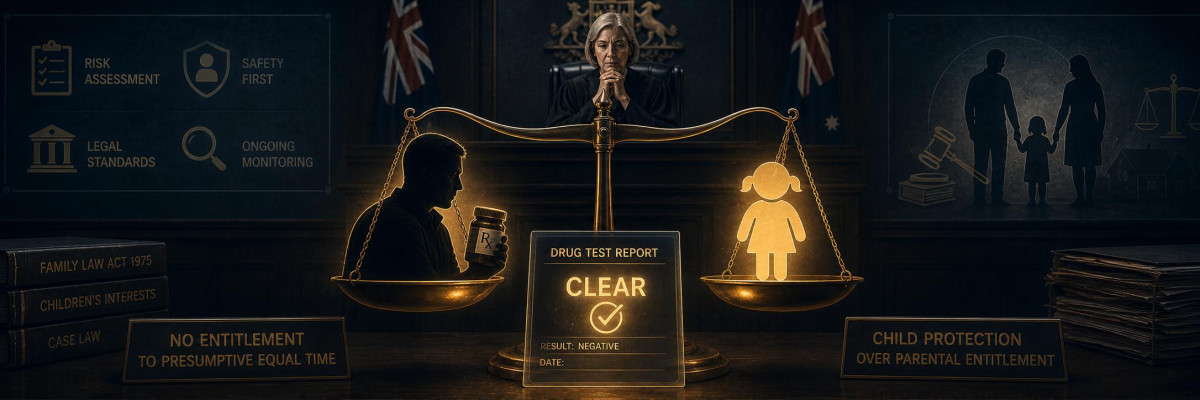
In Zakariya & Rana [2026] FedCFamC1A 75, the Full Court (Riethmuller J) reinforced a critical principle in parenting litigation: lawful use of medicinal cannabis does not immunise a parent from scrutiny regarding its impact on parenting capacity. The decision confirms that courts may impose protective conditions (such as drug testing) even in the absence of direct evidence of impairment, where broader risk factors justify caution.
🧩 Facts
The parties had three children (aged 14, 12, and 9) who had lived with the mother since separation in 2018.
Key background:
- The father had a significant criminal history, including drug supply and weapons offences
- He had previously engaged in family violence toward the mother
- He had no meaningful contact with the children since 2019
- He was using prescribed medicinal cannabis at the time of trial
The primary judge ordered a graduated reintroduction regime, including:
- Supervised contact progressing to unsupervised time
- A requirement that the father provide three negative hair follicle tests (including THC-free) before progressing to overnight time
The father appealed, arguing:
- His cannabis use was legal and medically necessary
- Drug testing requirements were excessive
- Other ancillary orders (injunctions, travel, changeovers) were unreasonable
⚖️ Issues
- Whether the primary judge erred in imposing drug testing conditions despite lawful medicinal cannabis use.
- Whether the Court improperly assessed the impact of cannabis on parenting capacity.
- Whether ancillary parenting orders (injunctions, travel, changeovers) were outside discretion.
- Whether the appeal disclosed error under appellate principles.
⚖️ Applicable Law – Legislation, Regulations, Rules
Family Law Act 1975 (Cth)
- s 60CA — Best interests of the child paramount
- s 60CC — Best interests factors (including parental capacity and safety)
- s 102NA — Restrictions on personal cross-examination in family violence cases
- s 114UB — Costs in family law proceedings
FCFCOA Rules 2021 (Cth)
- r 13.39 — Further evidence on appeal
- r 10.13 — Slip rule (amendment of orders)
📌 Precedents Relied On
- House v The King — appellate intervention requires identifiable error
- CDJ v VAJ — strict limits on adducing fresh evidence on appeal
- Norbis v Norbis — wide discretion in family law decisions
- Gronow v Gronow — appellate restraint in discretionary matters
- Metwally v University of Wollongong — parties bound by conduct of their case
🧠 IRAC Analysis
Issue
Did the primary judge err in requiring the father to provide negative drug test results (including THC) before progressing to unsupervised parenting time, despite his lawful medicinal cannabis use?
Rule
- Parenting decisions are discretionary judgments, reviewable only for error under House v The King.
- The Court must prioritise the child’s best interests, including:
- Safety
- Stability
- Parental capacity
- Lawful conduct (e.g. prescribed medication) may still be relevant if it:
- Impacts functioning
- Creates risk to children
- Courts may impose protective conditions where evidence raises legitimate concerns, even if risk is not conclusively proven.
Application
1. Lawfulness of Cannabis Use Was NOT Determinative
The father’s central argument failed because:
➡️ The issue was not legality, but impact on parenting capacity
The Court emphasised:
- No evidence was led about how cannabis affected the father’s ability to care for children
- The father relied only on:
- Prescription status
- Personal assertions of safety
➡️ This was insufficient
2. Evidence Supported a Cautious Approach
The primary judge had evidence that:
- Cannabis use was significant enough to:
- Impair driving
- Require warnings about operating machinery
- The father had:
- A history of drug offending
- A criminal record involving drugs and weapons
- Demonstrated poor compliance with prior arrangements
Additionally:
- The Family Report writer recommended negative drug testing before reunification
➡️ This created a risk-based foundation for the order
3. Absence of Evidence Hurt the Father’s Case
A critical failure:
➡️ The father did not provide evidence showing:
- His cannabis use was safe in a parenting context
- His functioning was unimpaired
On appeal, he attempted to:
- Introduce further evidence
But the Court refused:
➡️ Appeals are not an opportunity to rebuild the case
Under CDJ v VAJ, fresh evidence must:
- Be decisive
- Likely change the outcome
➡️ His evidence did neither
4. Protective Orders Within Discretion
The Court held:
➡️ Requiring three negative hair follicle tests was:
- Rational
- Protective
- Within the “generous ambit” of discretion
Importantly:
- The order did not permanently restrict contact
- It created a pathway to increased time
5. Other Grounds Also Failed
- Changeover arrangements → reflected father’s own proposal
- Injunctions (school / communication) → justified by violence history
- Travel orders → no evidence of flight risk by mother
- Slip rule correction → minor technical amendment only
➡️ None disclosed legal error
Conclusion
The Court held:
✔️ No error in imposing drug testing conditions
✔️ Lawful cannabis use does not negate risk considerations
✔️ Orders were within discretionary range
✔️ Appeal dismissed
➡️ Costs awarded against the father
🧠 Key Legal Insight
This case is particularly significant because it draws a clear boundary between legality and parenting capacity:
- A parent can be legally entitled to use a substance
- Yet still be restricted in parenting if its effects are uncertain
➡️ The Court’s focus is not legality — it is risk to children
It also reinforces:
- Evidence is critical — assertions are not enough
- Appeals are not a second chance to fix evidentiary gaps
- Courts will adopt a precautionary approach where risk is unclear