
FLAST-AI V.9 Private Server ~ LEGAL RESEARCH ASSISTANT
FFLAST-AI V9 PRIVATE SERVER
Private intelligence for Australian Family LawFind the Evidence. See the Connections.Get Better Answers.FLAST-AI does more than search for matching words. It looks across your case information, finds related evidence, follows connections between documents, and brings the most relevant information together before generating an answer.Book a free demonstration↗Your documents. Your evidence. Your private AI workspace. YOUR CASE, CONNECTED01 → 02 → 03≡Affidavits≡Communications≡ReportsRelevant case contextSearch the evidence. Follow the connections.An answer you can investigateCase-specific analysis, with sources to review.EvidenceConnectionsSource materialILLUSTRATIVE WORKFLOW · POWERED BY KIRAGPrivate ServerAustralian Family LawKIRAG IntelligenceSource-AwareGenAI Governance
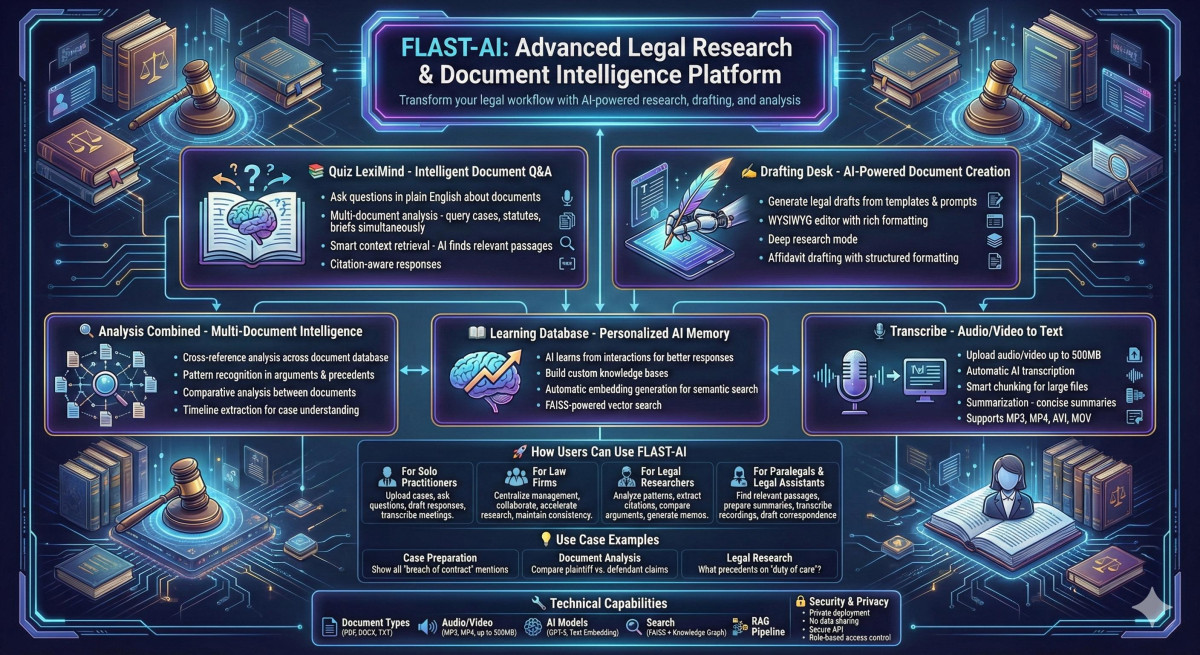
FLAST-AI V9 PRIVATE SERVERPrivate Australian Family Law AI, Evidence Intelligence & Legal Practice PlatformFLAST-AI V9 combines legal research, evidence analysis, document management, drafting, transcription and practice-management tools in one private AI-powered platform. But FLAST-AI does not simply send your question to an AI model. At its core is our proprietary KIRAG retrieval system, designed to search, connect and understand information across your private case databases before generating an answer.Instead of relying solely on what an AI model already knows, FLAST-AI first looks through your documents, your evidence and the relationships between them to build the context needed to answer your question.Research the Law. Analyse the Evidence. Find the Connections. Verify the Sources.This intelligent retrieval process is powered by FLAST-AI’s proprietary KIRAG system.
01 / THE GenAI DIFFERENCEPublic AI and FLAST-AI are not the same thing.The information an AI receives matters as much as the question you ask.Built around your legal matterPublic consumer AI tools such as ChatGPT, Gemini, Claude and Grok are designed to answer almost any type of question and keeps log files of your interactions for training their models. FLAST-AI is designed for something very different:Understanding the information inside your legal matter.When you ask FLAST-AI a question, it doesn't simply pass that question directly to an AI model, nor are your interactions with the AI stored or used for training. Our KIRAG system first searches your private knowledge environment using several complementary methods. It looks for:Relevant documents and passages, Information with a similar meaning, People, events and issues connected across different documents, relationships between evidence contained throughout your caseIt then combines the most relevant information into a structured context before the AI generates its response. The technical processes happen automatically behind the scenes. You simply ask your question.
Why this reduces the risk of ERRORS AND HALLUCINATIONS THAT PLAGUE GenAI in PUBLIC MODELS Relevant evidence. Before the AI responds.One of the weaknesses of GenAI is that it can produce a confident answer even when it does not have enough reliable information. FLAST-AI's approach is different. Before the AI responds, KIRAG attempts to retrieve relevant information from the knowledge available to it. That means the AI can be provided with case-specific context rather than being asked to answer entirely from general model knowledge.This does not mean an AI response can never be wrong. It means FLAST-AI has been designed so that the underlying evidence and source material play a much greater role in generating the response. The result is intended to be:More grounded, More traceable, More relevant to the matter, Easier to review and Easier to verifyThat distinction is particularly important in legal work.
AI COMPLIANCE FOR AUSTRALIAN FAMILY LAWThe Court Has Spoken. Are You Ready?On 29 May 2026, the Federal Circuit and Family Court of Australia issued Pactice Direction PD-AI setting out responsibilities for AI use in proceedings. Its message is clear: court users must understand the tools they use and remain responsible for the result.“The Courts will not accept a lack of understanding as justification for inadvertence in the use of AI.”If asked, the person responsible for a document or file should be able to explain:01Was AI used?02What tool was used?03How was the output checked and supervised?04How were the Practice Direction’s principles observed?Inappropriate AI use can lead to material being disregarded, costs orders, other penalties or referral to a regulator. FLAST-AI’s compliance tools help you maintain the records and checks needed to account for your use of AI.Read the Court’s Practice Direction PD-AI
THE COMPLIANCE DIFFERENCEA legal workflow. With accountability built in.A general-purpose AI answer does not, by itself, provide a record of how a document was produced, how citations were checked or how sensitive evidence was handled. FLAST-AI brings those responsibilities into the workflow for your Australian family law matter.Track AI use. Check references. Classify sensitive material. Screen for family violence indicators. Structure parenting analysis. Prepare disclosure records. These are practical tools for responsible AI use, alongside the evidence search and analysis already built into FLAST-AI V9.Seven Compliance Features Built In01 / ACCOUNTABILITYAI Usage Audit LogEvery AI interaction across every mode is automatically recorded: who used it, what was done, when it happened and which databases were used. When the Court asks whether AI was used, you have a record ready to review.02 / ACCURACYCitation Verification GatewayAI-generated citations are automatically extracted and checked against known Family Law Act sections. Verified references from your source documents appear with pinpoint precision, verified references of legislation, regulations, rules and cases come with links and Unverified references carry a prominent warning to verify them before relying on them in court documents. These checks support review; case authorities, quoted passages and legal propositions still require independent verification.03 / CONFIDENTIALITYDocument Risk ClassificationBefore a document enters the AI pipeline, it is classified by risk tier. Suppression-order material, subpoena material and documents subject to the Harman undertaking are hard-blocked from AI processing. Evidentiary material triggers warnings about preserving witness authenticity. These product controls support careful handling of restricted material.04 / PARENTING MATTERSs 60CC Best Interests AnalysisA structured framework covers the six general considerations in s 60CC(2): safety, the child’s views, developmental and other needs, parental capacity, safe relationship benefits and other relevant circumstances. It also addresses family violence history and orders, and the additional cultural considerations for Aboriginal or Torres Strait Islander children under s 60CC(3). It supports a systematic review while leaving professional judgment with the practitioner.05 / SAFETYFamily Violence Risk ScreeningEvery document processed through the retrieval pipeline is automatically scanned for family violence indicators, including direct allegations, patterns of behaviour, escalation language and references to family violence orders. When indicators are found, a warning banner appears with a link to: 1800RESPECT (1800 737 732). Screening supports review and does not replace a professional risk assessment.06 / OVERSIGHTPD-AI Compliance DashboardA real-time dashboard brings together your compliance status against the six PD-AI principles: Integrity, Accountability, Accuracy, Confidentiality and data security, Safety, and Education and understanding. Download a compliance report for your records or to support a response to the Court. The dashboard supports compliance management; it does not certify legal compliance.07 / TRANSPARENCYAI Disclosure Statement GeneratorFor a document drafted with AI assistance, generate a disclosure statement addressing the four questions the Court may ask. Review and adapt it before use. Under PD-AI paragraph 4.11, court users other than expert witnesses generally do not need to disclose AI use unless requested; the tool helps you prepare an accurate response when disclosure is required or appropriate.Practice Direction: principles and responsibilities · Family Law Act: s 60CC
THE REAL CONSEQUENCESThe risks are alreadybefore the courts.MERTZ & MERTZ (NO 3)Incorrect citations.Costs and regulatory referrals.In Mertz & Mertz (No 3) [2025] FedCFamC1A 222, the solicitor reported that a paralegal had used AI to alphabetise and organise authorities. The filed material included non-existent, inaccurate and misleading references. The Court referred the solicitor to the South Australian regulator and two counsel to the Victorian regulator. It described $36,955 in appeal costs and a separate $10,000 payable by the former solicitor for correcting AI-generated errors. Read the judgmentHELMOLD & MARIYA (NO 2)Confidential documents.Public disclosure risks.In Helmold & Mariya (No 2) [2025] FedCFamC1A 163; (2025) FLC 94-272, the Full Court warned that entering court documents into open AI could engage the publication restrictions in Part XIVB of the Family Law Act and put privilege at risk. Section 114Q creates an indictable offence for certain identifying communications of proceedings to the public. Read the judgmentDAYALInvented authorities.Professional consequences.In Dayal [2024] FedCFamC2F 1166, a practitioner was referred to the Victorian regulator after presenting AI-generated authorities that did not exist. In 2025, the regulator imposed practising-certificate restrictions, including two years of supervised practice. Read the regulator’s statement
DATA SOVEREIGNTY — THE FOUNDATIONPrivate hosting.Clear data boundaries.FLAST-AI is privately hosted on your server within Australian jurisdiction. Your core case databases, documents and retrieval tools sit within that private environment.When AI inference is required, selected request content is sent to the OpenAI API. API inputs and outputs are not used to train OpenAI models by default, unless the account holder opts in. External API processing is a separate data flow: applicable retention settings, processing locations and contractual protections still need to be considered.Private hosting is part of the foundation. Appropriate confidentiality safeguards and control over how information is used are also essential. The deployment and provider terms must be assessed against PD-AI before sensitive or privileged information is submitted.OpenAI API data controls · PD-AI: confidential and sensitive information FLAST-AI — AI compliance tools built for Australian family law.Be ready with records. Be ready with checks. Be ready with answers.
02 / FIND & CONNECTThe right information. From more than one direction.Finding a Document Is One Thing. Understanding How the Evidence Connects Is Another.Traditional RAG systems generally search a collection of documents for passages related to a question and provide those passages to an AI model. FLAST-AI goes further. We developed our own retrieval pipeline called KIRAG. KIRAG combines three important layers of intelligence:Intelligent IndexFLAST-AI first identifies where the most relevant information is likely to be located.Deep Document SearchIt then searches the indexed content of your case databases to retrieve the passages most closely connected to your question.Knowledge GraphFinally, it examines relationships between documents, people, events, issues, annexures and other information across the database. FLAST-AI combines these results before providing the information to the AI for analysis.What does that mean for you?You don't need to understand how any of this technology works. The important part is that FLAST-AI doesn't rely on one search method to find an answer. It searches your matter from several different perspectives and brings the relevant information together.Why this matters in a legal caseLegal matters are rarely contained in a single document. A statement made in an affidavit might relate to:A text message written six months earlierAn email from a solicitorAn expert reportA Court OrderAn annexureAnother person's affidavitA diary entryA previous applicationA simple keyword search may find the words. A semantic search may find passages with a similar meaning. But the Knowledge Graph can help identify how the information is connected. KIRAG brings these methods together. That means you can ask:“What evidence supports or contradicts this allegation?”“Where has this person discussed this issue previously?”“Show me communications connected with this event.”“Compare what was said in this affidavit with earlier documents.”“What other evidence in my database relates to this issue?”FLAST-AI searches for the information, follows the connections and brings relevant context together for analysis.
03 / FROM QUESTION TO ANSWERYou ask. FLAST-AI investigates.What Happens Behind the Scenes?You ask:“Where does the Applicant's evidence conflict with their earlier communications?”FLAST-AI then: 01Understands the QuestionIdentifies the people, issues and information you are asking about. 02Searches the IndexLocates the areas of your database most likely to contain relevant material. 03Searches Your Case DataRetrieves relevant passages based on both wording and meaning. 04Follows the ConnectionsUses the Knowledge Graph to identify related documents, people, events and evidence. 05Builds the ContextCombines the strongest information retrieved from these different sources. 06Analyses the MaterialThe AI receives that case-specific context and prepares a structured response. 07Shows the SourcesWhere available, FLAST-AI provides source information so the answer can be checked against the underlying material. You ask the question. KIRAG does the searching.
04 / THE V9 WORKSPACEOne place to understandand work with your matter.Research, evidence analysis, drafting and practice tools, connected to your private case information.